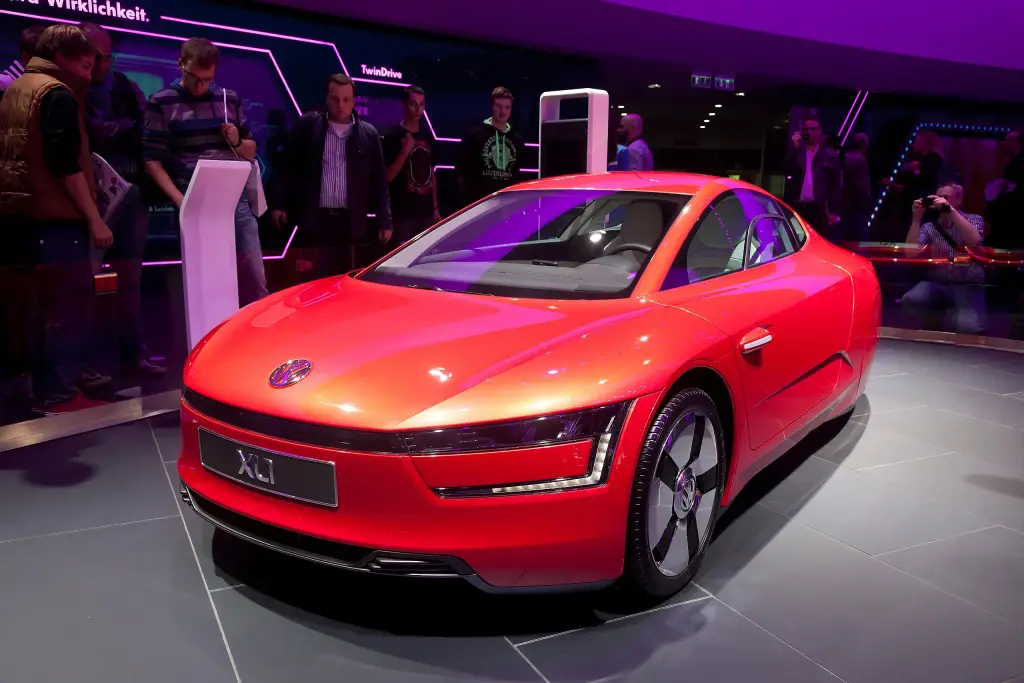
The Volkswagen 1-litre car is the name of a line of experiments that began with a 2002 concept and ended with the XL1, a two-seat diesel plug-in hybrid of which 250 were built from 2013. All of them were shaped around the same target: to travel 100 km on one litre of fuel. The 2002 prototype weighed 290 kg and had a drag coefficient of 0.159; the production XL1 was a road-legal car with a 5.5 kWh battery and 50 km of electric range.
Volkswagen 1-litre car at a glance
| Maker | Volkswagen AG, Wolfsburg |
|---|---|
| First shown | April 2002, as the 1-litre concept |
| Later versions | 2009 L1, 2011 XL1 concept, 2013 XL1 production |
| Seats | two, in tandem |
| 2002 engine | 299 cm³ one-cylinder diesel, 6.3 kW (8.4 hp) |
| 2009 engine | 800 cm³ twin-cylinder TDI with a 10 kW electric motor |
| XL1 drivetrain | 800 cm³ TDI of 35 kW plus a 20 kW motor, 51 kW combined, 140 N·m |
| Battery | 5.5 kWh lithium-ion, 50 km electric range |
| Consumption | 0.9 l/100 km and 21 g/km CO2 (XL1, NEDC) |
| Drag coefficient | 0.159 (2002 concept), 0.195 (L1) |
| Weight | 290 kg (2002 concept), 381 kg (L1) |
| XL1 built | 250, from mid-2013, from €111,000 |
Written from the English Wikipedia article on the Volkswagen 1-litre car, which covers the 2002 concept, the 2009 L1 and the XL1.
History of the Volkswagen 1-litre car
The first 1-litre car was shown in April 2002, when Ferdinand Piëch, then chairman of the board of management, drove it between Wolfsburg and Hamburg during Volkswagen’s annual meeting of stockholders. Everything about it served aerodynamics and low weight: the two occupants sat in tandem, there were no door mirrors but cameras and screens, and the rear wheels were set close together. The car was 3.47 m long, 1.25 m wide and 1.10 m tall, with 80 litres of storage space, an aircraft-style canopy and cooling vents that opened only when needed. Its drag coefficient was 0.159, against 0.30 to 0.40 for ordinary cars. The body was an unpainted carbon-fibre skin over a magnesium subframe, with carbon-fibre wheels, aluminium brakes, titanium hubs and ceramic bearings, which brought the empty weight to 290 kg. The engine was a one-cylinder 299 cm³ diesel of just 6.3 kW (8.4 hp), driving through a six-speed transmission without a clutch pedal; Volkswagen quoted 0.99 l/100 km and a 650 km range on one tank.
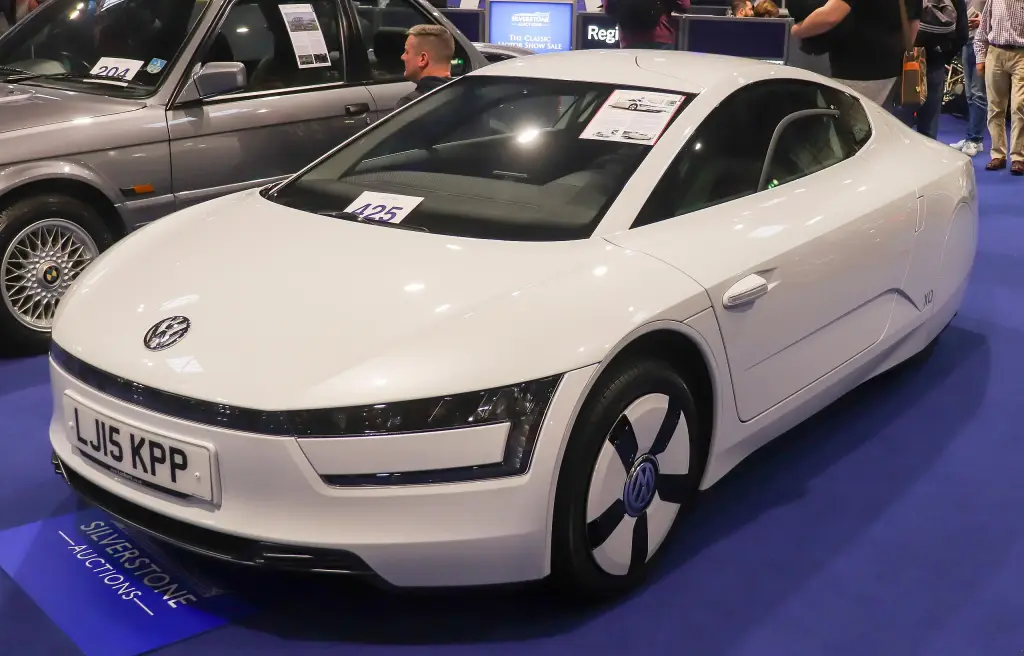
The second car, named L1, was shown at the 2009 Frankfurt Motor Show. It kept the tandem two-seater idea and weighed 381 kg with a drag coefficient of 0.195; it was 3.813 m long, 1.2 m wide and 1.143 m tall, with a frontal area of 1.02 m². Instead of the single-cylinder engine it used one half of a 1.6-litre TDI: an 800 cm³ twin-cylinder common-rail turbodiesel joined by a 10 kW electric motor, with CO2 emissions of 39 g/km. The engine ran in an eco mode of 20 kW (27 hp) or a sport mode of 29 kW (39 hp), the electric motor could move the car on its own for short distances, and Volkswagen claimed 158 km/h and 0 to 100 km/h in 14.3 seconds.
The third iteration, the XL1, was unveiled at the 2011 Qatar Motor Show as a “Super Efficient Vehicle”. In February 2012 Volkswagen confirmed a limited series from 2013, and the production XL1 appeared at the Geneva Motor Show in 2013. It used the same 800 cm³ two-cylinder turbodiesel, here with 35 kW (47 hp), and a 20 kW (27 hp) electric motor for a combined 51 kW (68 hp) and 140 N·m, sent to the rear wheels through a seven-speed DSG. The 5.5 kWh lithium-ion battery gave 50 km of electric range, and the NEDC figures were 0.9 l/100 km and 21 g/km of CO2. The car was sold only in Europe, production was limited to 250 units from mid-2013 at a starting price of €111,000, and retail deliveries in Germany began in June 2014.
Design and features
- One litre per 100 km: the target that shaped every version, from the 2002 concept to the XL1.
- Extreme aerodynamics: a drag coefficient of 0.159 in 2002 and 0.195 for the L1, with tandem seating to keep the body narrow.
- Lightweight construction: carbon-fibre skin on a magnesium subframe and a 290 kg empty weight in the first car.
- Diesel plug-in hybrid: the XL1 combined a two-cylinder TDI with an electric motor and a 5.5 kWh battery.
- Limited series: 250 XL1s for Europe only, from €111,000.
Volkswagen 1-litre car versions
- 2002 1-litre concept: 290 kg, 0.159 Cd, 299 cm³ diesel of 6.3 kW.
- 2009 L1: 381 kg, 800 cm³ turbodiesel plus a 10 kW motor, 39 g/km of CO2.
- 2011 XL1 concept: shown in Qatar, the base for the production car.
- 2013 XL1: the production plug-in hybrid, 250 built.
The 1-litre car sat well apart from the ordinary range: the up! was the smallest production Volkswagen and the Golf the volume model. More cars are in the Volkswagen collection.
Video: Volkswagen XL1 review
Video by Auto Express on YouTube.
Sources
- Volkswagen 1-litre car, English Wikipedia: prototypes, engines, dimensions, XL1 production and price