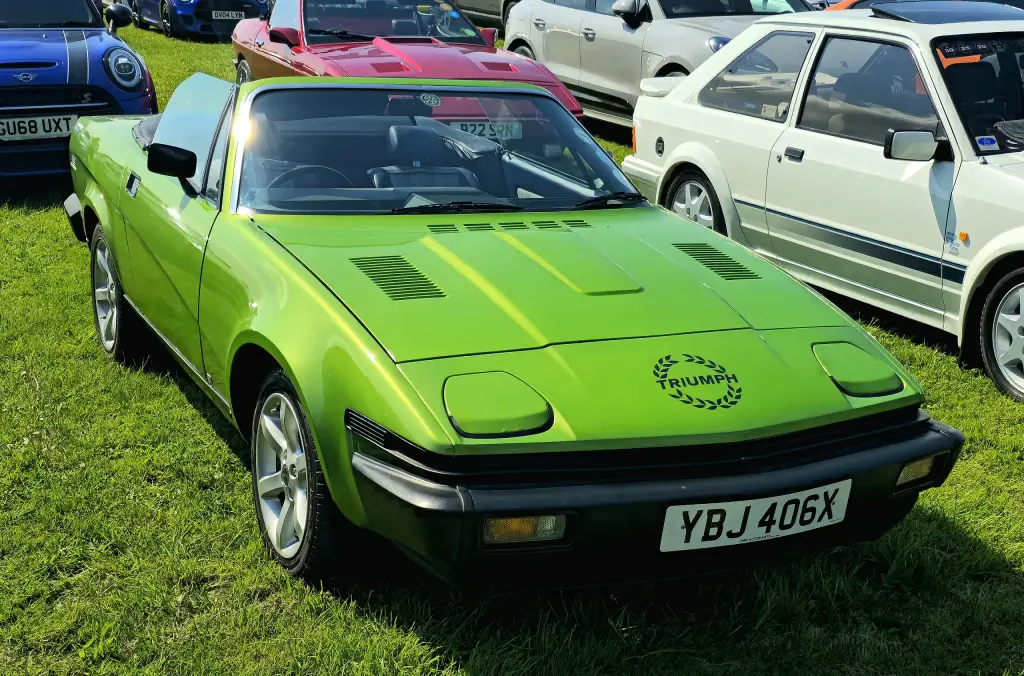
The Triumph TR7 was a wedge-shaped sports car built by British Leyland from 1974 to 1981. It was designed by Harris Mann, sold as a coupé before a convertible arrived in 1979, and with about 111,500 cars it became the best-selling TR.
Triumph TR7 at a glance
| Maker | British Leyland |
|---|---|
| Production | September 1974 – October 1981 |
| Stylist | Harris Mann |
| Launch | USA January 1975, UK May 1976 |
| Body | two-door coupé, convertible from 1979 |
| Length | 410 cm, width 170 cm, wheelbase 220 cm |
| Weight | 1000 kg (coupé) |
| Engine | 1998 cc eight-valve four, 105 bhp at 5500 rpm |
| Torque | 161 Nm at 3500 rpm |
| Gearbox | four-speed, optional five-speed or automatic from 1976 |
| Top speed | 108.5 mph |
| Built | about 111,500 |
Based on the English Wikipedia article on the TR7; the V8 TR8 appears in it as a derivative, and the old record “Triumph tr8” now leads here.
History of the Triumph TR7
A wedge for America
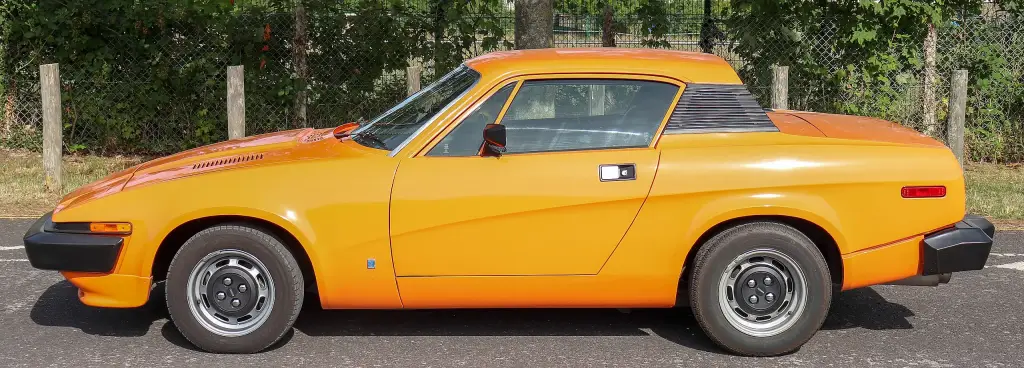
The TR7 was built from September 1974 to October 1981 by British Leyland, which was still BLMC at the start. It was launched in the United States in January 1975 and in Britain only in May 1976, the home launch being delayed at least twice by American demand; new TR7s were still being sold into 1982. Production began at Speke in Liverpool, moved to Canley in Coventry in 1978 and finally to the Rover plant at Solihull in 1980. The car’s shape, with a swage line sweeping down from the rear to just behind the front wheel, was drawn by Harris Mann, who also designed the Princess, and was advertised as the shape of things to come. It measured 160 inches long, 66 wide, with an 85-inch wheelbase and a 49.5-inch height, and the coupé weighed 2,205 lb. During development it was code-named Bullet, and MG badges were considered for upmarket versions, with MG Magna appearing on some clay models.
Why it was a coupé first
The TR7 was the first TR not offered as a convertible at launch. American safety legislation was being considered that would have banned open cars because of rollover risk, and since the United States was the most lucrative market for Triumph sports cars, BL chose a fixed roof. The ban never came, and a convertible followed in 1979.
Engineering
The engine was a 1998 cc eight-valve four sharing its basic design with the Dolomite 1850 unit, enlarged to two litres with larger carburettors. It gave 105 bhp at 5500 rpm and 161 Nm at 3500 rpm, or 92 bhp in North American and Australian form to meet local emissions rules. European cars took about 10 seconds to 60 mph and reached 108.5 mph. Drive went to the rear wheels through a four-speed gearbox, with an optional five-speed manual and a three-speed automatic from 1976. The front used coil spring and damper struts with a lower single link, the rear a four-link system on coil springs, with anti-roll bars at both ends, disc brakes in front and drums behind.
Revisions and the TR8
In March 1977 the interior trim changed to red or green tartan check inserts with black vinyl edging, matched on the door cards. Building the convertible meant moving the interior light from the headlining to switches in the door cards, deleting the map light and fitting a smaller fuel filler cap to make room for the hood; those changes also went onto the 1978 hardtop. Wheel trims grew from small black centre caps to larger silver covers. Badges were simplified, the rear panel changed from black to body colour, and a large laurel-wreath emblem replaced the TR7 nose badge before a smaller circular badge ended the run. The V8 version, the Triumph TR8, needed a bulge in the bonnet to clear its carburettors, giving the double-bulge bonnet seen on cars built at Canley and Solihull.
Design and features
- Harris Mann wedge — the shape of things to come, with a sweeping swage line.
- 2-litre four — Dolomite-derived, 105 bhp and 108.5 mph in European form.
- Convertible from 1979 — added once the feared American rollover ban did not happen.
- TR8 — the V8 version with a double-bulge bonnet.
Triumph TR7 versions
- TR7 coupé (1974–1981): the original fixed-roof car.
- TR7 convertible (1979–1981): drophead with a stowed hood behind the seats.
- TR7 with five-speed or automatic: available from 1976.
- TR8: V8-engined version, identifiable by the double-bulge bonnet.
The TR7 replaced the TR6 and shared its engine family with the Dolomite and Stag. More in the Triumph collection.
Sources
- Triumph TR7, English Wikipedia: design, launch, engineering, revisions, TR8