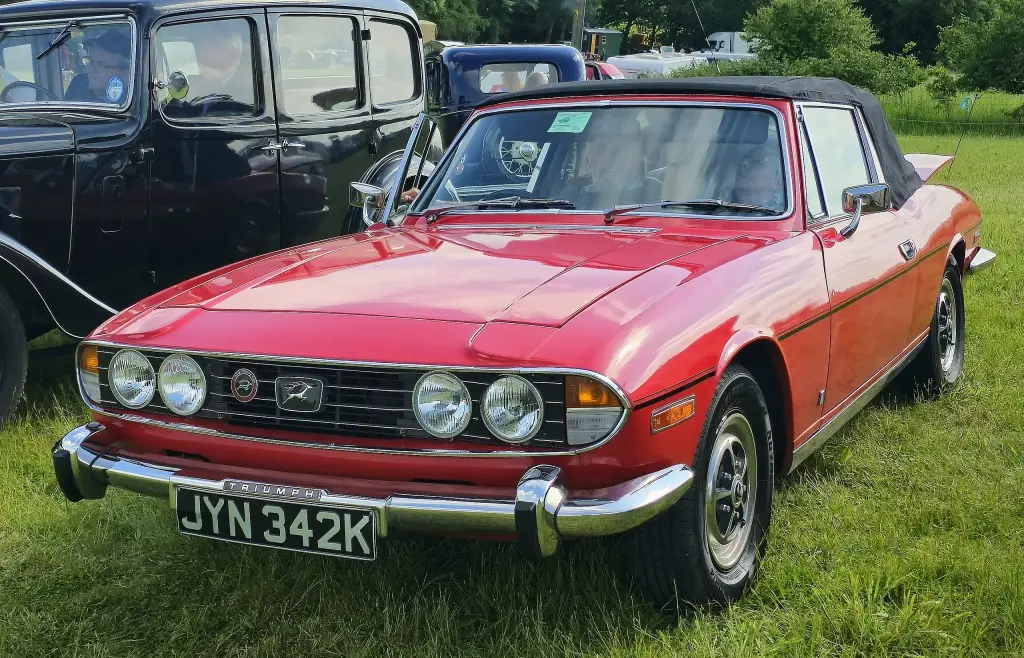
The Triumph Stag was a 2+2 sports tourer sold between 1970 and 1977 and styled by Giovanni Michelotti. It was designed to compete with the Mercedes-Benz SL, used Triumph’s own 3-litre V8, and became famous as much for its cooling troubles as for its looks.
Triumph Stag at a glance
| Maker | Triumph Motor Company (British Leyland) |
|---|---|
| Production | 1970–1977 |
| Stylist | Giovanni Michelotti |
| Body | 2+2 convertible coupé with T-bar and roll hoop |
| Engine | 2997 cc Triumph V8 |
| Induction | twin Zenith-Stromberg 175 CDSE carburettors |
| Construction | unitary, MacPherson struts front, semi-trailing arms rear |
| Brakes | discs front, drums rear |
| Steering | power-assisted rack and pinion |
| Launch | June 1970 |
Based on the English Wikipedia article on the Stag; the original record’s video is no longer available, so the article has none.
History of the Triumph Stag
A design from a cut-down 2000
The Stag began as a styling experiment cut and shaped from a pre-production 1963–64 Triumph 2000 saloon, also drawn by Michelotti. His agreement was that if Harry Webster, Triumph’s director of engineering, liked it, the company could use the prototype as the basis for a new model; Webster took it back to England. The result shared little with the 2000 apart from its suspension and driveline, and its lines were later carried over to the Mark II 2000/2500 saloons and estates. Triumph gave its projects four-letter code names, and the Stag was the only one to keep its code name in production.
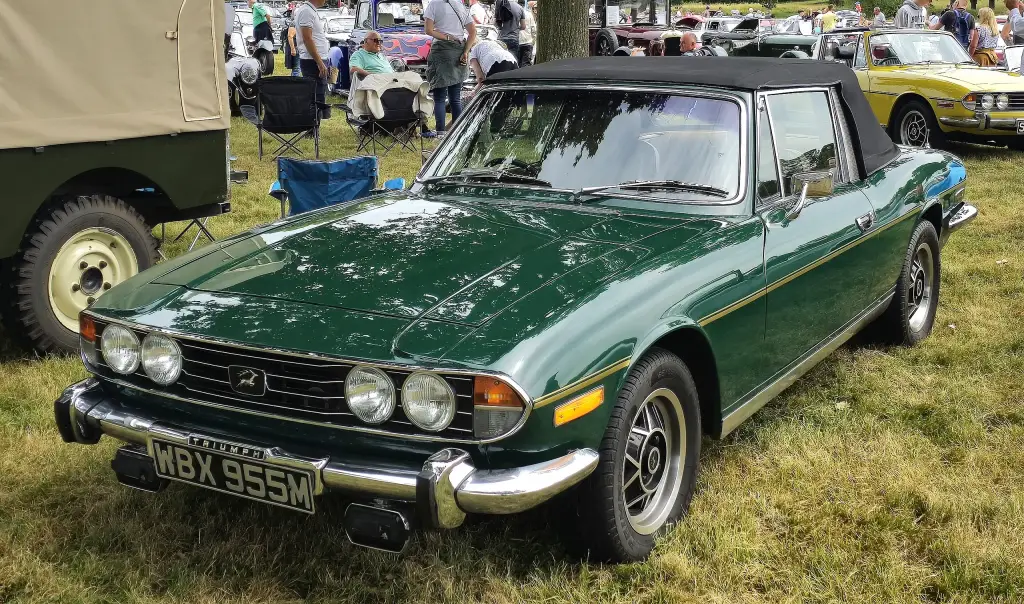
The Triumph V8
The first design used the saloon’s 2.0-litre six, but Webster wanted a new overhead-cam 2.5-litre fuel-injected V8 for the Stag and the big saloons. In 1968 that engine was enlarged to 2997 cc, and to meet American emissions rules the mechanical injection was dropped in favour of twin Zenith-Stromberg carburettors. Triumph was building a family of four-, six- and eight-cylinder engines around a common crankshaft; the slant-four of the Dolomite and TR7, the Saab 99 engine and the Stag V8 all belonged to it, and the four-cylinder units were effectively the left half of the V8. Triumph has often been accused of refusing the all-aluminium Rover V8 because it would not fit; installation tests in 1967 found the Rover engine too tall, but the decision also reflected Rover’s lack of manual gearbox, different torque and weight, and the re-engineering that would have delayed a car already behind schedule.
1970: launch and the American market
The Stag was launched nearly two years late, in June 1970, to a warm reception. In Britain it was an immediate success, with a twelve-month waiting list and cars changing hands above list price. In the United States, its main target market, it quickly gained a reputation for unreliability, usually overheating.
Why it overheated
Several causes combined. Because the Saab 99 installation had put the engine back to front, the water pump sat high inside the block, and the shared machining line carried that layout to the V8; if coolant escaped through the expansion bottle, the level could fall below the pump and circulation stopped. Poorly hardened drive gears could also wear out and stop the pump. The iron block and aluminium heads needed corrosion-inhibiting antifreeze all year, which owners and dealers did not always appreciate, so electrolytic corrosion clogged radiators and led to head gasket failure. The long simplex roller timing chains stretched and could fail inside 25,000 miles, and a stretched chain could let valves hit pistons. Owners often got cars back with the radiator still clogged, which led to repeat failures.
Design and features
- Michelotti body — a 2+2 convertible with a T-bar and roll hoop for rigidity and American rollover rules.
- Triumph V8 — 2997 cc, twin carburettors, part of a modular engine family.
- Removable hard top — body-colour, with a heated rear window and quarter windows.
- Comfortable chassis — unitary construction, MacPherson struts, semi-trailing arms and powered rack-and-pinion steering.
Triumph Stag versions
- Stag (1970–1977): the standard convertible with soft top.
- Hard-top cars: factory option with a heated rear window and full headlining.
- Automatic and manual: both gearboxes were offered through the run.
The Stag shared its styling language with the 2000 and 2500 Mark II and its engine family with the Dolomite and TR7. More in the Triumph collection.
Sources
- Triumph Stag, English Wikipedia: styling, V8 development, Rover V8 question, overheating causes