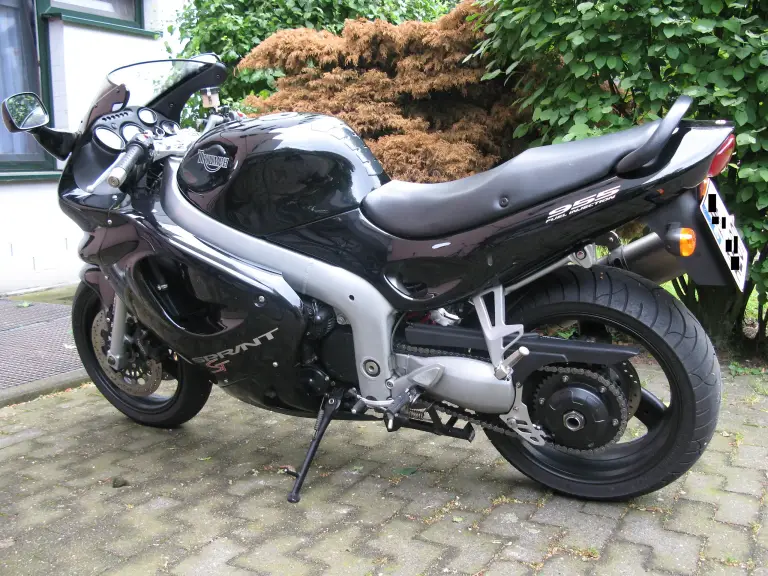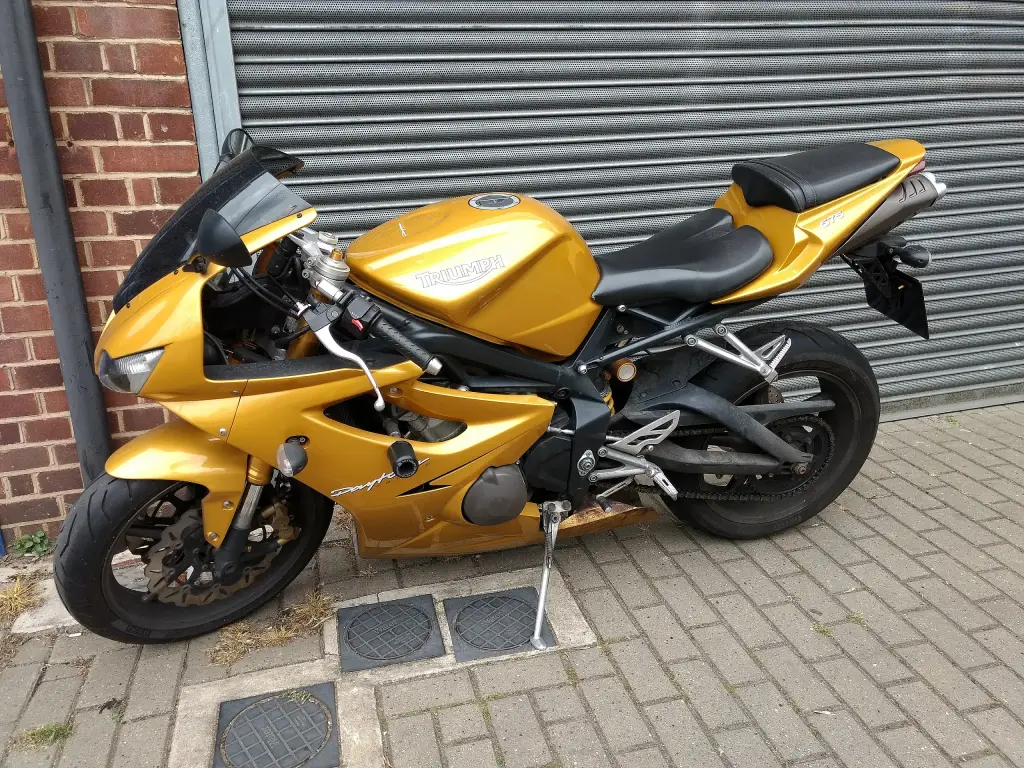
The Triumph Daytona 675 was a three-cylinder sport bike built by Triumph Motorcycles. It replaced the four-cylinder Daytona 650, and with 128 bhp, light weight and sharp handling it took on the Japanese 600 cc supersport class and won races.
Triumph Daytona at a glance
| Maker | Triumph Motorcycles, Hinckley |
|---|---|
| Launched | 2005 at the NEC show |
| Replaced | Triumph Daytona 650 |
| Engine | 675 cc three-cylinder |
| Peak power | up to 128 bhp |
| 2008 tested output | 104.4 hp at 12,100 rpm |
| 2008 dry weight | 165 kg |
| Design start | 2000, after the TT600 |
| First race win | Glen Richards, 5 May 2008 |
| End of base model | 2016 (675R until 2018) |
Based on the English Wikipedia article on the Daytona 675.
History of the Triumph Daytona
2000–2005: from TT600 to triple
Development started in 2000, after the four-cylinder TT600 failed to trouble the Japanese 600s. Triumph decided to go back to its traditional three-cylinder layout. In 2001, after finishing the Daytona 955i, engineers analysed weight, power and torque; the project moved into concept phase in March 2002. Chassis work used a cut-down Daytona 600 frame, with a changed wheelbase, head angle and tank, tested against a Kawasaki ZX-6R and a Honda CBR600RR. Early styling, based on the Daytona 600, was discarded as too angular; the production design came from a naked-bike concept drawing and the earlier T595.
2005: launch
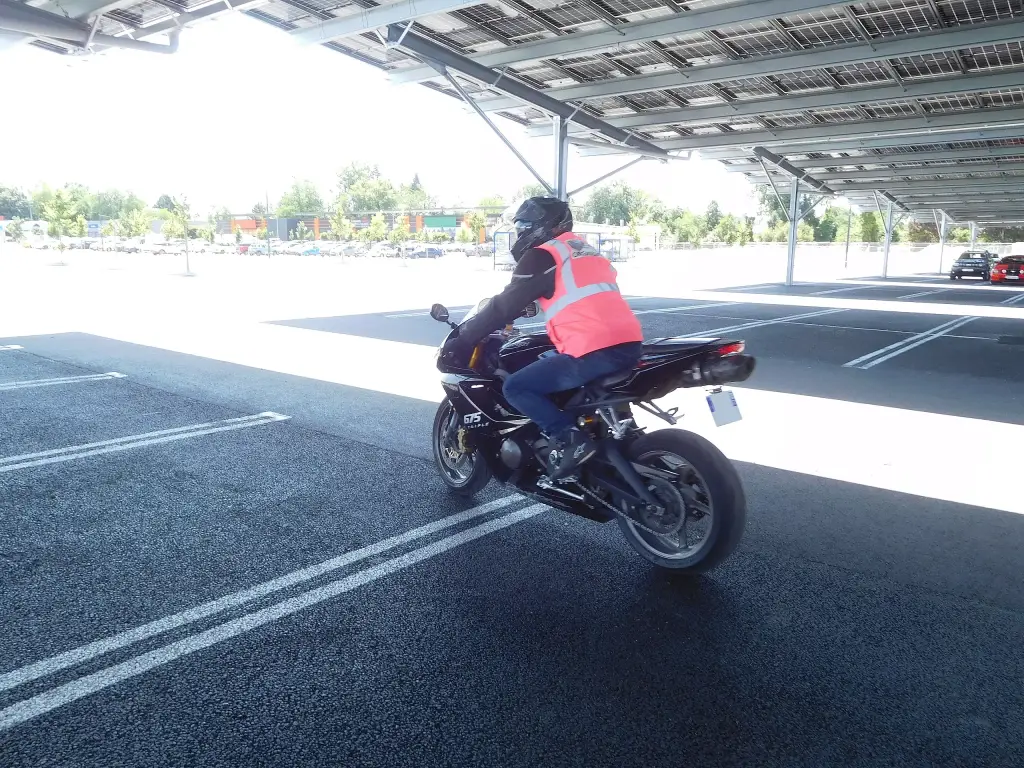
The engine was first run on a dynamometer in May 2003, prototype testing began in late 2004, and the bike was launched at the NEC International Motorcycle and Scooter Show in 2005. Bike magazine called it “the best British sportsbike ever”. Triumph planned 4,000 bikes for 2006 — 1,000 for Britain, 2,000 for the United States and 1,000 for the rest of the world — and demand produced waiting lists of three months or more.
On the road and on the track
The 2008 model weighed 165 kg dry and 185 kg wet, and produced 104.4 hp at 12,100 rpm on the test bench, with 72.3 Nm at 11,750 rpm. Motor Cycle News praised its compact handling and engine. The 675 won the Supersport class of Masterbike in 2006 and 2007. Racing began with privateers; in 2008 MAP Embassy Racing entered the British Supersport Championship and Glen Richards took the first win for a Triumph-backed team on 5 May 2008, adding three more on the way to the title.
2016–2018: the end
Triumph stopped making the base Daytona 675 in 2016, citing falling demand for supersport bikes and tighter European emissions rules, but kept the uprated 675R until the 2018 model year. A later Daytona with a 660 cc engine appeared in 2024.
Design and features
- Three-cylinder engine — Triumph turned from the TT600’s four to a 675 cc triple.
- Low weight — 165 kg dry on the 2008 model, with 104.4 hp at 12,100 rpm.
- Racing pedigree — Masterbike Supersport wins in 2006 and 2007, and the 2008 British Supersport title.
- 675R — the uprated version stayed on sale until 2018.
Triumph Daytona versions
- Daytona 675 (2006–2016): the standard model.
- Daytona 675R (to 2018): the uprated version with better cycle parts.
- Daytona 660 (2024): the later, smaller-engined revival of the name.
The Daytona replaced the four-cylinder TT600 in Triumph’s sports range. More in the Triumph collection.
Sources
- Triumph Daytona 675, English Wikipedia: development, launch, weights, racing, end of production