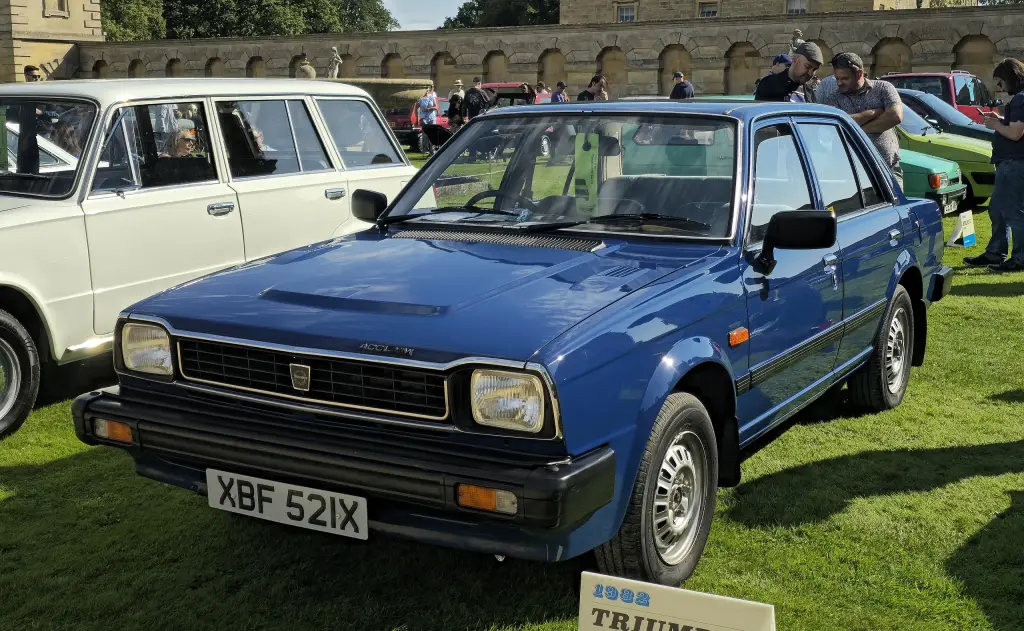
The Triumph Acclaim was a small family saloon built by British Leyland at Cowley from 1981 to 1984. It was a licence-built Honda Ballade, the first Japanese-designed car assembled in Europe and the last car sold with the Triumph badge.
Triumph Acclaim at a glance
| Maker | British Leyland, Cowley, Oxford |
|---|---|
| Production | 1981–1984 |
| Launched | 7 October 1981 |
| Basis | Honda Ballade, itself derived from the second-generation Civic |
| Project name | Bounty, later LC9 |
| Body | four-door saloon, front engine, front-wheel drive |
| Engine | 1335 cc all-alloy OHC four (Honda CVCC family) |
| Carburettors | twin Keihin instead of the Ballade’s single unit |
| Gearboxes | five-speed manual or three-speed Trio-matic |
| Trim levels | L, HL, HLS and CD |
| Investment | £80 million in new Cowley facilities |
Everything here comes from the English Wikipedia article on the Acclaim.
History of the Triumph Acclaim
1978–1981: the Honda deal
Development began in 1978, when British Leyland opened negotiations with Honda about a new small saloon. On 26 December 1979 Michael Edwardes signed the collaboration; the project was first called Bounty and later LC9. The car was essentially a licence-built Honda Ballade with changes for Europe and more British content. It replaced the Dolomite, whose Canley plant had closed, and it was launched on 7 October 1981, taking over the withdrawn Austin Maxi lines at the Pressed Steel Fisher plant in Cowley.
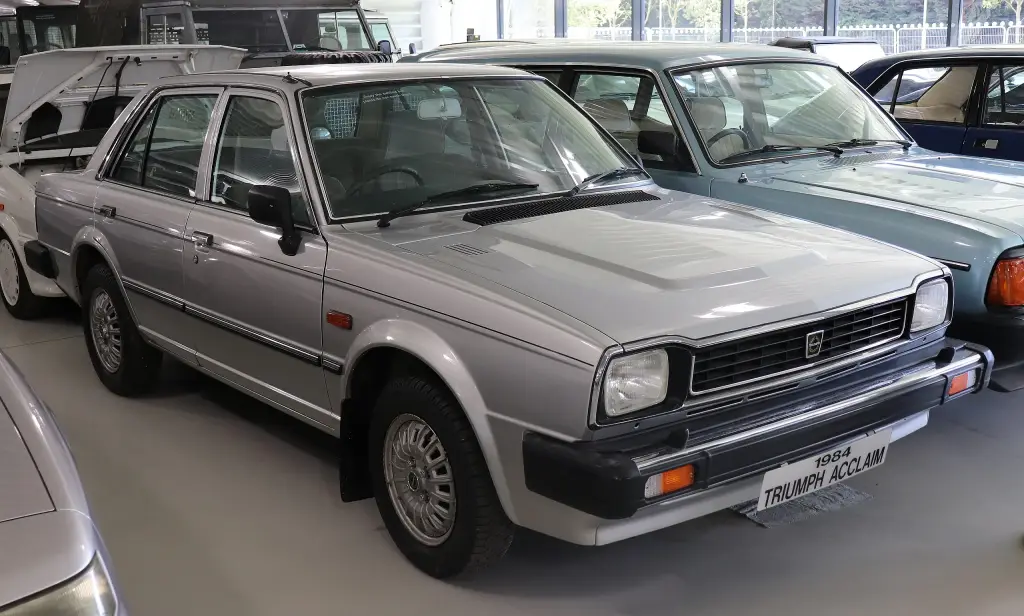
A Japanese design built in Britain
The Acclaim was the first Japanese-designed car manufactured inside the European Economic Community, a way around Japan’s voluntary limit of 11 per cent of the European market. BL invested £80 million in new press and paint facilities at Cowley, and workers from the closed MG plant at Abingdon moved there to build it. Most cars were sold in the United Kingdom.
Design and mechanicals
The visible changes from the Honda were a central badge on the grille — the Japanese car wore Honda lettering on the right — twin Keihin carburettors instead of one, mirrors on the doors and suspension tuned for Britain. The engine was the 1335 cc all-alloy overhead-cam unit from the Honda Civic, with a plain black pressed-steel rocker cover to disguise its origin. Front disc and rear drum brakes, MacPherson struts all round, and a choice of five-speed manual or three-speed Trio-matic transmission. Trim ran from L through HL and HLS to the CD, which added electric windows, chrome bumpers, headlamp washers and velour upholstery.
1983–1984: Mark 2 and the end
A Mark 2 arrived in 1983 with new exterior door handles, a digital clock, a restyled steering wheel and gear knob and a moved heater control; Mark 2 HL and HLS cars were better equipped than the earlier ones. There was also a limited-edition Avon Acclaim converted by Avon coachbuilders with leather trim, two-tone paint and a vinyl roof. The Acclaim held BL’s record for the lowest percentage of warranty claims, a sharp contrast with earlier models. Production ended in 1984, and no further car carried the Triumph name.
Design and features
- Honda engineering — a licence-built Ballade, the first Japanese-designed car built in the EEC.
- Build quality — BL’s lowest warranty-claim rate, a turning point for the company.
- British content — locally sourced trim and seats based on Morris Ital frames, increasing over the model’s life.
- Generous equipment — twin carburettors as standard and a CD model with electric windows.
Triumph Acclaim versions
- L: base trim on 145/80 tyres.
- HL and HLS: 155/80 tyres, more equipment; Mark 2 versions upgraded further.
- CD: top of the range with electric windows, chrome bumpers and headlamp washers.
- Avon Acclaim: limited edition with leather seats, two-tone metallic paint and a vinyl roof.
- Mark 2 (1983): detail changes to handles, clock, wheel and controls.
The Acclaim replaced the Dolomite and was the last Triumph; the cars that came before it are in the Triumph collection.
Sources
- Triumph Acclaim, English Wikipedia: Honda agreement, Cowley production, engines, trim levels, Mark 2