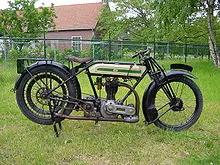
The Triumph Ricardo was a British single-cylinder motorcycle built by Triumph Engineering between 1921 and 1928. Named after engine designer Sir Harry Ricardo, it used an innovative four-valve head, was capable of over 70 mph and set three world speed records.
Triumph Ricardo at a glance
| Maker | Triumph Engineering, Coventry |
|---|---|
| Production | 1921–1928 |
| Engine | 499 cc single-cylinder OHV, four valves |
| Designer | Sir Harry Ricardo |
| Output | over 20 bhp |
| Top speed | over 70 mph |
| Valve layout | two pairs of parallel valves at 90 degrees, exposed stems and springs |
| Cycle parts | based on the Triumph Model H |
| Records | three world speed records |
| Racing | gold medal, 1923 International Six Day Trial |
Based on the English Wikipedia article on the Ricardo. No free photograph of the motorcycle was found, so the page uses the record’s existing picture.
History of the Triumph Ricardo
Development
Triumph commissioned the engine from Ricardo as a replacement for its ageing side-valve singles. Ricardo built several prototypes aimed at reducing thermal stress on the poor valve materials of the day while improving airflow with more valve area. His final design used four valves worked by the existing tappet mechanism, with two pairs set at 90 degrees to each other, exposed stems and springs and long pushrods running outside the engine. A light alloy piston ran in a cast iron barrel on road bikes and a steel barrel on racers, and the cylinder head was cast iron.
Performance for its time
The four-valve head allowed more efficient gas flow and put the spark plug in the middle for better combustion. The result was over 20 bhp from 500 cc — the same as a 1500 cc car engine of the period — and a top speed above 70 mph. The cycle parts came from the well-proven Triumph Model H, although that chassis had a poor reputation for handling and was not really built for the more powerful engine. Later models replaced the manual hand oil pump with an external pump. The “Riccy”, as it was known, stayed in production as a sports model until 1928.
Racing and records
Ricardo was as interested in racing fuels and octane as in engines. Triumph had a poor 1921 Isle of Man TT, with only one of three Ricardos finishing, but a Model R Fast Roadster was entered in the 1922 Senior TT by Ricardo’s assistant Frank Halford, who finished 13th. Halford also lapped Brooklands at 68 mph on a tuned Ricardo with a bronze alloy cylinder head of his own design, broke the Brooklands hour record at 76.74 mph and the flying mile at 87.8 mph, much of the credit going to a racing fuel later banned. In 1923 a Model R won a gold medal in the International Six Day Trial.
Design and features
- Four-valve head — Harry Ricardo’s design, with exposed valve gear outside the engine.
- 20 bhp from 500 cc — as much as a 1500 cc car engine of the time.
- 70 mph — exceptional for a British single of the early 1920s.
- Racing pedigree — three world records and an ISDT gold medal.
Triumph Ricardo versions
- Standard road model: cast iron barrel, hand oil pump, external pump on later bikes.
- Model R Fast Roadster: the sporting version used for records and the TT.
- Racing models: steel cylinder barrel and tuned engines.
The Ricardo came before the singles that made Triumph’s name in the 1930s, such as the Tiger Cub. More in the Triumph collection.
Sources
- Triumph Ricardo, English Wikipedia: engine design, performance, records, ISDT