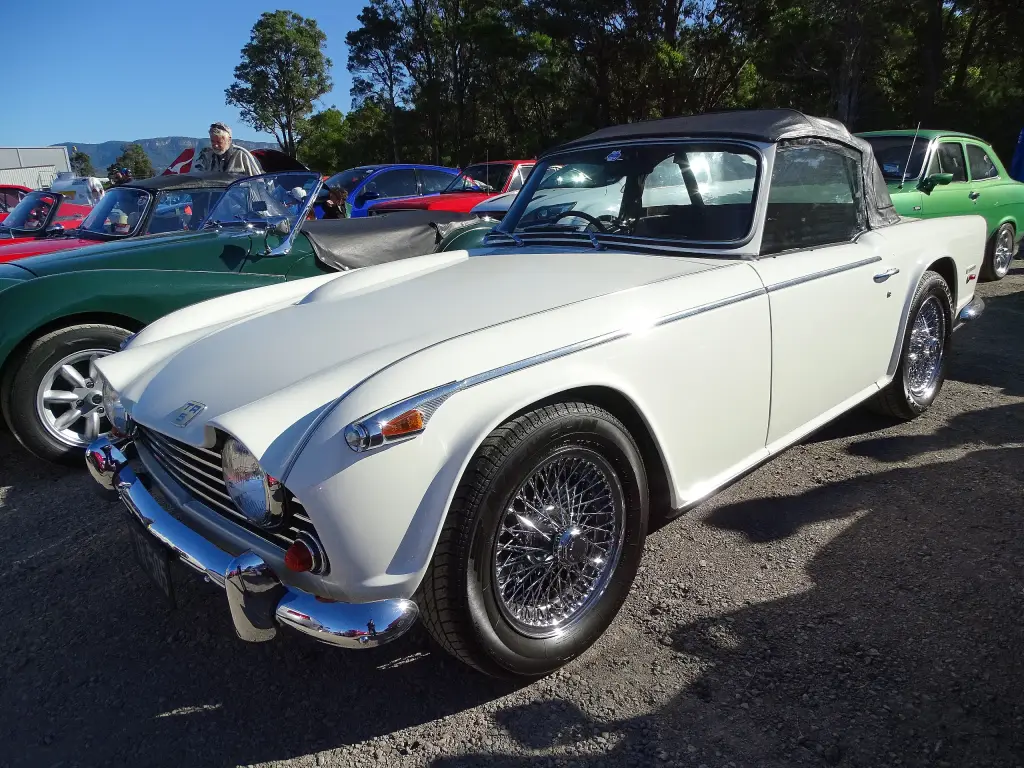
The Triumph TR5 was a sports car built in Coventry for just fourteen months, from August 1967 to September 1968. It kept the TR4A’s body but replaced the four-cylinder engine with a 2.5-litre six and Lucas mechanical fuel injection.
Triumph TR5 at a glance
| Maker | Triumph Motor Company, Coventry |
|---|---|
| Production | August 1967 – September 1968 |
| Body | open two-seater, almost identical to the TR4A |
| Engine | 2498 cc straight-six |
| Injection | Lucas Mark II mechanical |
| Gearbox | four-speed with optional overdrive |
| Rear suspension | independent, semi-trailing arms |
| Brakes | front discs of 10.875 in, servo as standard |
| US version | TR250, twin carburettors |
| UK price | £1,260 including taxes (1968) |
Based on the English Wikipedia article on the TR5.
History of the Triumph TR5
Why a six-cylinder TR
Each TR generation had grown heavier while power rose only slightly, and Triumph expected the TR4’s four-cylinder engine to fail the stricter American emissions rules due to come in for 1968. Triumph had been testing a six-cylinder TR since 1962, and began the Wasp programme before the TR4A even reached showrooms. At least seven Wasp cars were built: chassis X747 in February 1965, X748 in February 1966, X753 to X755 registered for the road in 1967, and prototypes X760 and X761.
Two versions for two markets
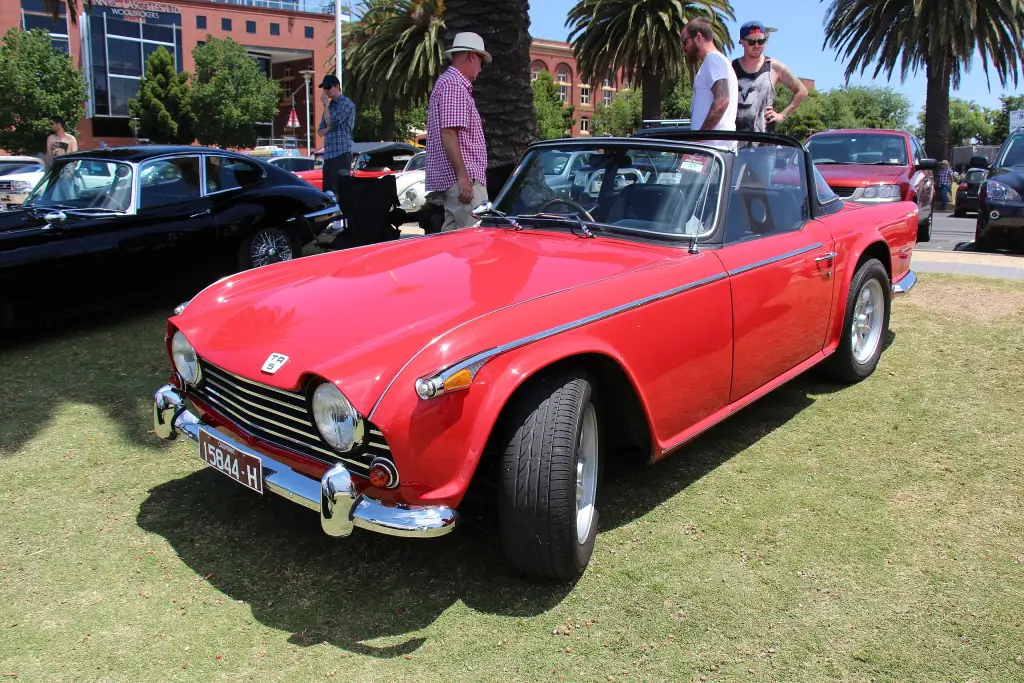
Triumph chose a British-made fuel-injection system, but it could not meet the new American standards, and American dealers objected to the price premium. The answer was to build two cars: the fuel-injected TR5 for the rest of the world and the carburetted TR250 for North America. American dealers had also persuaded Triumph to sell the TR4A with a cheaper live axle instead of independent rear suspension, but since nobody objected to the independent set-up on the TR5, no beam-axle version was made.
Body and chassis
The TR5’s open two-seater body is almost indistinguishable from the Michelotti TR4 that preceded it. Outside there was a new grille, side trim, rear marker lights and badges, with steel wheels and Rostyle-style covers as standard and wire wheels optional. Inside the wood dashboard gained a matte finish and the steering wheel padded spokes, and the knobs and switches were updated for the new American safety standards. The chassis was similar to the TR4A’s, with some front members moved so the radiator could go forward to clear the longer engine. Front suspension was the same double-wishbone layout, and the rear used stiffer springs and redesigned semi-trailing arms to clear wider 4.5-inch wheels. Front discs grew to 10.875 inches and the brake servo, optional on earlier cars, became standard.
The engine
The TR5 used a 2.5-litre version of the Triumph straight-six, developed from the 2-litre six of the 1960 Standard Vanguard Six, itself a six-cylinder derivative of the four-cylinder Standard SC engine. The bore was already at its maximum in the 2-litre block, so Triumph redesigned the block for a crankshaft with a 19 mm longer stroke and redesigned the cylinder head for more rigidity and better breathing. With Lucas Mark II mechanical injection Triumph claimed the TR5 was the first British production sports car with petrol injection. In 1968 a TR5 cost £1,260 including taxes, with wire wheels at £38, overdrive at £60 and a tonneau cover at £13.
Design and features
- Lucas injection — mechanical fuel injection, a British production first for a sports car.
- 2.5-litre six — a redesigned block and head with a longer-stroke crankshaft.
- TR4A chassis — independent rear suspension and a standard brake servo.
- Short run — only fourteen months of production, which makes the TR5 rare.
Triumph TR5 versions
- TR5 (1967–1968): fuel-injected, for markets outside North America.
- TR250 (1968): carburetted version for the United States and Canada.
- Options: wire wheels, overdrive and tonneau cover.
The TR5 came from the TR4A and its six-cylinder engine was shared with the 2000/2500 saloons; the TR6 followed. More in the Triumph collection.
Sources
- Triumph TR5, English Wikipedia: Wasp programme, TR250, body, chassis, engine, prices