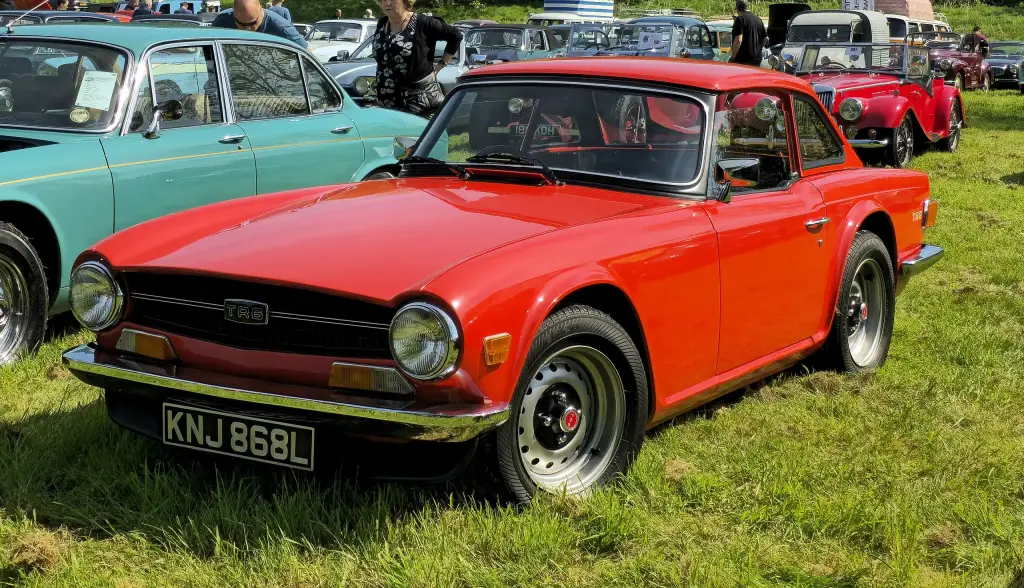
The Triumph TR6 was introduced as a 1969 model and built until July 1976. Its body was restyled by Karmann around the TR5’s chassis and 2.5-litre six, and almost all of the 91,850 cars made went to the United States.
Triumph TR6 at a glance
| Maker | Triumph Motor Company, Coventry |
|---|---|
| Production | September 1968 – 14 July 1976 |
| Styling | Karmann of Germany |
| Body | two-seater, body on frame, four-wheel independent suspension |
| Engine | 2498 cc straight-six, injection or carburettors by market |
| Power, injected | 150 bhp and 222 Nm (early cars) |
| Gearbox | four-speed, A-type then J-type overdrive |
| Overdrive | 22 per cent on A-type, 28 per cent on J-type |
| Brakes | front discs, rear drums |
| Built | 91,850, of which 83,480 exported |
| UK sales | 8,370 |
Based on the English Wikipedia article on the TR6.
History of the Triumph TR6
A budget restyle
Triumph had a limited budget for the TR6, so although the Karmann-designed exterior looked very different from the TR4, TR4A, TR250 and TR5, the chassis, engines, running gear, doors, windscreen and much of the body tub were carried over. The removable hardtop was designed in house. Construction stayed traditional: body on frame, four-wheel independent suspension, front disc and rear drum brakes, aluminium semi-trailing arms at the back and rack-and-pinion steering. All TR6s used the 2.5-litre straight-six, with a four-speed gearbox and an optional Laycock de Normanville overdrive — A-type on early cars, working in second, third and fourth with a 22 per cent reduction, and J-type later, on third and fourth only but with 28 per cent.
Production and changes
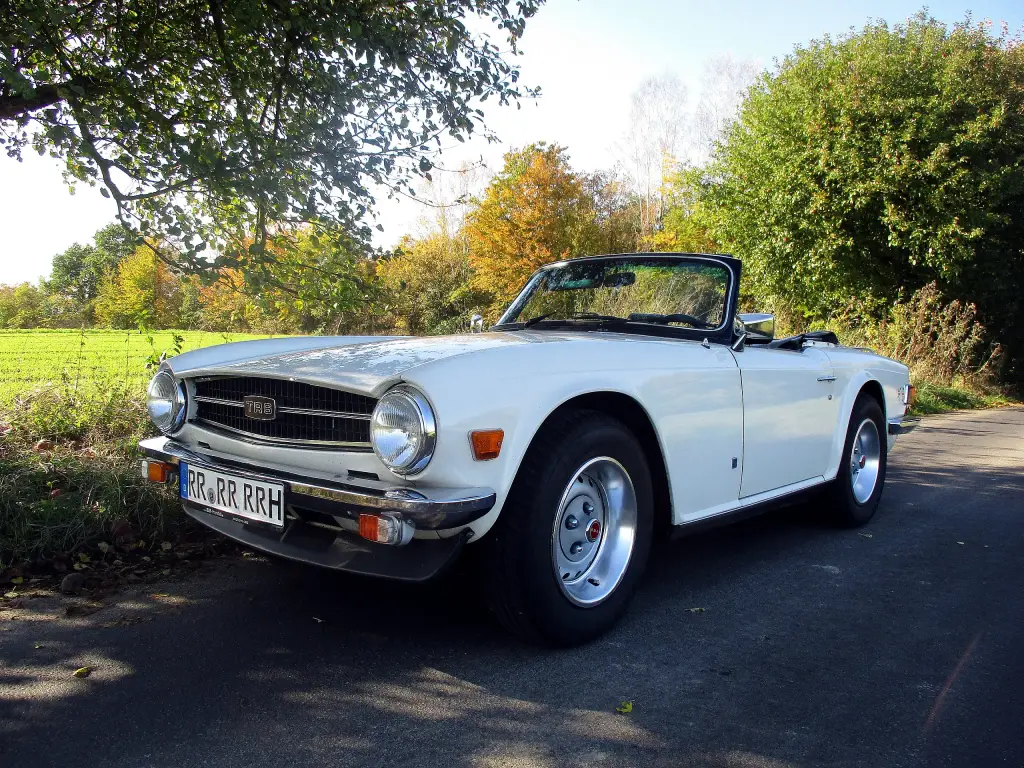
The first TR6 was built on 19 September 1968 as a 1969 model. Cars built until 28 November 1968 were carburetted with CC commission numbers, after which petrol-injected cars with CP numbers came off the same line. The only factory-recognised change came in 1973, when the prefixes became CF for carburetted and CR for injected cars; at that time a front spoiler was added, the gauges and horn push changed, and the later injected cars received the milder camshaft of the carburetted models and a revised injection pump. That cut power to 125 bhp but made the cars easier in traffic. Carburetted cars were officially quoted at 104–106 bhp. Wheel rims grew from 5 to 5.5 inches for 1970 and the Rostyle covers gave way to centre caps. There were also trim and colour changes, such as Wilton wool carpets early on and tufted nylon later.
Performance
The early CP-injected TR6 used the same Lucas mechanical injection as the TR5, giving 150 bhp and 222 Nm of torque. The last injected TR6 was built in July 1975, while carburetted production continued to the final car on 14 July 1976. Of the 91,850 TR6s built, 83,480 were exported, almost all to the United States, and only 8,370 were sold in Britain.
Design and features
- Karmann body — new sheet metal over the TR5’s proven structure.
- 2.5-litre six — 150 bhp with Lucas injection in early cars.
- Overdrive options — A-type with 22 per cent, later J-type with 28 per cent.
- America first — nine out of ten cars were exported, almost all to the USA.
Triumph TR6 versions
- TR6 PI (1969–1975): Lucas-injected cars with CP and CR commission numbers.
- TR6 carburettor (1969–1976): CC and CF cars for North America and some markets.
- 1973 update: front spoiler, new instruments and J-type overdrive.
The TR6 followed the TR5 and was replaced by the wedge-shaped TR7. More in the Triumph collection.
Sources
- Triumph TR6, English Wikipedia: design, production changes, performance, exports