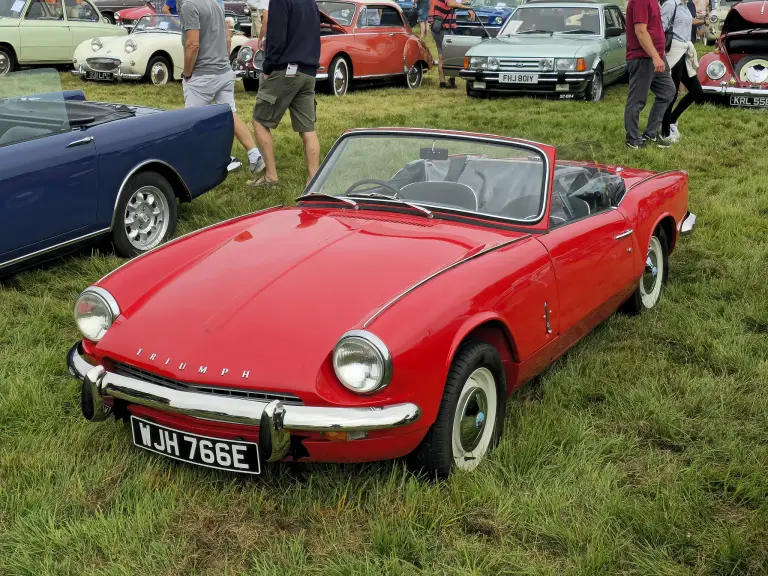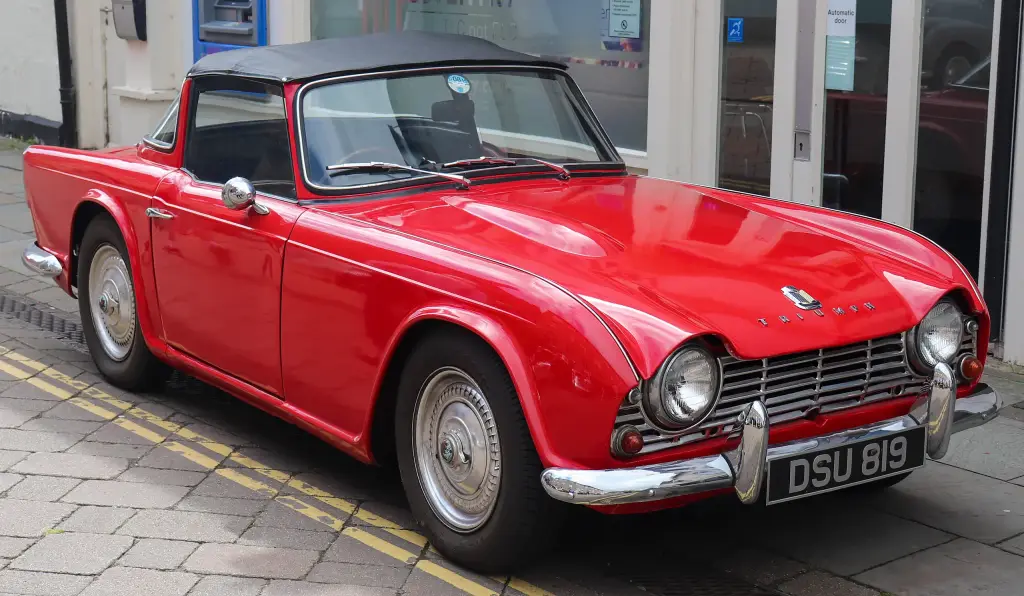
The Triumph TR4 was built by the Triumph Motor Company from 1961 to 1965 as the successor to the TR3A. Its chassis and drivetrain came from the older car, but the new Michelotti body brought wind-down windows, a proper boot and the option of a Surrey top.
Triumph TR4 at a glance
| Maker | Triumph Motor Company, Coventry |
|---|---|
| Production | 1961–1965 (TR4A to 1967) |
| Stylist | Giovanni Michelotti |
| Body | full-width two-seater convertible with wind-down windows |
| Chassis | TR3 ladder frame with cruciform bracing |
| Wheelbase | 2238 mm, the same as the TR3 |
| Track | 4 in wider at the front, 2.5 in wider at the rear |
| Bonnet | power bulge to clear the carburettors |
| Roof option | rigid hard top with backlight, or Surrey top with vinyl insert |
| Steering | collapsible column |
Based on the English Wikipedia article on the TR4, which also covers the TR4A.
History of the Triumph TR4
1956–1959: Zest and Zoom
Triumph began planning a TR3 successor in 1956. Money was short until the tractor division was sold to Massey-Harris, and the departure of chief stylist Walter Belgrove complicated the small saloon programme. Through an introduction to Giovanni Michelotti, managing director Alick Dick commissioned the Triumph TR3 Speciale, a dream car built by Vignale on an unmodified TR3 chassis with tailfins, a full-width grille and lidded headlamps, shown at Geneva in March 1957. It was too expensive to produce, but Michelotti was given the Herald instead. Later in 1957 he was asked for a serious TR proposal: the prototype, code-named Zest and built on a TR3A chassis, was ready by 1958 with a full-width body and headlamps set high in the grille above a cowled bonnet.
The 20X and the Zoom
At the same time the competitions department was developing a twin-cam four, the 20X, nicknamed Sabrina, expected to give 160 bhp. A chassis was built for it with the track widened by four inches and the wheelbase extended by six. Michelotti was asked for a body for that chassis, named Zoom, with tall doors and wind-down windows; two prototypes were ready in 1959. The Zoom body went onto the three TRS cars at Le Mans in 1960, which staged a formation finish but were unclassified, and in 1961 they finished ninth, eleventh and fifteenth and won the manufacturer’s team prize. By mid-1960 Triumph had two candidates, Zest and Zoom, at a combined cost of £676,000. The expense of a detuned 20X engine killed Zoom, and management judged neither car right for the market, so the TR4 took the Zest shape with the Zoom’s wider track and hardtop option.
The TR4 body
The new body, built at Triumph’s Speke factory, did away with the cutaway doors and sloping boot of earlier TRs. Taller doors allowed wind-down windows instead of side curtains, making the TR4 a true convertible, and the squared-off rear enclosed a large boot for a sports car. The bonnet had a power bulge offset to one side to clear the carburettors, short on early cars and longer after CT 6429. The optional hard top had a fixed glass backlight with an integral rollbar and a detachable centre panel, aluminium on the first 500 cars and steel afterwards; it was the first such roof on a production car, five years before the Porsche 911 Targa. The rigid panel could be replaced by a vinyl insert and frame, sold as the Surrey top, which could be carried in the car. Inside there was adjustable fascia ventilation and a collapsible steering column, features aimed at the American market where most TR4s were sold.
Chassis and the TR4A
The TR4 kept the TR3’s ladder chassis with central cruciform bracing and the same 2238 mm wheelbase, but the track grew by 4 inches at the front and 2.5 inches at the rear. In 1965 the TR4A added a revised chassis with independent rear suspension, which American dealers had resisted on cost grounds and which had therefore been dropped from the TR4.
Design and features
- Michelotti body — full-width styling with wind-down windows instead of side curtains.
- Surrey top — a rigid backlight with rollbar and a removable panel, the first of its kind on a production car.
- Bigger boot — squared-off rear bodywork for practical touring.
- Wider track — 4 inches at the front and 2.5 inches at the rear over the TR3.
Triumph TR4 versions
- TR4 (1961–1965): Michelotti body on the TR3 chassis.
- TR4A (1965–1967): revised chassis with independent rear suspension.
- Surrey-top cars: hard top with removable panel or vinyl insert.
The TR4 followed the TR3 and was replaced by the TR5; the TR4A’s rear suspension carried over to the TR6. More in the Triumph collection.
Sources
- Triumph TR4, English Wikipedia: development, Zest and Zoom, body, chassis, TR4A