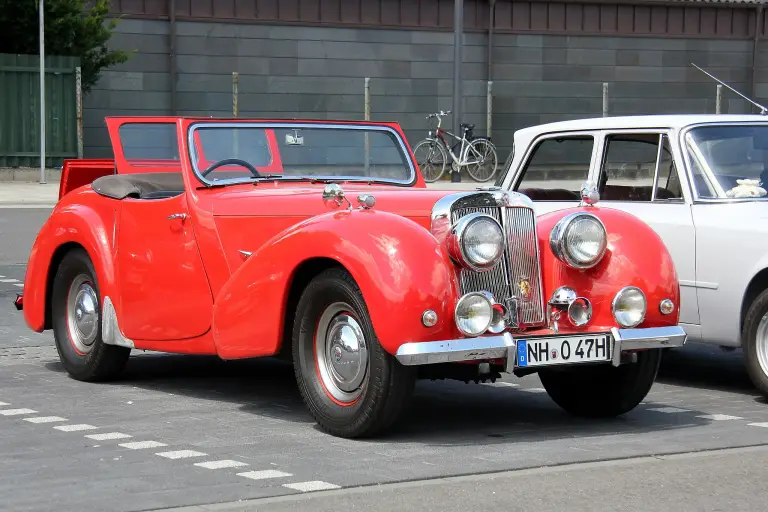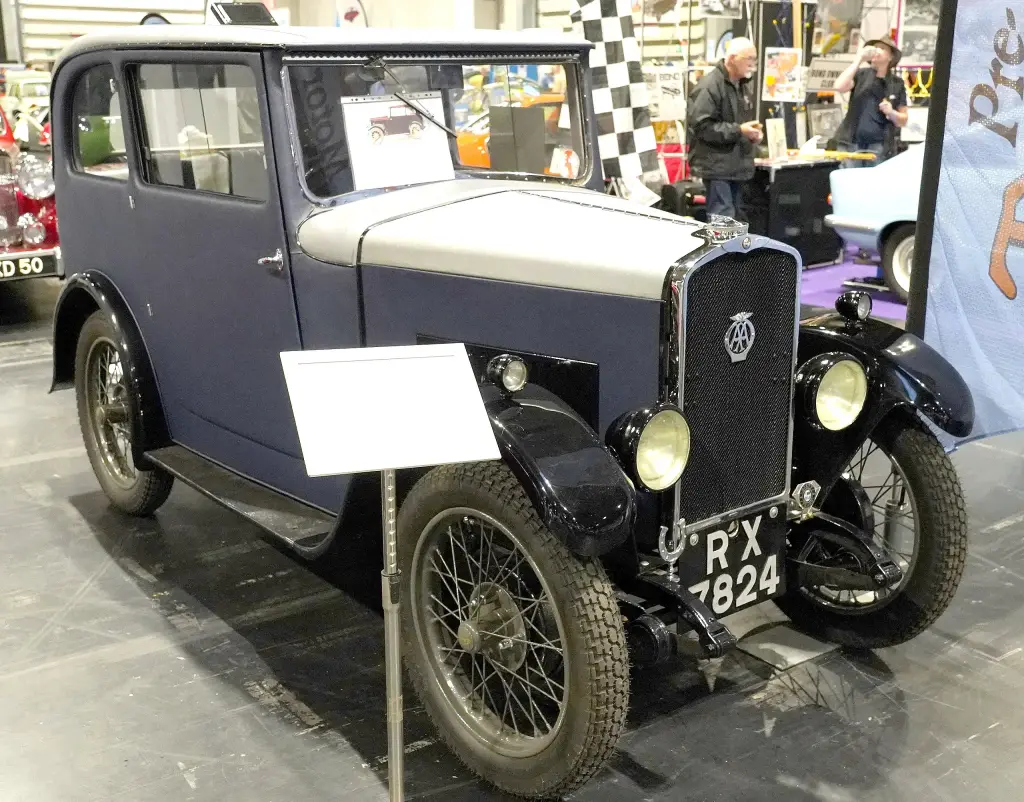
The Triumph Super 7 was a small car built by the Triumph Motor Company from 1927 to 1934 in response to the Austin 7. It was Triumph’s first car made in large numbers, and in 1933 it was renamed the Super 8.
Triumph Super 7 at a glance
| Maker | Triumph Motor Company, Coventry |
|---|---|
| Production | 1927–1934 |
| Launched | September 1927 |
| Engine | 832 cc side-valve four, designed mainly by Harry Ricardo |
| Bore and stroke | 56.5 x 83 mm |
| Crankshaft | three bearings, pressure lubrication |
| Gearbox | three-speed, non-synchromesh, in unit with the engine |
| Brakes | Lockheed hydraulic, 9.5 in internal expanding drums |
| Suspension | rigid front axle, live rear axle, leaf springs |
| Electrical system | 6 volts |
| Top speed | just over 50 mph |
| Prices | £113 for a chassis to £190 for the Gordon England saloon |
Based on the English Wikipedia article on the Super 7. The old record’s video was a music track, not a film about the car, so the article has none.
History of the Triumph Super 7
1927: a rival for the Austin 7
Development started in 1925, when Arthur Sykes, formerly of Lea-Francis, was given responsibility for a new small car; among those he recruited was Stanley Edge, the original draughtsman of the Austin 7. The car was launched in September 1927, 6 inches longer and 2 inches wider than the Austin. Its 832 cc four-cylinder side-valve engine, designed mainly by Harry Ricardo, had an 83 mm stroke and a 56.5 mm bore and, unlike the Austin, a three-bearing crankshaft with pressure lubrication in a cast-iron monobloc crankcase. Triumph kept Lockheed hydraulic brakes, now internal expanding in 9.5-inch drums and less affected by water than the older external contracting type; the handbrake worked on the transmission.
Chassis and bodies
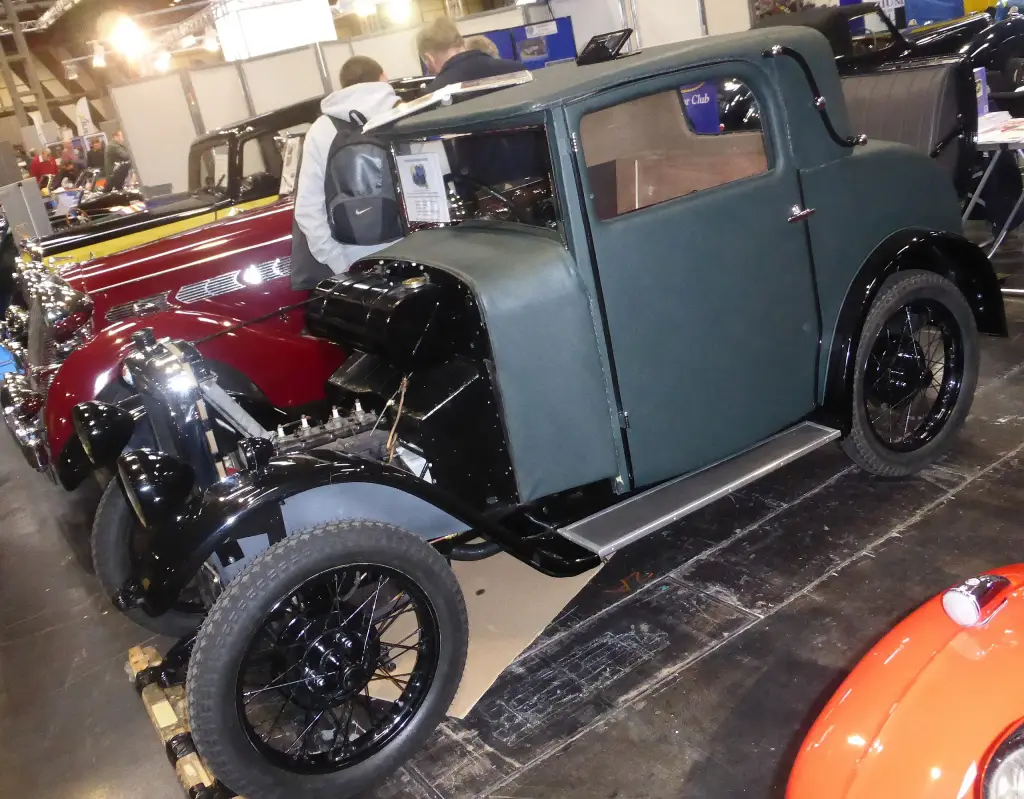
The chassis had a rigid front axle on half-elliptic springs and a live rear axle with Austin 7-like quarter-elliptics, allowing the side members to end ahead of the rear axle. The three-speed non-synchromesh gearbox was in unit with the engine and drove through a torque tube to a worm final drive, and the electrical system was 6 volts. A range of bodies was made in house, from a two-door four-seat tourer through a de-luxe two-tone tourer, a two-seater with dickey seat, two saloons and a coachbuilt saloon, with a Gordon England fabric saloon available too. Chassis were also sold to other coachbuilders. On test the car reached just over 50 mph and returned 40 mpg.
1929–1932: sports models and rationalisation
For 1929 Triumph added a Special Sports with a pointed tail and briefly a supercharged version, its engine reduced to 747 cc and reputedly capable of 80 mph, but at £250 it was expensive and few were sold. In 1929 Donald Healey entered a standard car in the Monte Carlo Rally from Berlin and failed to finish; in 1930 he tried again and became the first British car to finish, seventh overall, in a car with a 50 mph top speed. More bodies followed in 1930, and wire wheels replaced artillery type. For 1931 the range was simplified: fabric saloons, the landaulet, coupé and Special Sport went, and a Gnat sports tourer and Tickford saloon arrived. In 1932 the cars were designated Mark I for tourers and Mark II for saloons, a pillarless saloon joined the range, the track grew from 42 to 43.5 inches, Mark II saloons moved to semi-elliptic rear springs and de-luxe models got a four-speed gearbox.
1933: the Super 8
The name changed to Super 8 in 1933, since the car had always fallen in the 8 hp taxation class, and all cars received the Mark II chassis. The range shrank to the two-door saloon, the pillarless saloon and the four-seat tourer. That was the last year of the car, as the Super 9 launched in 1931 was intended to replace it.
Design and features
- Ricardo engine — 832 cc with a three-bearing crankshaft and pressure lubrication, better than the Austin 7’s.
- Hydraulic brakes — Lockheed internal-expanding drums, less affected by water than older designs.
- Wide body range — tourers, saloons, coupés, a landaulet and coachbuilt options.
- Rally history — Donald Healey finished the 1930 Monte Carlo Rally in a standard car.
Triumph Super 7 versions
- Super 7 (1927–1932): the original range with 832 cc engine.
- Special Sports (1929): pointed-tail body.
- Supercharged (1929): 747 cc, about 80 mph claimed, very few built.
- Mark I and Mark II (1932): tourers and saloons respectively.
- Super 8 (1933–1934): renamed model on the Mark II chassis.
The Super 7 came before the pre-war Gloria and the post-war razor-edge Renown. More in the Triumph collection.
Sources
- Triumph Super 7, English Wikipedia: design, chassis, bodies, model history, Super 8