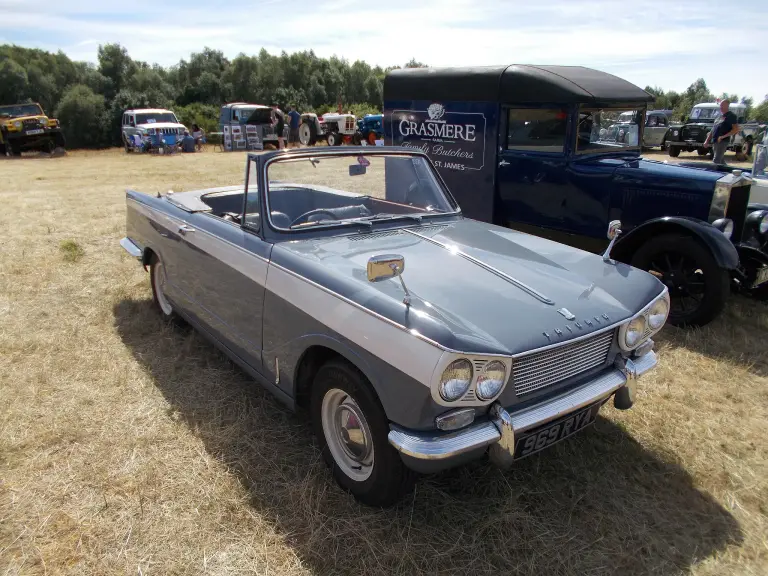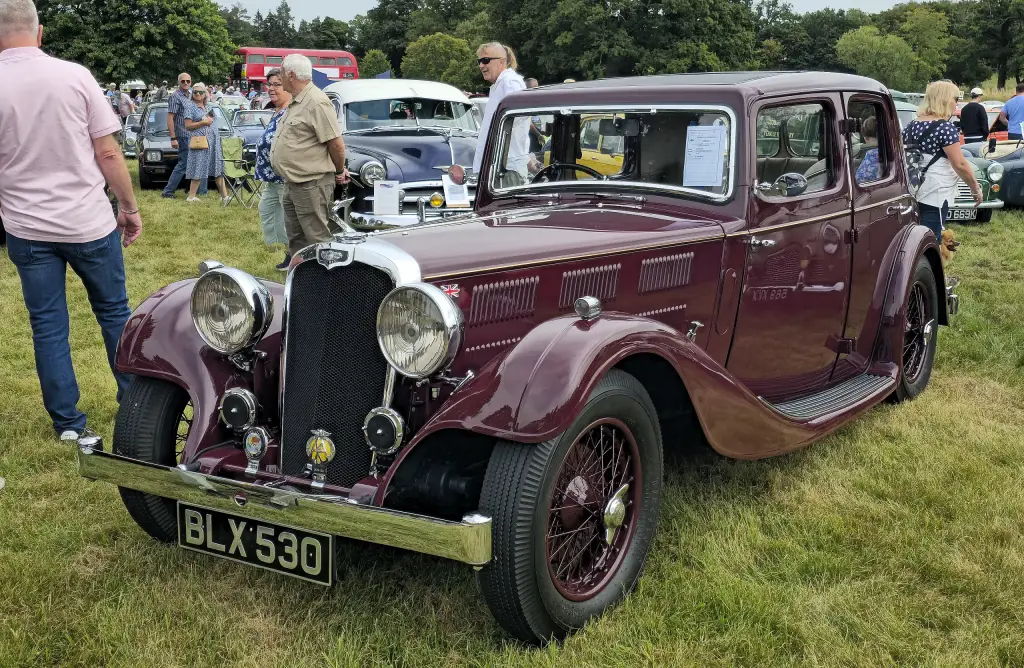
The Triumph Gloria was a range of sporting cars built by the Triumph Motor Company in Coventry between 1933 and 1938. It covered saloons, coupés, tourers, two-seater sports cars, drophead coupés and golfer’s coupés, with four- and six-cylinder engines and two chassis lengths.
Triumph Gloria at a glance
| Maker | Triumph Motor Company, Coventry |
|---|---|
| Production | 1933–1938 |
| Engines | Coventry Climax-designed fours of 1087 and 1232 cc, sixes of 1467 and 1991 cc |
| Valve gear | overhead inlet, side exhaust, built by Triumph under licence |
| Chassis | two lengths, 8 in (203 mm) longer ahead of the cabin for six-cylinder cars |
| Suspension | non-independent, semi-elliptic leaf springs |
| Brakes | Lockheed hydraulic, 12 in drums |
| Gearbox | four-speed, optional free wheel |
| First models | 9.53 hp four (1087 cc) and 12.95 hp six (1467 cc), August 1933 |
| Six-cylinder output | 55 bhp at 4500 rpm from 1991 cc |
Based on the English Wikipedia article on the Gloria.
History of the Triumph Gloria
1933: the base range
The first Glorias appeared in August 1933 as a 9.53 hp four-cylinder car of 1087 cc and a 12.95 hp six of 1467 cc. Their engines were designed by Coventry Climax with overhead inlet and side exhaust valves, then modified and built under licence by Triumph. The chassis came in two lengths, the six-cylinder cars having an extra 8 inches (203 mm) ahead of the passenger compartment, and used conventional non-independent suspension with semi-elliptic leaf springs. Lockheed hydraulic brakes with large 12-inch drums and a four-speed gearbox with an optional free wheel completed the specification.
1934: bigger engines and the Vitesse
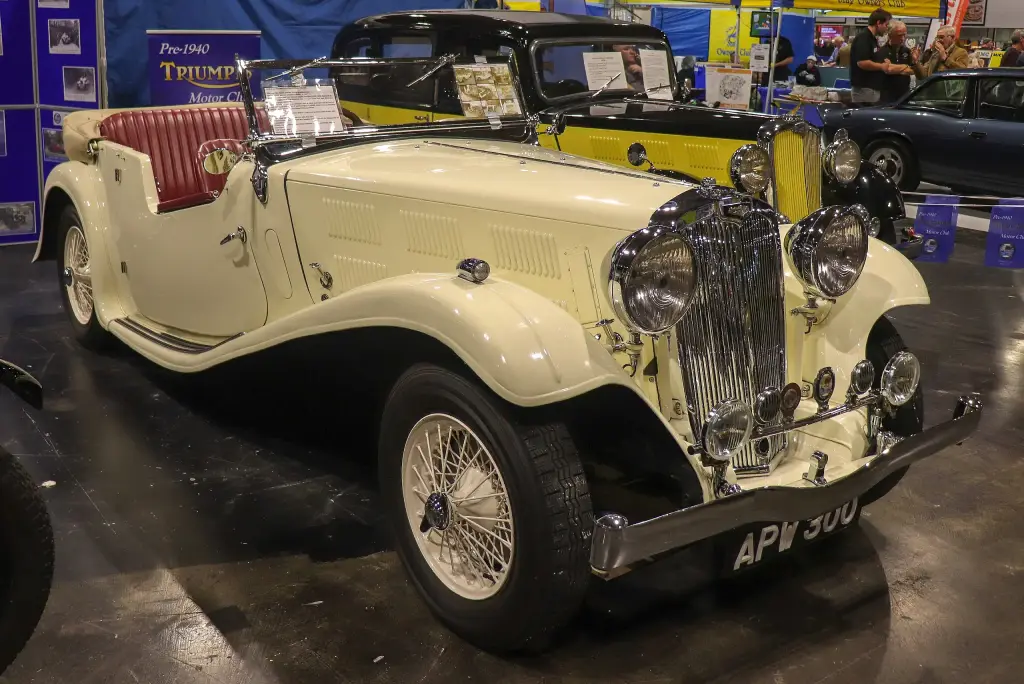
After about 1,850 cars had been built, the four-cylinder engine grew to 1232 cc in August 1934, although the smaller unit stayed in the Gloria Ten Saloon until July 1935. At the same time the six was enlarged to 1991 cc and 15.7 hp, producing 55 bhp at 4500 rpm. From August 1934 to 1936 the range also included the Gloria Vitesse, an uprated model with twin carburettors and extra equipment, some saloons with slightly different bodywork; the Vitesse Six claimed 65 bhp at 4750 rpm.
Southern Cross and body styles
Between 1934 and 1937 there was also the Gloria Southern Cross, an open two-seater that reused the name of the sporting version of the Triumph Super 9. It sat on a shortened chassis of 96 inches for the 1232 cc four and 104 inches for the 1991 cc six. Across the range Triumph offered saloons, coupés, tourers, two-seater sports cars, drophead coupés and golfer’s coupés, which made the Gloria one of the most complicated ranges the company ever built.
1937–1938: the last Glorias
The final two models, the 1.5-Litre Saloon and the Fourteen hp Six-Light Saloon of 1937–1938, were the only Glorias not powered by the Climax-derived engines. They also brought synchromesh to the gearbox. After 1938 the Gloria name disappeared, and Triumph moved on to the razor-edge saloons of the post-war years.
Design and features
- A range, not a model — saloons, tourers, coupés, two-seaters and golfer’s coupés on the same chassis family.
- Coventry Climax engines — fours of 1087 and 1232 cc and sixes of 1467 and 1991 cc.
- Two chassis lengths — the six-cylinder cars had 203 mm more ahead of the cabin.
- Gloria Vitesse — twin carburettors and extra equipment from 1934 to 1936.
Triumph Gloria versions
- Gloria four-cylinder: 1087 cc, later 1232 cc.
- Gloria Six: 1467 cc, later 1991 cc with 55 bhp.
- Gloria Vitesse (1934–1936): twin carburettors, up to 65 bhp in six-cylinder form.
- Southern Cross (1934–1937): open two-seater on a shortened chassis.
- 1.5-Litre and Fourteen hp Six-Light (1937–1938): the final models, with synchromesh.
The Gloria came before the post-war razor-edge Renown and the Mayflower. More cars are in the Triumph collection.
Sources
- Triumph Gloria, English Wikipedia: engines, chassis, Vitesse, Southern Cross, final models