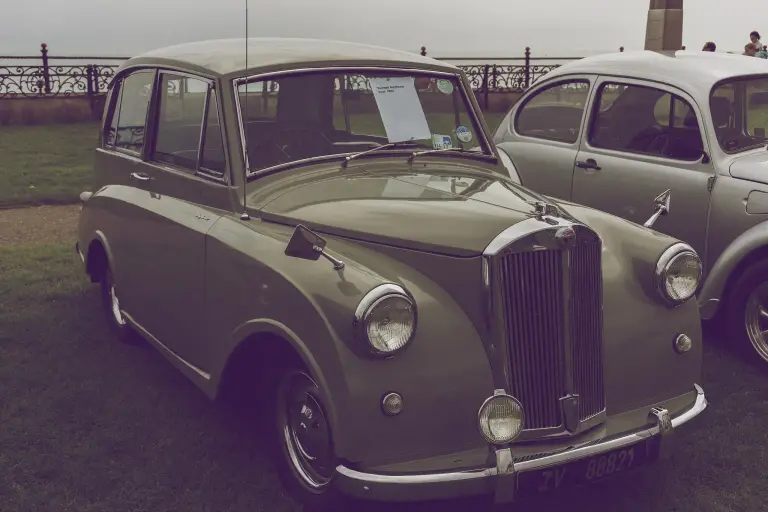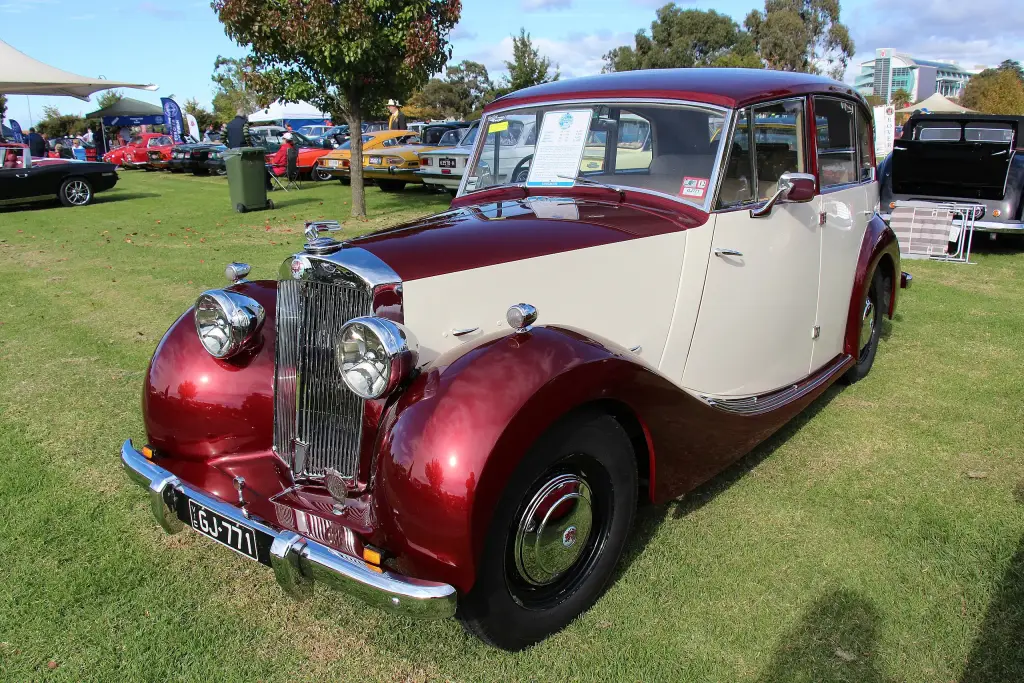
The Triumph Renown was the large razor-edge saloon built by the Triumph Motor Company between 1949 and 1954. It was the final development of a three-car series that began with the Triumph 1800 Town and Country, and it was the last traditional big Triumph before the company turned to smaller cars.
Triumph Renown at a glance
| Maker | Triumph Motor Company (Standard) |
|---|---|
| Production | 1949–1954 |
| Body | six-light razor-edge saloon, aluminium panels over a wooden frame |
| Coachbuilder | Mulliners of Birmingham |
| Engine | 2088 cc four, 68 bhp at 4200 rpm |
| Gearbox | three-speed column shift, synchromesh; overdrive from June 1950 |
| Chassis | Standard Vanguard based, pressed steel |
| Suspension | independent front on coil springs, live axle rear |
| Top speed | 75 mph (The Motor, 1950) |
| 0–60 mph | 24.3 seconds |
| Built | 6,501 Mk I, 190 limousines, 2,800 Mk II |
Based on the English Wikipedia article on the Renown.
History of the Triumph Renown
Razor-edge style
The Renown belongs to a three-car series with the Triumph 1800 and 2000, and along with the Roadster it was among the first cars to carry the Triumph badge after Standard bought the company. The styling followed the late-1930s fashion for razor-edge coachwork, with a six-light cabin — three side windows on each side — and thin C-pillars that anticipated the bigger glass areas of 1960s British cars. Sir John Black, managing director of Standard, drove the design forward and insisted on using the Triumph name.
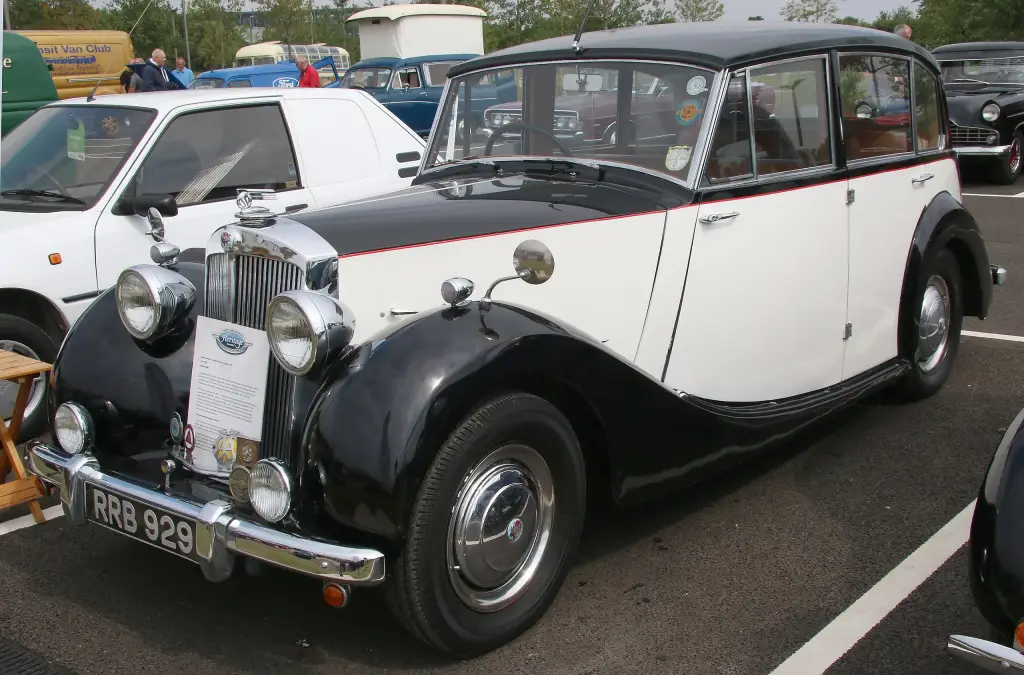
Aluminium over wood
The bodies were built by Mulliners of Birmingham in the traditional coachbuilder’s way, sheet metal over a wooden frame. The main panels were aluminium rather than steel, which was in short supply after the war but had been plentiful for aircraft production in the Midlands shadow factories. By the mid-1950s aluminium had become the more expensive metal, which may have hastened the Renown’s end.
From 1800 to Renown
The series began with the 1800 Town and Country Saloon of 1946–1949, with a 1776 cc, 65 bhp engine and gearbox from the pre-war Standard Flying Fourteen, a tubular steel chassis and transverse leaf front suspension; 4,000 were built at £1,425. The 2000 Type TDA of 1949 used the 2088 cc Vanguard engine with a single Solex carburettor, 68 bhp at 4200 rpm, and a Vanguard three-speed gearbox; 2,000 were made in a single year. The car was renamed Renown in October 1949 with an entirely new pressed-steel chassis based on the Vanguard and coil-spring front suspension. From June 1950 an overdrive was optional.
Limousine and Mk II
A Renown tested by The Motor in 1950 reached 75 mph and 0–60 mph in 24.3 seconds at 23.9 mpg; the test car cost £991. Of the 6,501 Mark Is built, fewer than 100 are known to survive. In 1951 a limousine joined the range with a wheelbase 3 inches longer, a glass partition behind the driver, and a radio and heater as standard; 190 were made. The final Renown Mk II of 1952–1954 used the limousine’s longer chassis and is identified by push-button door handles and a wider rear window; 2,800 were built and only about 150 remain. There was no direct replacement: a Vanguard-based car intended to be called Renown was launched in August 1956 as the Standard Vanguard Sportsman instead.
Design and features
- Razor-edge coachwork — six-light cabin with thin pillars and a resemblance to the Bentley Mark VI.
- Aluminium body — hand-built by Mulliners over a wooden frame.
- Vanguard mechanicals — 2088 cc engine and pressed-steel chassis from 1949.
- Rarity — fewer than 100 Mk Is and about 150 cars of all types are thought to survive.
Triumph Renown versions
- 1800 Town and Country (1946–1949): 1776 cc, tubular chassis, 4,000 built.
- 2000 TDA (1949): 2088 cc, one-year model, 2,000 built.
- Renown Mk I TDB (1949–1952): Vanguard chassis, 6,501 built.
- Renown Limousine (1951–1954): longer wheelbase, partition, 190 built.
- Renown Mk II TDC (1952–1954): limousine chassis, 2,800 built.
The Renown’s styling was echoed by the smaller Mayflower, and the pre-war Gloria came before it. More in the Triumph collection.
Sources
- Triumph Renown, English Wikipedia: bodywork, 1800 and 2000, Mk I, limousine, Mk II, production figures