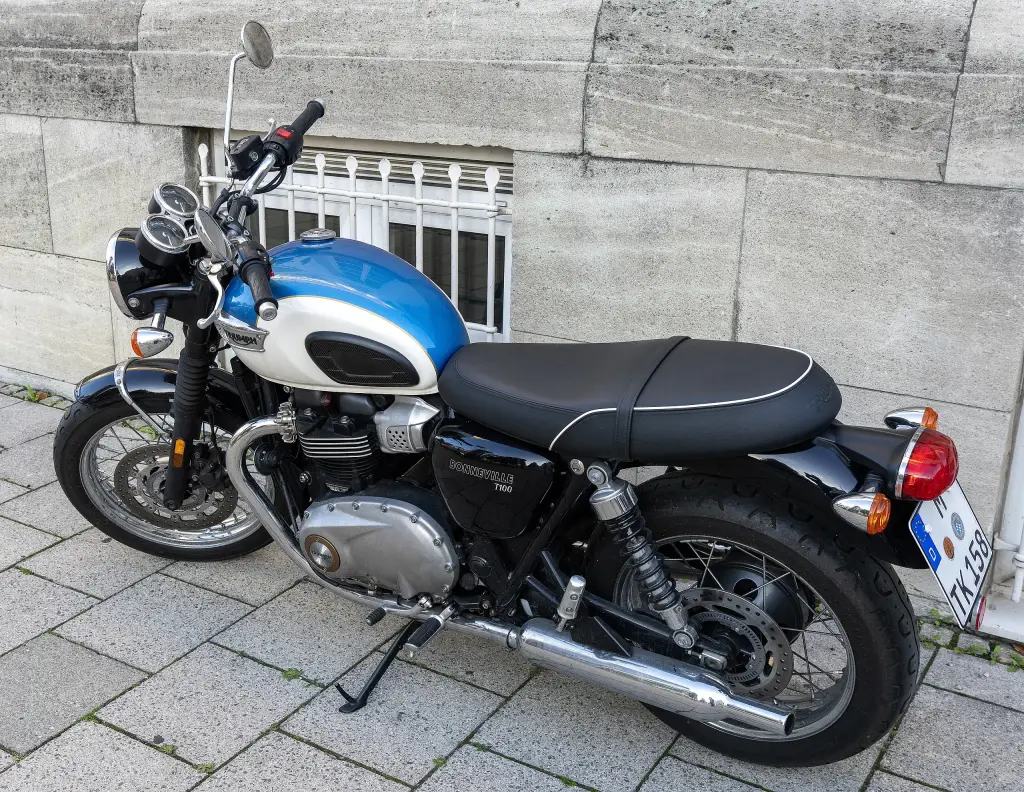
The Triumph Bonneville is a parallel-twin motorcycle built in three generations. The first two came from Triumph Engineering in Meriden between 1959 and 1988; the third, from Triumph Motorcycles in Hinckley, began in 2001 and is still in production.
Triumph Bonneville at a glance
| Name from | the Bonneville Salt Flats, Utah |
|---|---|
| First generation | T120, 650 cc, 1959–1974 |
| Based on | Triumph Tiger T110 |
| Carburettors | twin 1 3/16 in Amal monobloc |
| Second generation | T140, 750 cc, 1973–1983 |
| T140 engine | 724 cc, then 744 cc |
| Continuation bikes | Les Harris, Devon, 1985–1988 |
| New Bonneville | 790 cc, launched September 2001 |
| 865 cc | T100 from 2005, all models from 2007 |
| Fuel injection | 2008 in Britain, 2009 in the United States |
| Later engines | T120 1200 cc (2016), T100 900 cc (2017) |
The English article covers all three generations; the German one adds detail on the 1956 record run and the T140.
History of the Triumph Bonneville
1959: the T120
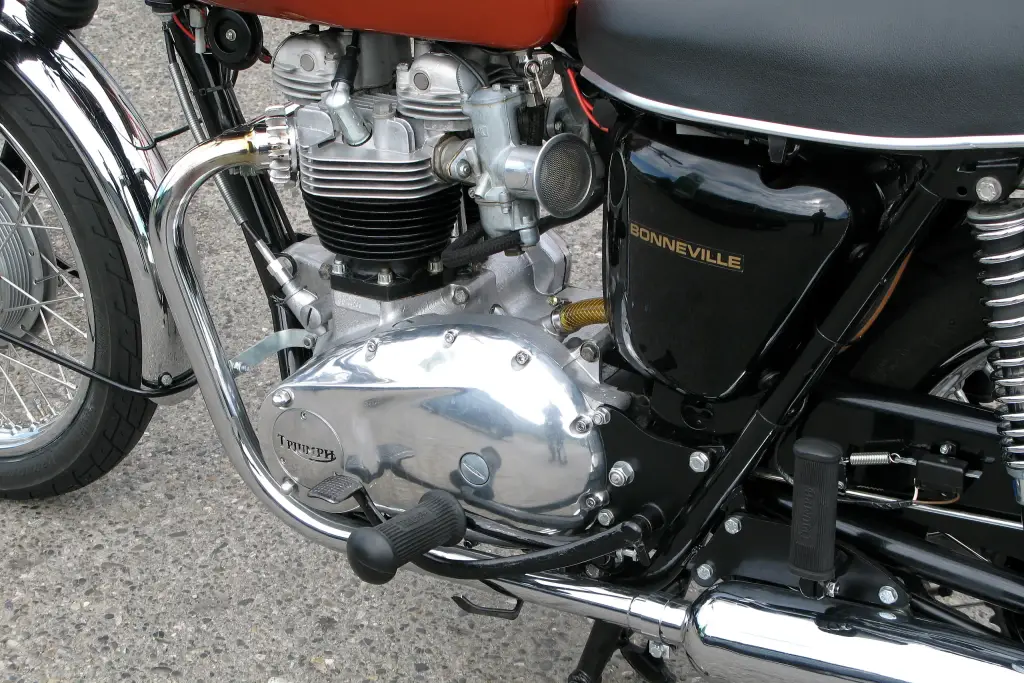
The original Bonneville was a 650 cc parallel twin built by Triumph Engineering between 1959 and 1974, and later by Norton Villiers Triumph. It grew out of the Tiger T110: Triumph took that model’s optional twin 1 3/16 inch Amal monobloc carburettors and high-performance inlet camshaft and made them standard. The engine was enlarged from 500 to 650 cc with a new one-piece forged crankshaft, and a streamlined machine using the T120 engine set a 214.5 mph world record at the Bonneville Salt Flats in 1956 with Johnny Allen riding — the run that gave the model its name.
Unit construction and the oil-in-frame
The first bikes used a pre-unit engine and gearbox and could reach 115 mph without modification. In 1963 a unit-construction version arrived, stiffer and more compact, with extra bracing at the steering head and swingarm. Later T120s used a frame that held the engine oil instead of a separate tank, the so-called oil-in-frame version. The T120 engine became a favourite of café racers, especially in Tritons built with a Norton Featherbed frame.
1973: the 750 T140
The T140 joined the range in 1973 with a 724 cc engine, a five-speed gearbox and a single front disc brake; the engine was soon bored out to 744 cc. A factory lock-in at Meriden kept the twins off the market for over a year, and when the Bonneville returned in 1975 the gear lever had moved from right to left for American rules and a rear disc brake had been added. Electronic ignition came in 1979 and electric starting in 1980. Production ended when the Meriden works closed in 1983.
1985–1988: the Harris Bonnevilles
John Bloor, who had bought Triumph Motorcycles, licensed Les Harris of Racing Spares in Devon to build the T140 from remaining parts. These continuation bikes, known as Devon or Harris Bonnevilles, reached the market in 1985 and were not sold in the United States; production stopped in 1988.
2001: the new Bonneville
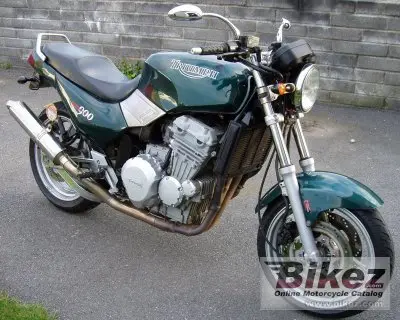
Triumph Motorcycles launched a completely new Bonneville in September 2001 with a 790 cc parallel twin, styled after the originals but engineered to modern standards. The upmarket T100 received an 865 cc engine from 2005, and from 2007 every Bonneville used 865 cc. Carburettors gave way to fuel injection in 2008 in Britain and 2009 in America, with dummy carburettors hiding the throttle bodies. A liquid-cooled 1200 cc T120 followed in 2016 and a 900 cc T100 in 2017, and the whole Modern Classics range — Thruxton, Scrambler, America and Speedmaster — descends from this Bonneville.
Design and features
- Three generations — Meriden T120, Meriden T140 and the Hinckley twin from 2001.
- T120 engine — 650 cc with twin Amal monobloc carburettors and a high-lift inlet cam.
- Café-racer favourite — the T120 engine powered Tritons and Tribsas.
- Modern Classics — the 2001 bike became the base for Thruxton, Scrambler, America and Speedmaster.
Triumph Bonneville versions
- T120 (1959–1974): 650 cc, pre-unit then unit construction, later oil-in-frame.
- T140 (1973–1983): 750 cc, five-speed, front and later rear disc brakes.
- Jubilee (1977): Silver Jubilee special in blue, white and red.
- Harris Bonneville (1985–1988): Les Harris continuation T140 for the British market.
- New Bonneville (2001–): 790 cc, then 865 cc, then the 1200 cc T120 and 900 cc T100.
The Bonneville family includes the Thruxton, Scrambler, America and Speedmaster. More in the Triumph collection.
Sources
- Triumph Bonneville, English Wikipedia: T120, T140, Harris bikes, new Bonneville
- Triumph Bonneville, German Wikipedia: record run, T120 and T140 development