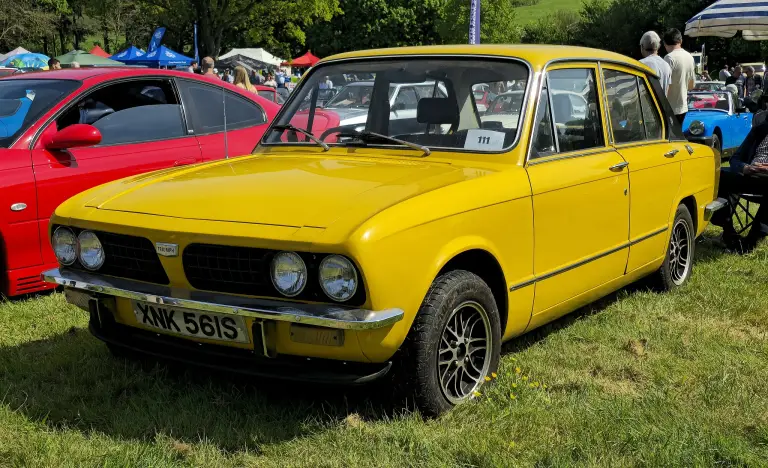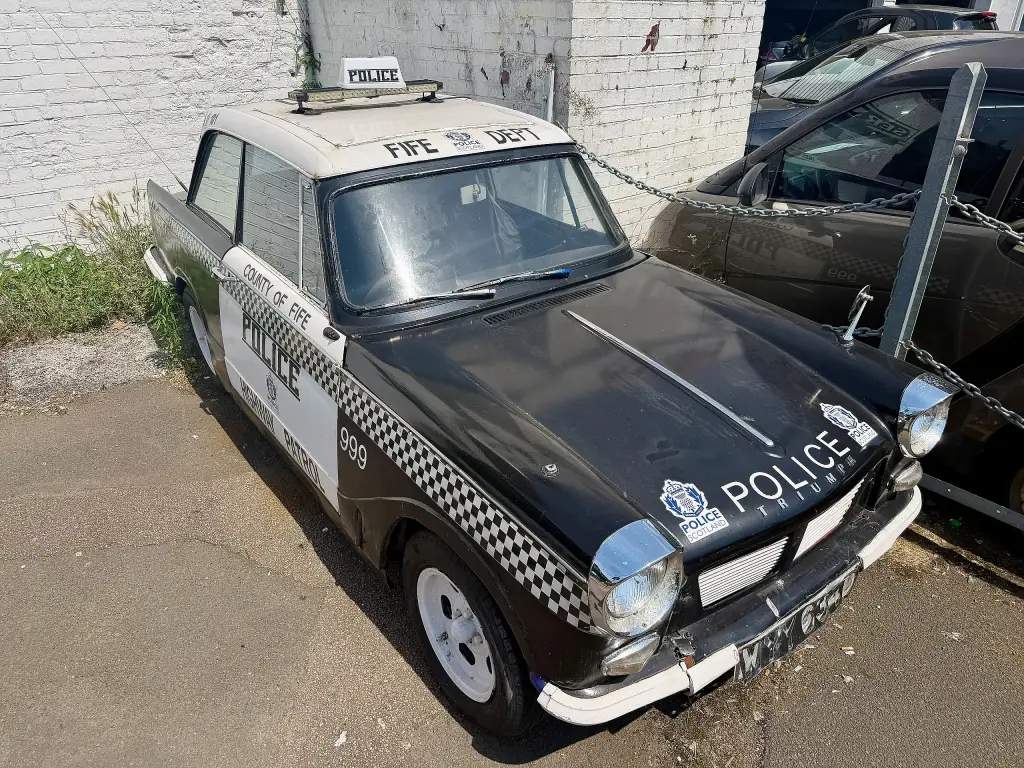
The Triumph Herald was a small two-door car introduced by Standard-Triumph in 1959 and built until 1971. Its body was designed by Giovanni Michelotti, every panel unbolted from a separate chassis, and total sales passed half a million.
Triumph Herald at a glance
| Maker | Standard-Triumph, Coventry |
|---|---|
| Production | 1959–1971 |
| Launched | Royal Albert Hall, 22 April 1959 |
| Styling | Giovanni Michelotti |
| Construction | separate chassis, bolted-on panels, hinged front end |
| Engine, 1959 | 948 cc OHV four, 34.5 bhp |
| Engine, 1961 | 1147 cc four, 39 bhp (Herald 1200) |
| Gearbox | four-speed, synchromesh on top three gears |
| Turning circle | 7.6 m, the smallest of any production car |
| Visibility | 93 per cent all-round in the saloon |
| Body styles | saloon, coupé, convertible, estate, Courier van |
Based on the English Wikipedia article on the Herald.
History of the Triumph Herald
1959: a car that could be unbolted
Standard-Triumph commissioned Michelotti to style a small two-door saloon with a large glass area; the result gave 93 per cent all-round visibility. Because Fisher & Ludlow, the company’s body supplier, had become part of a rival BMC, Triumph used a separate chassis instead of unitary construction: the body tub was bolted to the frame, the whole front end hinged forward for engine access, and every panel including the sills and roof could be unbolted so different body styles could be built on the same chassis. The car was launched at the Royal Albert Hall on 22 April 1959, but at close to £700 including purchase tax it was not an immediate success, and with 34.5 bhp it was no faster than average: The Motor recorded 70.9 mph and 0–60 mph in 31.1 seconds.
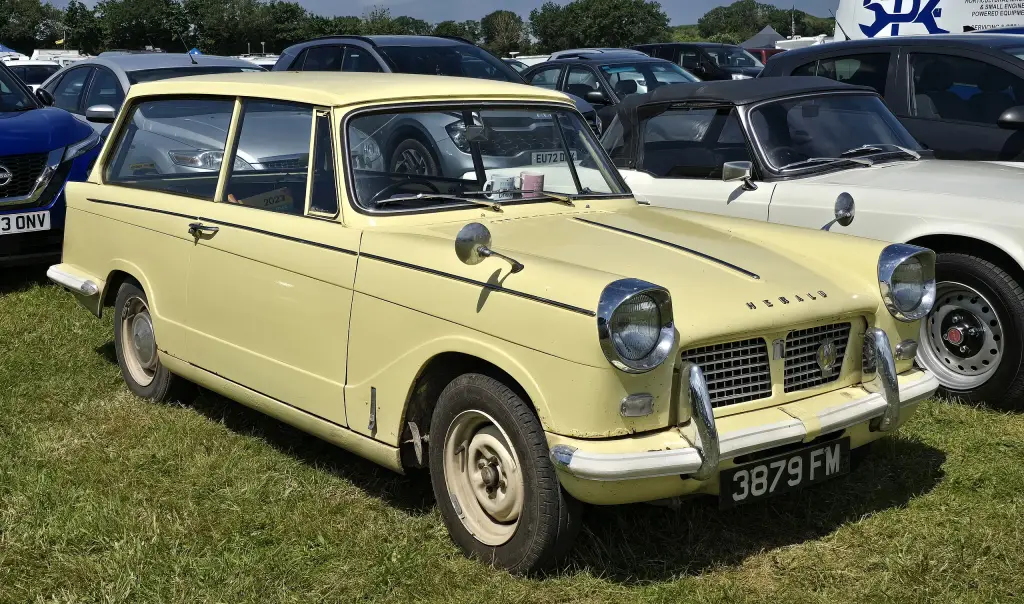
Chassis and equipment
The Herald used the 948 cc OHV engine and four-speed gearbox of the Standard Pennant, with synchromesh on the top three gears and a remote gear change. Rack-and-pinion steering gave a 7.6 m turning circle, the smallest of any production car. At the front there were coil springs and double wishbones — a layout later copied by Lotus, Reliant and others — and at the rear a single transverse leaf spring with swing axles, Triumph’s first attempt at independent rear suspension. Instruments were limited to one large speedometer with a fuel gauge in the saloon, though the coupé had a fuller set. Carpet and heater were standard. A lower-specification Herald S with less chrome followed in 1961, saloon only.
1961: the Herald 1200
After Leyland took over Standard-Triumph in 1961, money became available to develop the car. In April 1961 it was relaunched as the Herald 1200 with a 1147 cc engine, rubber-covered bumpers, a wooden laminate dashboard and better seats, and with quality control tightened. A single Solex carburettor replaced the twin SUs as standard, and power rose to 39 bhp. A three-door estate joined the range a month later, and disc brakes became optional from 1962. Sales picked up despite competition from the Mini and Ford Anglia. The coupé was dropped in late 1964 because it now competed with the Spitfire, and the 1200 stayed in production until 1970.
The Courier and the family
From 1962 to 1966 Triumph built the Courier, a Herald estate with panels instead of rear side windows; it sold poorly and was discontinued, with Maltese CKD assembly continuing into late 1965. The Herald’s chassis and running gear went on to underpin the Vitesse, the Spitfire and the GT6, all with the same bolt-together bodies. Total Herald sales were well over half a million.
Design and features
- Separate chassis — every panel, including sills and roof, could be unbolted, and the front hinged forward.
- Michelotti styling — razor-edge lines with 93 per cent visibility in the saloon.
- Tight turning circle — 7.6 m, the smallest of any production car at the time.
- Chassis donor — the basis of the Vitesse, Spitfire and GT6.
Triumph Herald versions
- Herald 948 (1959–1962): saloon, coupé and convertible, 34.5 bhp.
- Herald S (1961–1964): lower equipment, saloon only.
- Herald 1200 (1961–1970): 1147 cc, 39 bhp, saloon, convertible and estate.
- Courier van (1962–1966): estate with side panels instead of rear windows.
The Herald chassis was used for the Vitesse, Spitfire and GT6. More in the Triumph collection.
Sources
- Triumph Herald, English Wikipedia: design, chassis, 948 and 1200 models, Courier, family