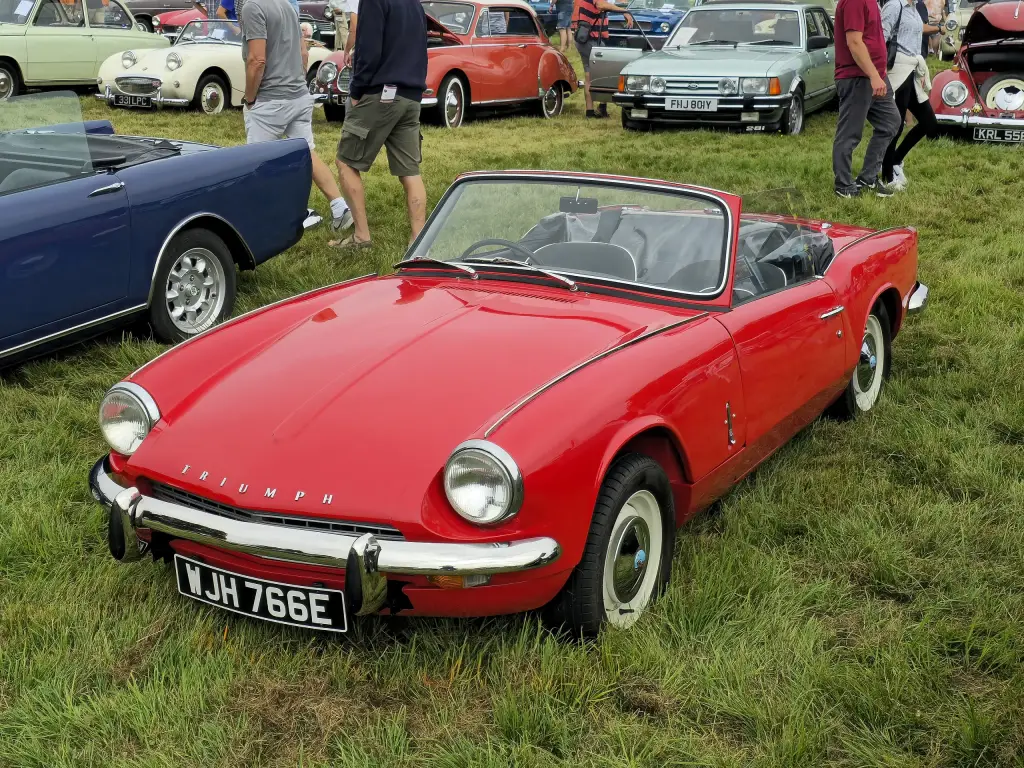
The Triumph Spitfire was a small British sports car made from 1962 to 1980. Styled by Giovanni Michelotti on a shortened Herald chassis, it was built in five generations and about 315,000 were produced over 18 years.
Triumph Spitfire at a glance
| Maker | Standard-Triumph, Canley, Coventry |
|---|---|
| Production | 1962–1980 |
| Stylist | Giovanni Michelotti (1957) |
| Launched | London Motor Show, 1962 |
| Chassis | shortened Triumph Herald backbone, body-on-frame |
| Engine, Mk I | 1147 cc OHV four, twin SU carburettors |
| Power, Mk I | 63 bhp at 5750 rpm |
| Torque, Mk I | 91 Nm at 3500 rpm |
| Top speed, Mk I | 92 mph |
| 0–60 mph, Mk I | 16.4 seconds |
| Mk II power | 67 bhp at 6000 rpm |
| Built | about 315,000 |
Based on the English Wikipedia article on the Spitfire.
History of the Triumph Spitfire
Origins: Project Bomb
Standard-Triumph planned the Spitfire to take on the Austin-Healey Sprite, under the codename Project Bomb. The Sprite used Austin A30 mechanicals in a new lightweight body, while the Spitfire used the Herald’s separate backbone chassis, which Triumph could shorten instead of developing a new structure. Michelotti, who had styled the Herald, drew a body with wind-down windows and a bonnet and wings that opened forward for engine access. Financial trouble delayed the launch, and Leyland officials found Michelotti’s prototype under a dust sheet in a factory corner after taking over Standard-Triumph; it was approved for production and shown at the London Motor Show in 1962.
Spitfire 4 / Mark I (1962–1964)
The production car was close to the prototype, with the full-width rear bumper replaced by two part-bumpers with overriders. The body was bolted to a modified Herald chassis from which the outer rails and rear outriggers had been removed, and structural outer sills stiffened the design. Front disc brakes were added. The 1147 cc four used a pushrod overhead-valve head, two valves per cylinder and twin SU carburettors, giving 63 bhp at 5750 rpm and 91 Nm at 3500 rpm: 92 mph, 0–60 mph in 16.4 seconds and 31 mpg. The Herald’s rack-and-pinion steering and coil-and-wishbone front suspension carried over. The rear used a single transverse-leaf swing axle, an arrangement that could produce large camber changes when cornering hard and led to oversteer. Trim was basic — rubber mats and a large plastic steering wheel — but the car had wind-down windows, exterior door locks and full instrumentation. For 1964 an overdrive became optional, and wire wheels and a hard top were offered.
Mark II (1965–1967)
The Mark II arrived in March 1965 with a retuned engine: revised camshaft, water-heated intake manifold and tubular exhaust manifold raised power to 67 bhp at 6000 rpm. The coil-spring clutch gave way to a Borg & Beck diaphragm unit, though North American cars kept the coil-spring housing and used ACDelco distributors. Outside there was a new grille and badges; inside, revised seats and carpeting in place of moulded rubber mats. At £550 it undercut the MG Midget’s £515 only slightly in price terms but offered more room; top speed was claimed at 96 mph and 0–60 mph took 14.8 seconds, with 38.1 mpg at 70 mph.
Mark III and the swing-spring
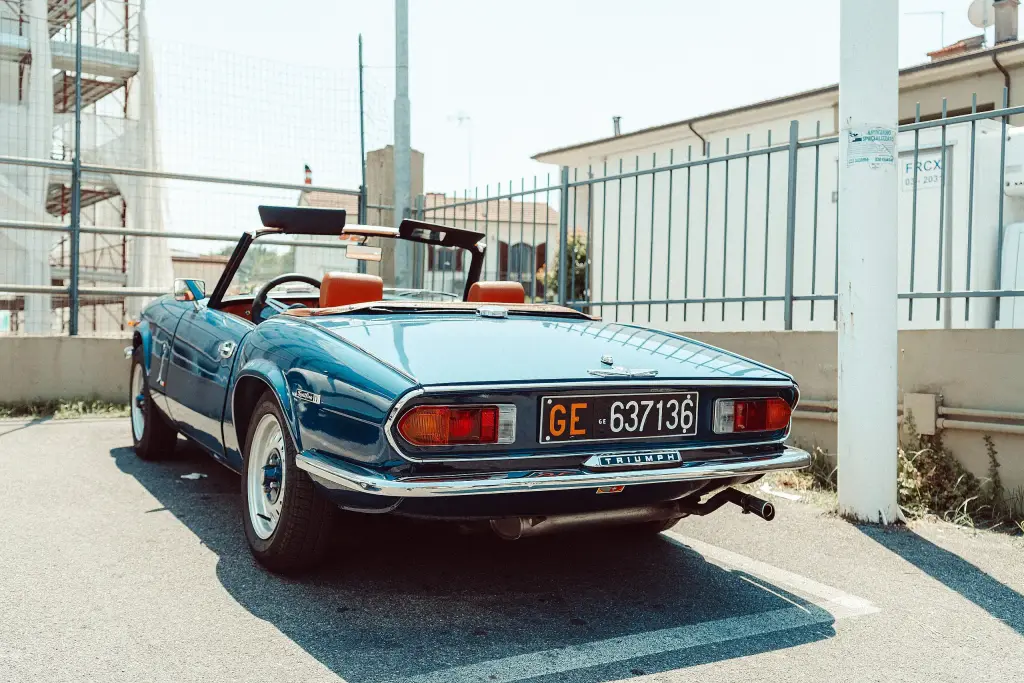
The Mark III of March 1967 was the first major facelift, with a raised front bumper for new crash rules, slightly raised front springs and revised bonnet pressings. Triumph kept improving the rear suspension: in 1970 it was decambered with what the factory called a swing spring — one leaf was removed from the stack, only the bottom leaf stayed fixed to the differential and the rest could pivot, removing the worst of the swing-axle behaviour. The Spitfire continued through the Mark IV and the 1500 until 1980, by which time about 315,000 had been built.
Design and features
- Herald backbone — a shortened separate chassis with a bolted-on body and stiffening sills.
- Michelotti body — wind-down windows and a front that hinged forward for engine access.
- Twin SU engine — 1147 cc, 63 bhp in Mk I form and 67 bhp in the Mk II.
- Swing spring — the 1970 rear suspension change that tamed the swing axles.
Triumph Spitfire versions
- Spitfire 4 / Mk I (1962–1964): 63 bhp, optional overdrive from 1964.
- Mk II (1965–1967): 67 bhp, revised clutch and trim.
- Mk III (1967–1970): raised bumper and front springs, facelifted body.
- Mk IV and 1500: the later generations, built until 1980.
The Spitfire used the Herald chassis, and its engine went into the 1300 TC; the six-cylinder GT6 was its coupé sister. More in the Triumph collection.
Sources
- Triumph Spitfire, English Wikipedia: origins, Mk I, Mk II, Mk III, swing spring