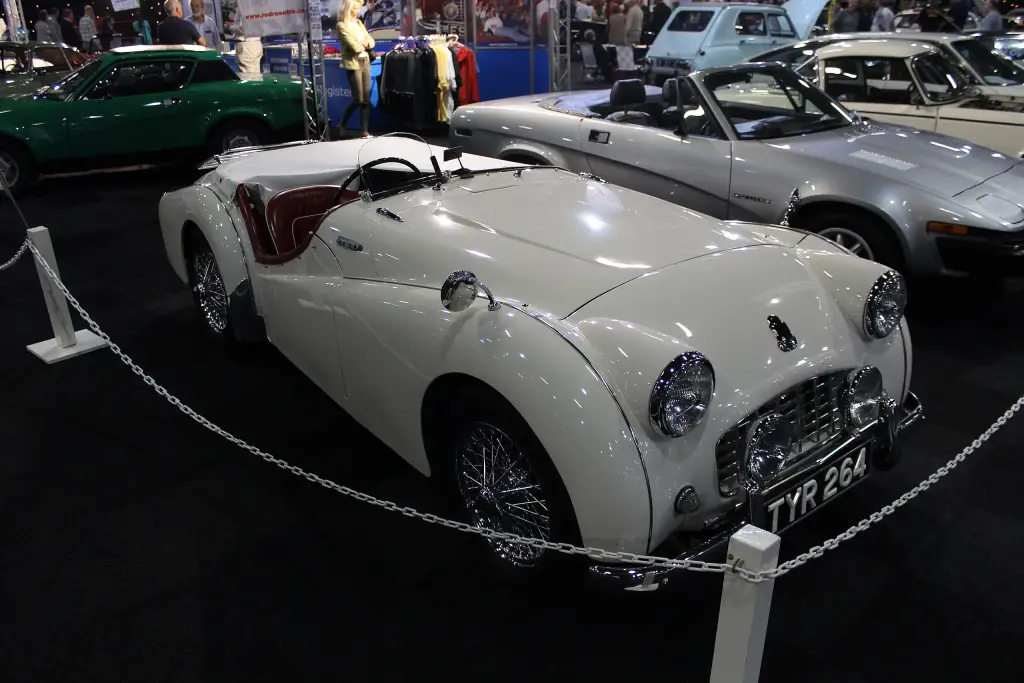
The Triumph TR3 was a British open two-seater built from 1955 to 1962. An evolution of the TR2 with more power and better brakes, it was the first British series-production car with front disc brakes and sold in large numbers, mostly in America.
Triumph TR3 at a glance
| Maker | Standard Motor Company, Coventry |
|---|---|
| Production | 1955–1962 |
| Body | open two-seater with removable side curtains |
| Engine | 1991 cc Standard wet-liner four |
| Power | 95 bhp, later 100 bhp at 5000 rpm |
| Carburettors | larger SU H6 |
| Brakes | drums, then front discs from 1956 |
| Gearbox | four-speed with optional electrically engaged overdrive |
| Suspension | double wishbones front, live axle and leaf springs rear |
| Top speed | 105.3 mph (hardtop with overdrive, 1956) |
| 0–60 mph | 10.8 seconds |
| Built | about 74,800 (all variants) |
Based on the English Wikipedia article on the TR3, which also covers the TR3A.
History of the Triumph TR3
1955: more power than the TR2
The TR3 replaced the TR2 in October 1955 with the same 1991 cc Standard wet-liner engine, but larger SU H6 carburettors raised output from 90 to 95 bhp. A high-port cylinder head and enlarged manifold later lifted it to 100 bhp at 5000 rpm. The four-speed gearbox could be had with an electrically engaged overdrive worked from a dashboard switch. In 1956 the front brakes changed from drums to discs, a first for a British series-production car. Front suspension used double wishbones, manganese bronze trunnions, coil springs and telescopic dampers, with an optional anti-roll bar; at the rear there were leaf springs, a live axle and lever-arm dampers. Steering was worm and peg, with more play and friction than the MG of the period.
Sidescreen motoring
The TR3 was a sunny-weather car with removable rain protection: a hood that snapped on and off and removable side curtains, which allowed very low doors with padding for the driver’s arm. There were holes in the floor with rubber plugs so the jack could be used from inside the car, as in the Jaguar XK120, and the optional heater was poor with its shut-off valve under the bonnet. Handling could be sudden: the chassis shared with the TR2, TR3A, TR3B and TR4 had limited wheel travel, so on very hard cornering the inside rear wheel could lift and provoke oversteer, especially on radial tyres, since the suspension was designed for crossplies.
1957: the TR3A
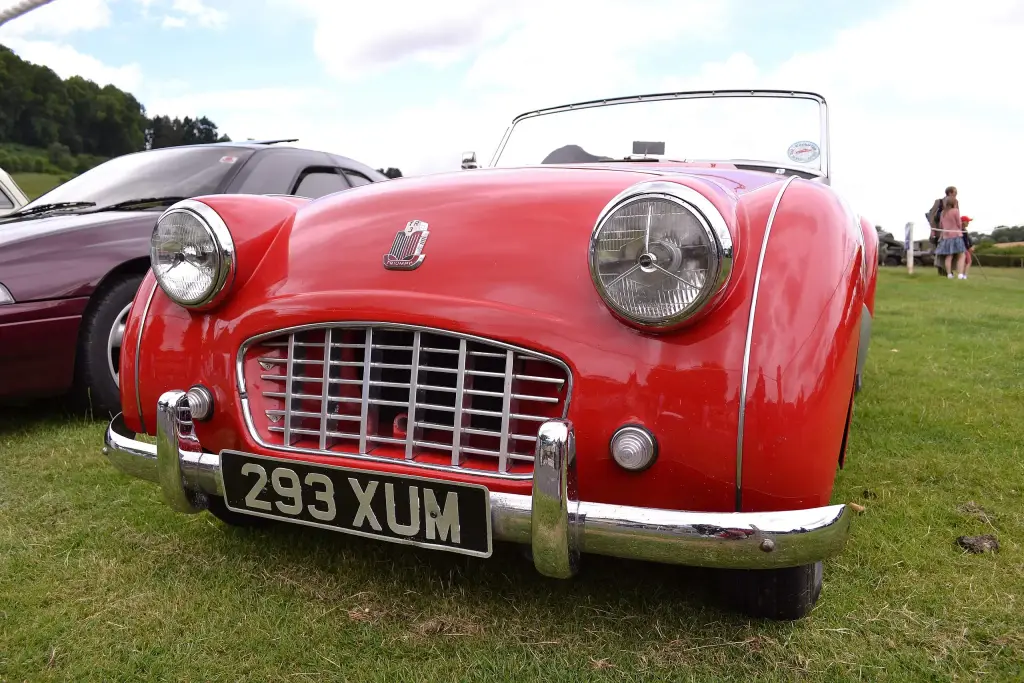
In 1957 the car was updated into what everyone calls the TR3A, although it was still badged TR3 and the name was never official. Changes included a new full-width front grille, exterior door handles and a lockable boot handle, and the previously optional full tool kit became standard. The front disc brakes were carried over, and the car’s braking made it an autocross favourite. In 1959 the bonnet and boot hinges and door handles gained raised stampings, the rear floor was redesigned and the windscreen was bolted rather than fastened with Dzus clips.
Sales and end
Of the original pre-facelift TR3, 13,377 were built and only 1,286 were sold in Britain; the rest went abroad, mainly to the United States. Across all variants about 74,800 TR3s were sold, making it Triumph’s third best-selling TR after the TR7 and TR6. The TR3 was replaced by the mechanically similar but Michelotti-styled TR4. A TR3B was also built for North America in 1962.
Design and features
- 95–100 bhp — larger SU carburettors and a high-port head over the TR2.
- Front disc brakes — standard from 1956, the first on a British series-production car.
- Sidescreens — a snap-on hood and removable side curtains for very low doors.
- Overdrive — electrically engaged from a dashboard switch.
Triumph TR3 versions
- TR3 (1955–1957): 95 bhp, drums then front discs; 13,377 built.
- TR3A (1957–1962): full-width grille, exterior door handles, lockable boot.
- TR3B (1962): a final version for the North American market.
The TR3 followed the TR2 and was replaced by the TR4. More in the Triumph collection.
Sources
- Triumph TR3, English Wikipedia: engines, brakes, chassis, TR3A changes, production