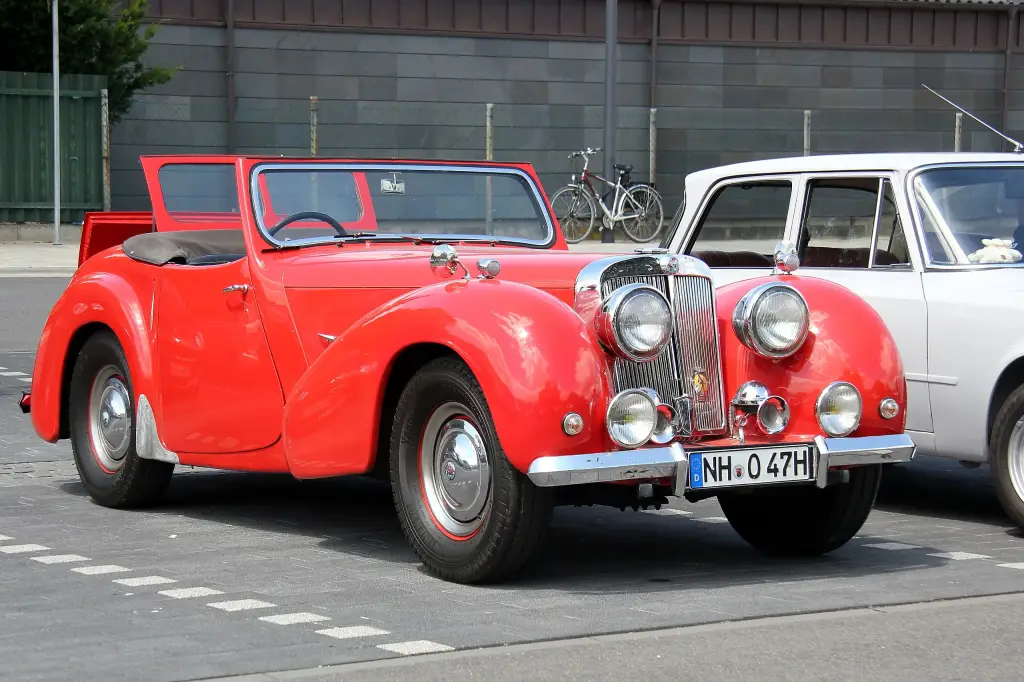
The Triumph Roadster was built by the Standard Motor Company from 1946 to 1949, sold as the Triumph 1800 Roadster and later the Triumph 2000 Roadster. Its aluminium body, three-abreast bench seat and rear dickey seat made it one of the oddities of post-war British motoring.
Triumph Roadster at a glance
| Maker | Standard Motor Company (Triumph) |
|---|---|
| Production | 1946–1949 |
| Models | 1800 Roadster (18TR), 2000 Roadster (20TR) |
| Body | aluminium over an ash frame, steel front wings |
| Seating | three on a bench seat, two more in the dickey seat |
| Width | 64 inches, enough for three abreast |
| Windscreen wipers | three in a row |
| Engine, 1800 | 1776 cc four, 65 bhp |
| Engine, 2000 | 2088 cc four from 1948 |
| Gearbox | four-speed, then three-speed from 1948 |
| Top speed | 75 mph (1800), 77 mph (2000) |
| Built | about 2,500 |
Based on the English Wikipedia article on the Roadster; the record titled “Triumph 1800” belongs to this model.
History of the Triumph Roadster
1946: a sports car for Sir John Black
The 1800 Roadster, model 18TR, was designed at the end of the Second World War. Triumph had been bought by Standard in 1944, and Standard’s managing director Sir John Black wanted a sports car to take on Jaguar, which had used Standard engines before the war. Frank Callaby styled the body with Arthur Ballard, and Ray Turner designed the chassis. Post-war steel shortages meant most of the body was aluminium over an ash frame, made with rubber press tools left over from Mosquito bomber panels built by Standard during the war; only the front wings were steel.
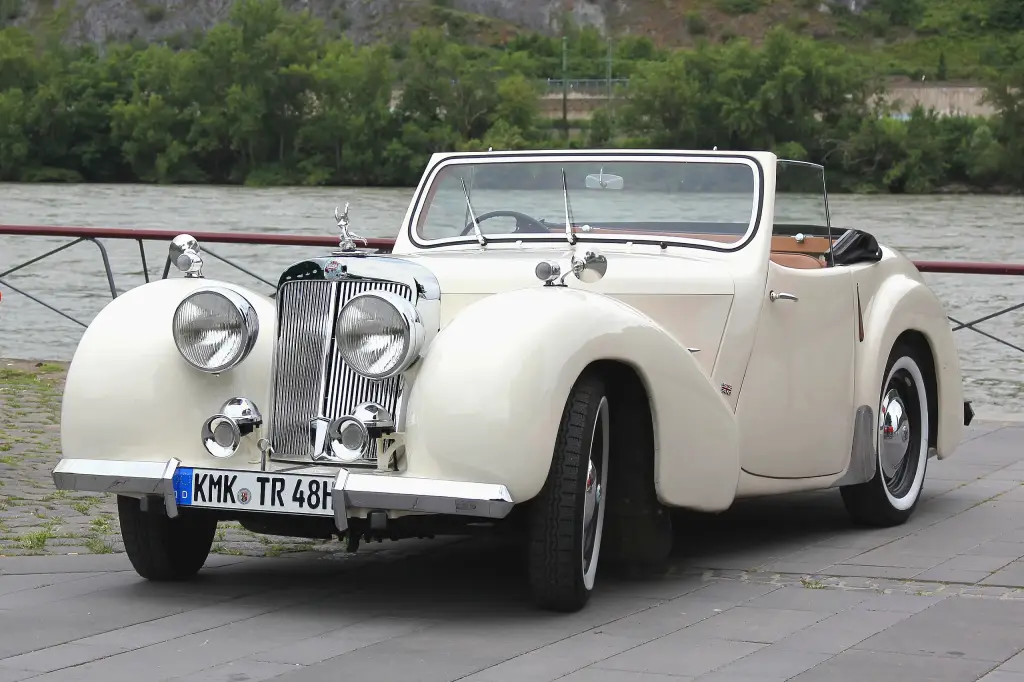
The engine and chassis
The engine was Standard’s 1.5-litre four, converted to overhead valves by Harry Weslake and built for SS-Jaguar before the war. The Triumph version used a downdraught Solex carburettor and a 6.7:1 compression ratio instead of the Jaguar’s side-draught SU and 7.6:1. The tubular steel chassis was a short-wheelbase version of the 1800 saloon, with transverse leaf independent front suspension and a live axle on semi-elliptic springs at the rear; the rear track was 4 inches wider than the front. Brakes were hydraulic.
Three abreast and a dickey seat
The styling was deliberately old-fashioned. One journalist who remembered the pre-war Dolomite Roadster that inspired it thought the elegant proportions had been abandoned for “a plump Christmas turkey”. The front had large separate headlamps and a radiator set well back between coal-scuttle wings. The 64-inch width allowed a bench seat for three, which required a column gear change and three windscreen wipers in a row. Behind it sat a dickey seat with its own folding windscreen, outside the hood that covered the front occupants, reached by a step on the rear bumper. The Roadster was the last production car with a dickey seat. Autocar tested an 1800 in 1947 at 75 mph and 0–60 mph in 34.4 seconds.
1948: the 2000 Roadster and the end
The only significant upgrade came in September 1948 for the 1949 models, when the Roadster received the 2088 cc Standard Vanguard engine, transmission and rear axle, becoming the 2000 Roadster or 20TR. The four-speed gearbox gave way to a three-speed unit with synchromesh on bottom gear. Top speed rose only to 77 mph, but 0–60 mph improved to 27.9 seconds. The car was mainly hand built and about 2,500 were made before production ended in October 1949. A further Roadster prototype, the TR-X of 1950 with power-operated hood, windows and headlamp shutters, never reached production. A burgundy 1947 1800 Roadster became familiar to British television viewers in the series Bergerac.
Design and features
- Aluminium body — built over an ash frame with wartime Mosquito press tools.
- Three-abreast seating — a 64-inch body, column gear change and three windscreen wipers.
- Dickey seat — the last production car to offer one, with its own folding windscreen.
- Vanguard power — the 2088 cc engine from 1948 in the 2000 Roadster.
Triumph Roadster versions
- 1800 Roadster 18TR (1946–1948): 1776 cc engine, four-speed gearbox.
- 2000 Roadster 20TR (1948–1949): 2088 cc Vanguard engine and three-speed gearbox.
- TR-X prototype (1950): full-width body with power-operated hood, windows and headlamp shutters.
The Roadster shared its era with the razor-edge Renown and was followed by the TR2. More in the Triumph collection.
Sources
- Triumph Roadster, English Wikipedia: 1800 Roadster, chassis, body, 2000 Roadster, TR-X