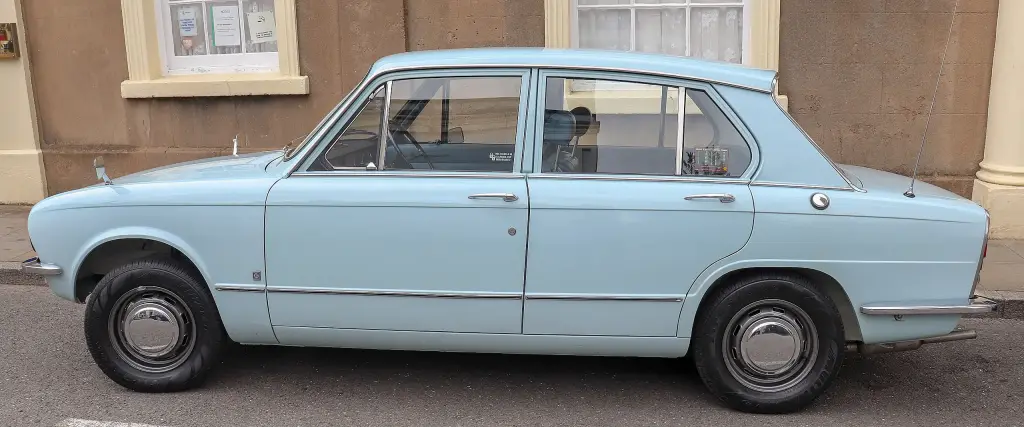
The Triumph Toledo was a compact saloon built by British Leyland from 1970 to 1976. Introduced as a cheaper version of the front-wheel-drive Triumph 1300, it switched to rear-wheel drive and a live axle to keep costs down, and it became one of Triumph’s best-selling small cars.
Triumph Toledo at a glance
| Maker | Rover-Triumph division, British Leyland |
|---|---|
| Production | 1970–1976 |
| Introduced | August 1970 |
| Layout | front engine, rear-wheel drive, live rear axle |
| First engine | 1296 cc Standard SC, 58 bhp net |
| Two-door | the original model, drum brakes all round |
| Four-door | from March 1971 (export), August 1971 at home |
| 1500 engine | 1499 cc, 61 bhp and 64 bhp in TC form |
| Disc brakes | standard from October 1972 |
| Built | 119,182 |
| Replaced by | Dolomite 1300 and 1500, March 1976 |
Based on the English Wikipedia article on the Toledo.
History of the Triumph Toledo
1970: a cheaper 1300
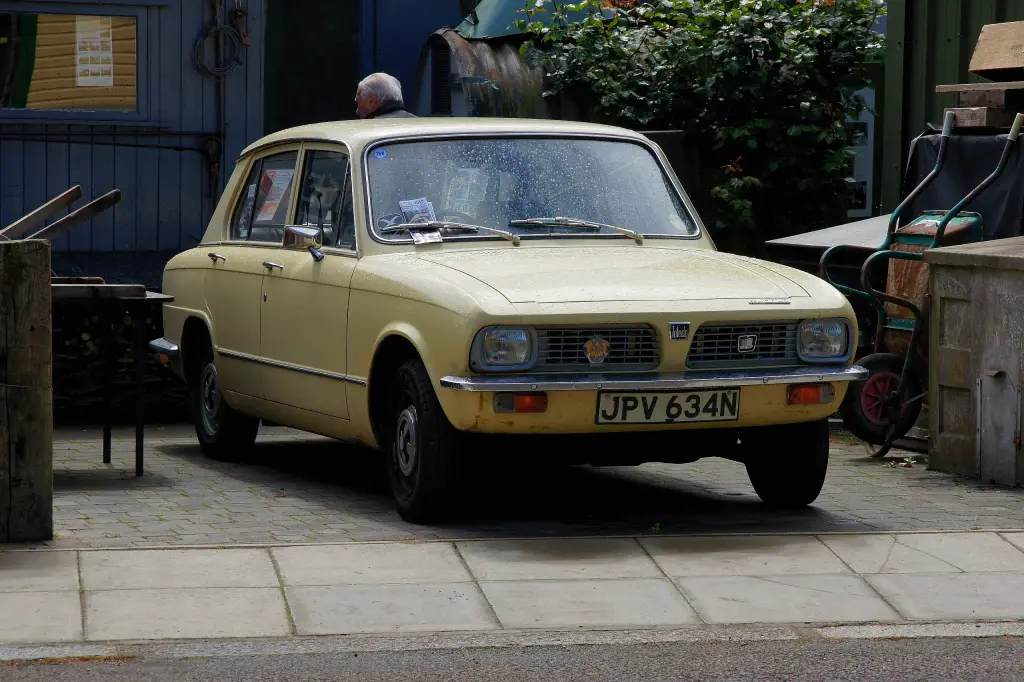
The Toledo was introduced in August 1970 as a cheaper version of the Triumph 1300, which was being replaced at the same time by the front-wheel-drive Triumph 1500. Like the 1500 it had a new split grille, but with single rectangular headlamps in a grey plastic grille instead of twin round units. The rear was like the 1300’s apart from simpler, flat-faced tail lights. The big change was a move to rear-wheel drive and a live rear axle, still on coil springs, for simplicity and low cost. The interior was cheaper too, with wood limited to a simple plank dashboard with holes drilled for basic instruments, although it was still a cut above most small cars of the time.
Two doors, then four
At first the Toledo was a two-door saloon only, with the 1296 cc Standard SC engine giving 58 bhp net, drum brakes all round and no overdrive or automatic option. In March 1971 a four-door special export version appeared at the Geneva Motor Show with the 1500 cc engine in single and twin-carburettor TC form, giving 61 and 64 bhp net; the four-door reached the British market from late August 1971. It used the same side pressings as the Triumph 1300 and came on radial tyres to cope with about 50 kg more weight. The two-door had non-wraparound bumpers at first, and from 1973 full wraparound bumpers.
Improvements and the end
The specification improved over the years: front disc brakes became standard in October 1972 and a heated rear window by late 1973 or early 1974. In March 1975 the two-door was dropped and the four-door gained the Triumph Spitfire 1500 single-rail gearbox, a new clutch, side body trims, a black grille, reclining front seats, twin reversing lights, hazard lights and a driver’s door mirror. The Toledo was replaced in March 1976 by the Dolomite 1300 and 1500. Total production was 119,182 cars. Knock-down kits were still being assembled in New Zealand in 1977 and registered as late as 1978, with a silver grille and side rubbing strips but the shorter Toledo shell.
The 1973 recall
In August 1973 the Toledo, along with the 1500 and Dolomite, was subject to the largest vehicle recall in Britain to that date. It covered 103,000 cars and replaced a front radius strut in the front suspension that could break and leave the car impossible to steer. The makers said they had reproduced the defect by driving into a solid kerb at 10 to 15 mph, and insisted it could only arise through misuse.
Design and features
- Rear-wheel drive — a live axle and coil springs instead of the 1300’s front-wheel drive.
- Simple dashboard — a wooden plank with drilled holes for basic instruments.
- Two- and four-door bodies — the four-door arrived in 1971 with the 1500 engine.
- Big seller — 119,182 cars, one of Triumph’s best small saloons.
Triumph Toledo versions
- Two-door 1300 (1970–1975): 58 bhp, drum brakes.
- Four-door 1500 (1971–1976): 61 bhp, radial tyres.
- TC: twin carburettors, 64 bhp, later 71 bhp with higher compression.
- Toledo TS (1973): a two-door 1500 twin-carburettor prototype, never produced.
The Toledo was developed from the Triumph 1300 and grew into the Dolomite. More in the Triumph collection.
Sources
- Triumph Toledo, English Wikipedia: design, models, specification changes, production, recall