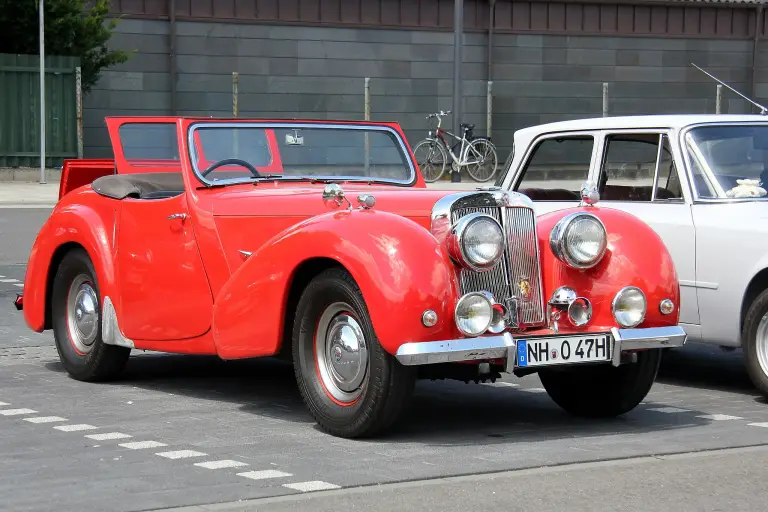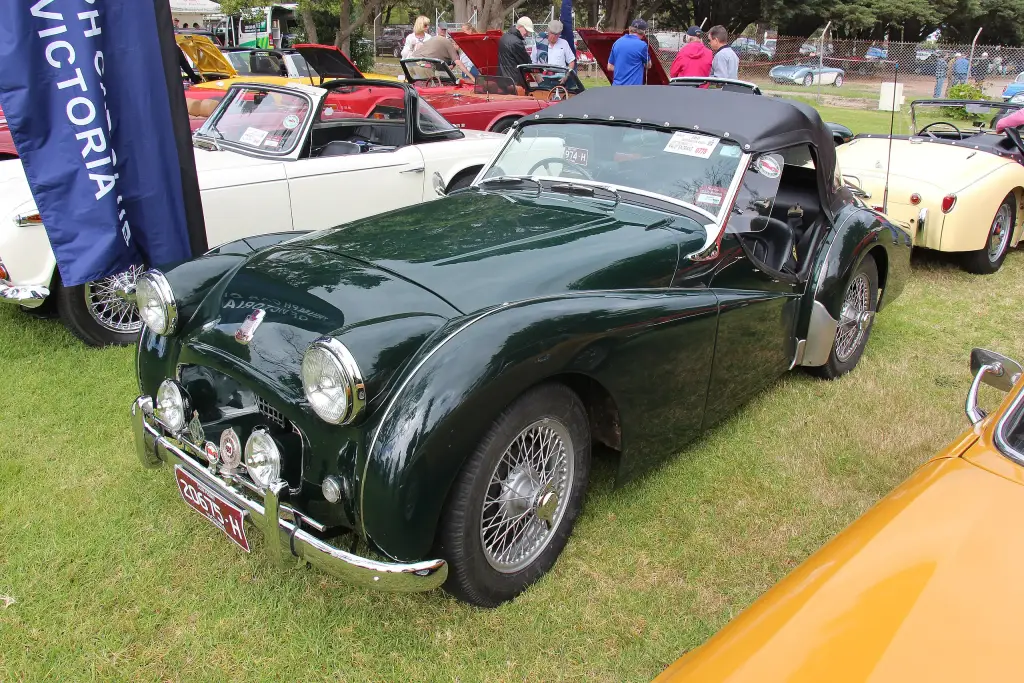
The Triumph TR2 was a small open two-seater sports car built by the Standard Motor Company from 1953 to 1955. Simple, cheap and quick, it sold strongly in the United States and laid the foundation of the TR line.
Triumph TR2 at a glance
| Maker | Standard Motor Company, Coventry |
|---|---|
| Production | 1953–1955 |
| Body | open two-seater on a separate ladder chassis |
| Engine | 1991 cc Standard wet-liner four, twin SU H4 carburettors |
| Power | 90 bhp |
| Gearbox | four-speed manual, optional overdrive |
| Suspension | independent front, live axle and leaf springs rear |
| Brakes | Lockheed drums all round |
| Top speed | 107.3 mph (The Motor, 1954) |
| 0–60 mph | 12.0 seconds |
| Built | 8,636 |
| Price | £900 including taxes |
Based on the English Wikipedia article on the TR2.
History of the Triumph TR2
From the 20TS to the TR2
Triumph’s post-war Roadster was out of date and underpowered when it arrived, and Sir John Black, boss of Standard, wanted an affordable sports car after failing to buy Morgan. A prototype two-seater was built on a shortened Standard Eight chassis with the Standard Vanguard’s 2-litre four, and it appeared as the Triumph 20TS at the 1952 London Motor Show. Black asked BRM development engineer and test driver Ken Richardson to assess it; Richardson called it a death trap. A year of work followed, and the TR2 emerged with better looks, a simple ladder chassis, a longer body and a bigger boot. The letters TR stood for Triumph Roadster, and period advertising called it the T.R.2.
Specification
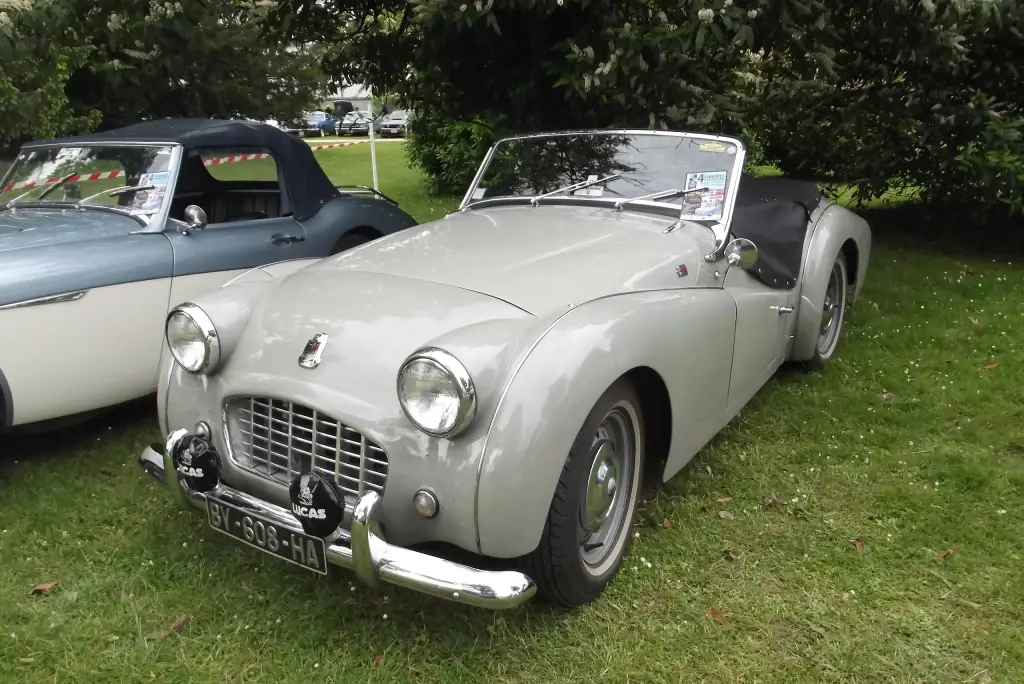
The TR2 used the 1991 cc wet-liner four from the Vanguard with twin SU H4 carburettors, tuned to 90 bhp. The body sat on a separate chassis with coil-sprung independent front suspension and a leaf-sprung live rear axle, wire or disc wheels, a four-speed manual gearbox with optional top-gear overdrive and Lockheed drum brakes all round. The Motor tested an overdrive car in 1954 at 107.3 mph and 0–60 mph in 12.0 seconds, with 34.5 mpg; the car cost £900 including taxes, plus £56 for overdrive. The magazine noted it was the cheapest British car able to exceed 100 mph.
Competition
Standard-Triumph had given little thought to racing, but two events changed that. In May 1953 a production TR2 with optional streamlining equipment, the Speedmodel, reached 124.889 mph on the closed Jabbeke motorway in Belgium. The following March, customer cars took first, second and fifth places on the RAC Rally. The publicity led to a works Competition Department under Ken Richardson, and TR2s competed in the Mille Miglia, the Ulster TT, Macao, the Alpine, Monte Carlo and many other events, collecting class and team awards including the Coupe des Alpes. In 1955 three works cars with disc brakes, larger carburettors and perspex aeroscreens ran at Le Mans, reaching 120 mph on the Mulsanne Straight and finishing 14th, 15th and 19th; their Girling disc brakes and uprated carburettors later appeared on the TR3. Doug Whiteford won the 1955 Moomba TT at Albert Park in a TR2.
The Belgian coupé
Impéria Automobiles of Nessonvaux assembled about 500 TR2s from CKD kits, with an N suffix on their commission numbers. In 1954 Impéria obtained permission to build a coupé version, designed by Frans Pardon and named after the Spa-Francorchamps circuit. It debuted at the 1955 Brussels show with a fixed head, glass backlight and a large Perspex roof panel; the extra glass made the interior uncomfortably warm. Production of the TR2 ended in 1955, when the more powerful TR3 with a redesigned grille replaced it.
Design and features
- Simple and cheap — a ladder chassis, a Vanguard engine and a price of £900.
- 100 mph for the money — The Motor called it the cheapest British car above 100 mph.
- Jabbeke record — 124.889 mph with the optional Speedmodel streamlining in 1953.
- Works racing — Le Mans in 1955 and a works Competition Department under Ken Richardson.
Triumph TR2 versions
- TR2 (1953–1955): the standard open two-seater.
- Speedmodel: factory streamlining kit for record attempts.
- Coupé Francorchamps: Belgian-built fixed-head coupé by Impéria.
The TR2 was replaced by the TR3, and its front suspension came from the Mayflower. More in the Triumph collection.
Sources
- Triumph TR2, English Wikipedia: history, specification, performance, competition, Coupé Francorchamps