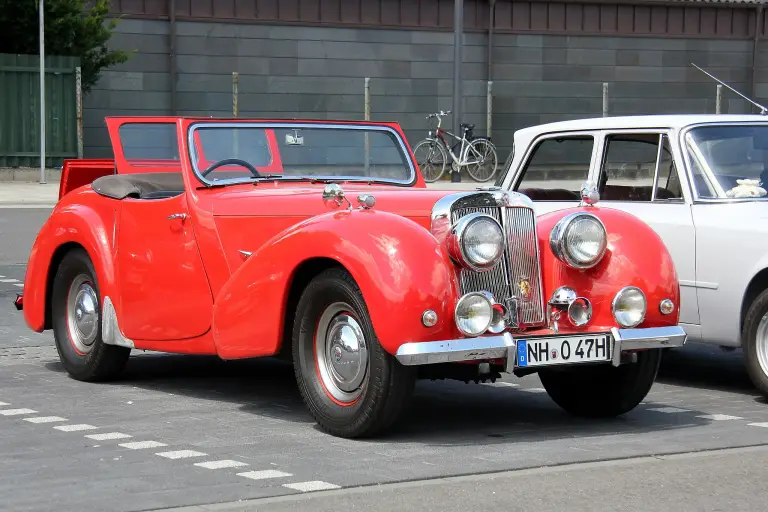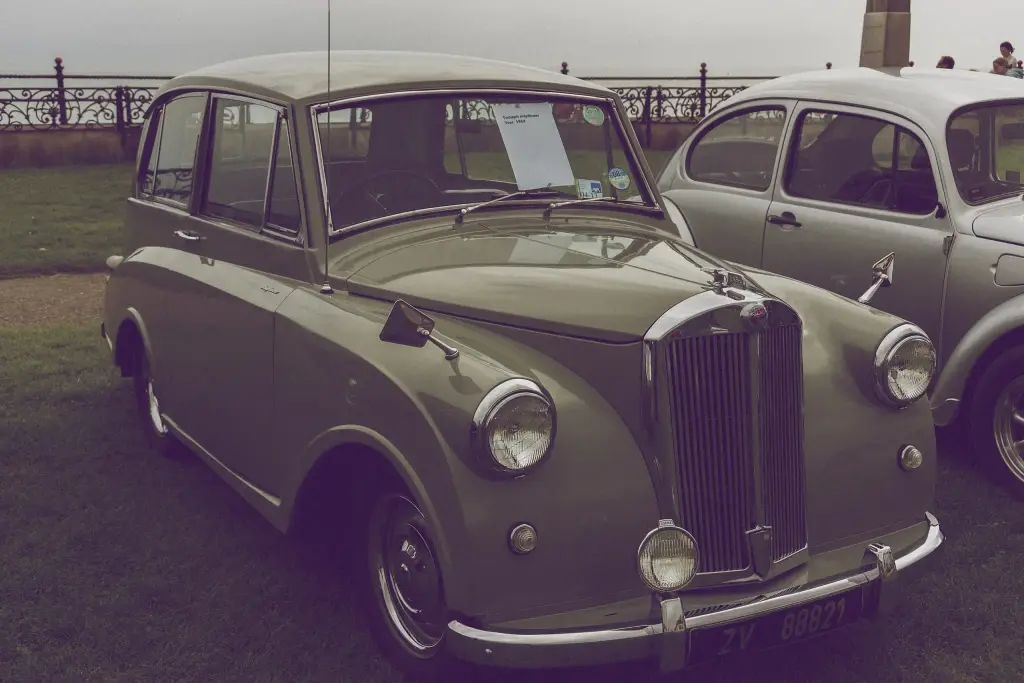
The Triumph Mayflower was a small, upmarket family car built by the Standard Motor Company from 1949 to 1953 and sold under the Triumph name. Its razor-edge styling echoed the bigger Renown, but the market did not respond and sales fell short of expectations.
Triumph Mayflower at a glance
| Maker | Standard Motor Company / Triumph |
|---|---|
| Production | 1949–1953 |
| Announced | October 1949 British International Motor Show |
| Deliveries | from the middle of 1950 |
| Body | four-seat saloon, unitary construction |
| Engine | 1247 cc side-valve four, 38 bhp at 4200 rpm |
| Carburettor | single Solex |
| Gearbox | three-speed, column shift, synchromesh on all gears |
| Suspension | independent front, live axle and leaf springs rear |
| Brakes | Lockheed hydraulic |
| Top speed | 62.9 mph (The Motor, 1950) |
| Price | £505 including taxes |
Based on the English Wikipedia article on the Mayflower.
History of the Triumph Mayflower
1949: a small car with big-car styling
The Mayflower was announced on 28 September 1949 at the Earls Court Motor Show, though deliveries, including CKD kits, only began in the middle of 1950. It used a version of the pre-war Standard Flying Ten side-valve engine updated with an aluminium cylinder head and a single Solex carburettor, giving 38 bhp at 4200 rpm. The three-speed gearbox with column shift came from the Standard Vanguard, with synchromesh on all forward ratios, and there was independent front suspension on coil springs with a live axle and semi-elliptic springs at the rear.
Body and construction
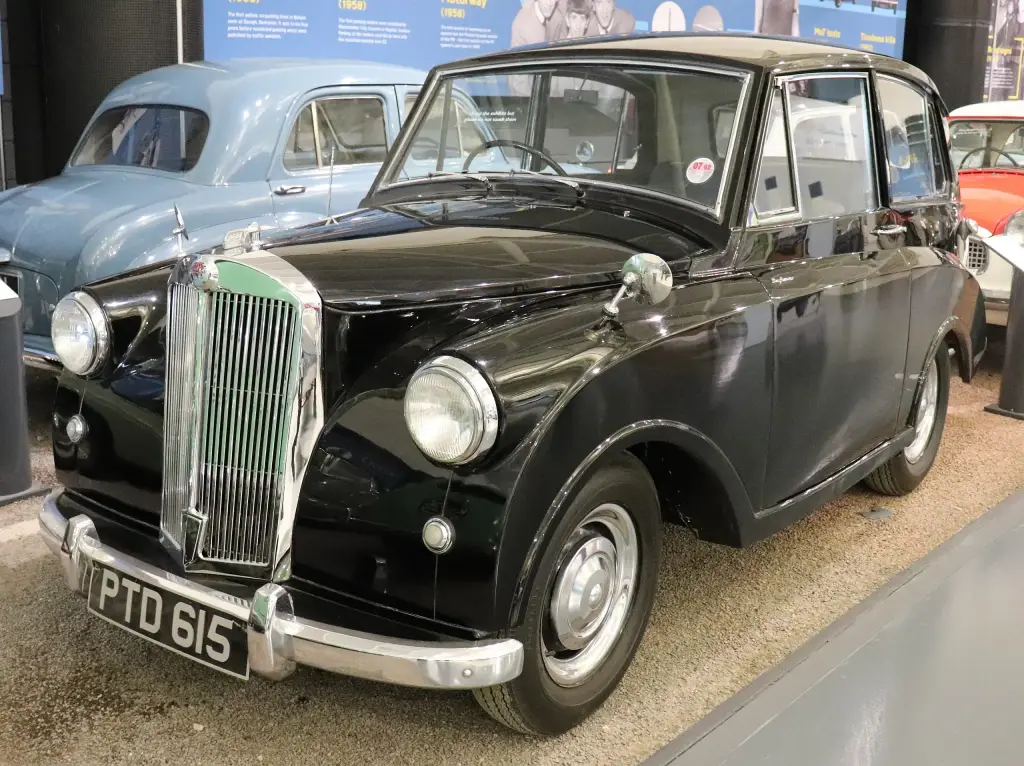
The Mayflower was the first unitary-construction car built by Standard or by the pre-war Triumph company. The body was designed by Leslie Moore of Mulliners of Birmingham with input from Standard’s Walter Belgrove, and the shells were built by Fisher and Ludlow at Castle Bromwich. Styling followed the razor edge of the Triumph Renown, imitating the look still used by Bentley and Rolls-Royce. Standard’s managing director Sir John Black believed that would appeal to American buyers. The upright body seated four in comfort despite the small size, although the rear seat was cramped by the axle. Ten drophead coupés were built in 1950, and Standard’s Australian plant made 150 coupé utility versions.
Performance and price
A Mayflower tested by The Motor at Brooklands in 1950 reached 62.9 mph and took 26.6 seconds to 50 mph, with 28.3 mpg. The test car cost £505 including taxes — far above the £382 Morris Minor — and in the United States it was priced at $1,750, more than a basic two-door Chevrolet. Despite the modest performance, testers including Tom McCahill of Mechanix Illustrated and Autocar were impressed by the car.
1953: the end
The upmarket small-car idea did not find a ready market, and Standard announced the Mayflower’s replacement in early 1952. The Standard Eight that followed in 1953 was a basic economy car aimed at a different buyer, and from the end of Mayflower production until the Herald of 1959 there was no small Triumph saloon in Britain. The Mayflower’s front suspension was used on the Triumph 20TS prototype and, modified, on the TR2. The car also appears in John Brack’s well-known painting The Car.
Design and features
- Razor-edge styling — a scaled-down Renown look intended to appeal to American buyers.
- Unitary construction — the first such car from Standard or Triumph.
- Vanguard drivetrain — three-speed column-change gearbox with synchromesh on all gears.
- Influence on the TR2 — its front suspension was developed for the TR2.
Triumph Mayflower versions
- Mayflower saloon (1949–1953): the standard four-seat car.
- Drophead coupé: ten built in 1950.
- Australian utility: 150 coupé utility versions built from CKD kits.
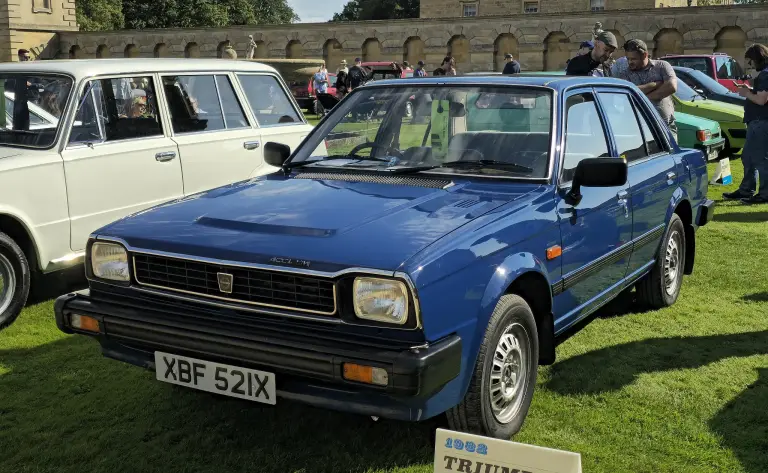
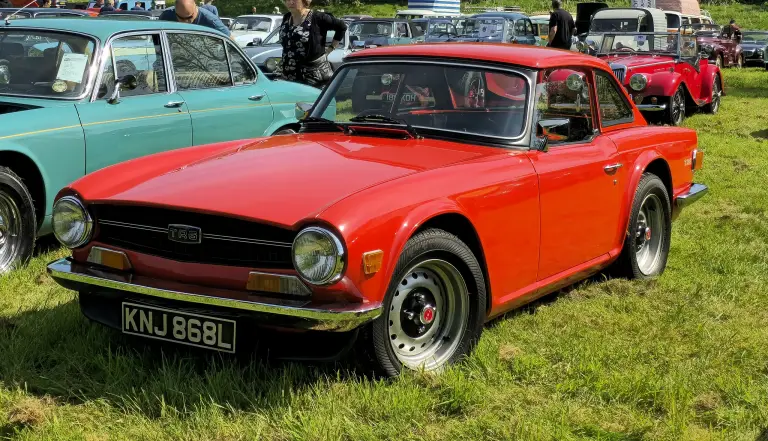
The Mayflower’s styling followed the bigger Renown, and its front suspension fed into the TR2. More in the Triumph collection.
Sources
- Triumph Mayflower, English Wikipedia: design, engineering, performance, pricing, legacy