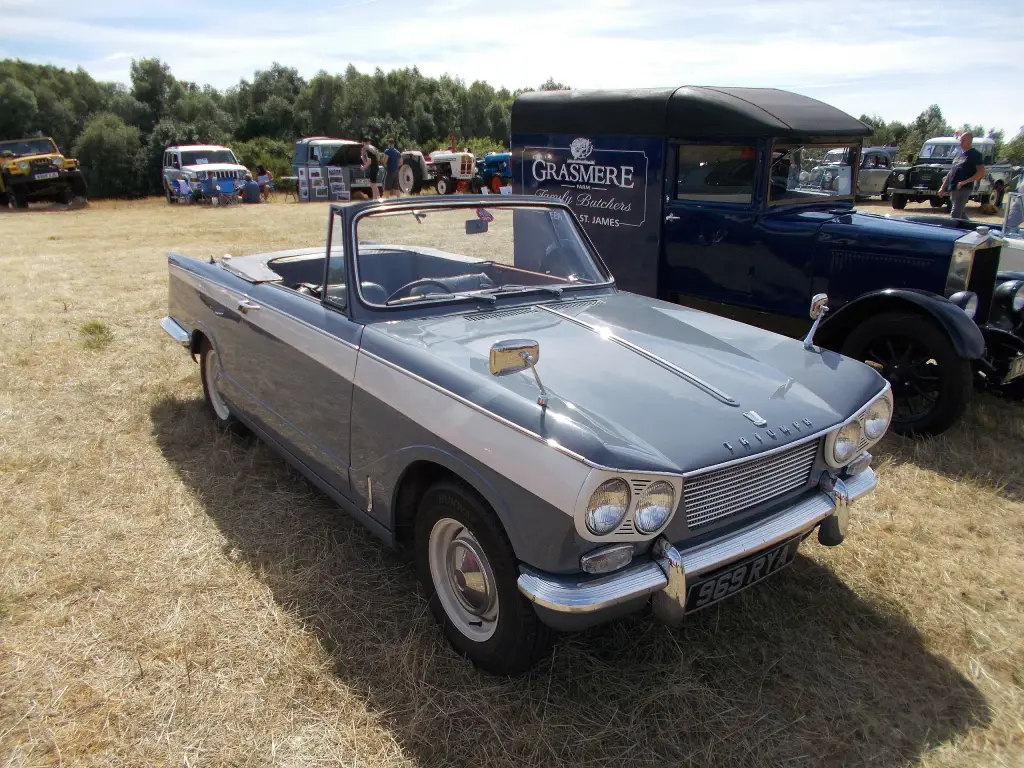
The Triumph Vitesse was a compact six-cylinder car built by Standard-Triumph from 1962 to 1971. Based on the Michelotti-styled Herald, it came as a saloon or convertible and brought a small six to a car designed around a four.
Triumph Vitesse at a glance
| Maker | Standard-Triumph, Coventry |
|---|---|
| Production | 1962–1971 |
| Introduced | 25 May 1962 |
| Bodies | saloon and convertible on the Herald chassis |
| Styling | Michelotti, with a four-headlamp front |
| Engine | 1596 cc straight-six, 70 bhp at 5000 rpm |
| Torque | 125 Nm |
| Carburettors | twin Solex, then twin Stromberg CD150 from 1965 |
| Gearbox | four-speed with optional overdrive |
| Top speed | 91 mph after the 1965 update |
| Later models | 2.0-litre from 1966, Mk2 from 1968 |
Based on the English Wikipedia article on the Vitesse.
History of the Triumph Vitesse
1962: a six in a Herald
The Vitesse was introduced on 25 May 1962 and reused a name that the pre-war Triumph company had used from 1936 to 1938. Its engine was a six-cylinder performance version of the Triumph Herald small saloon, which had appeared in 1959 as a two-door car styled by Giovanni Michelotti. Within two years Triumph began thinking about a sports saloon based on the Herald with its six-cylinder engine, and Michelotti was asked to style it; he used almost every Herald body panel but gave the car a new front with a slanted four-headlamp design.
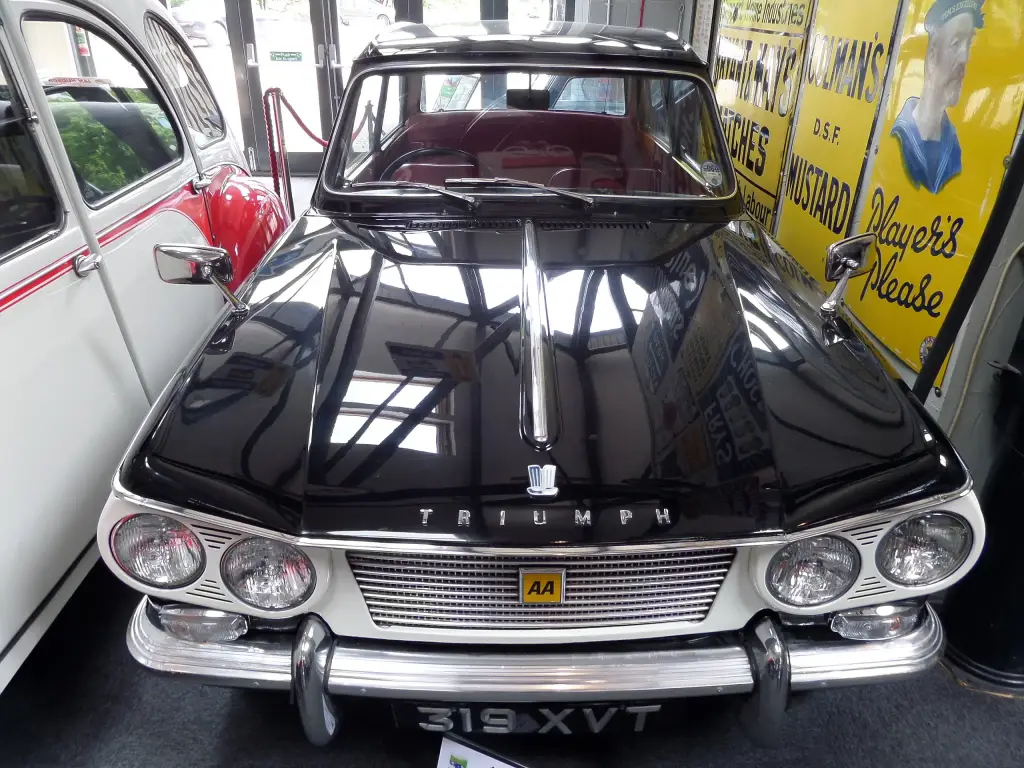
Engine and chassis
Standard-Triumph fitted a 1596 cc version of its traditional straight-six, derived from the Standard Vanguard Six engine but with a smaller 66.75 mm bore against the Vanguard’s 74.7 mm, and twin Solex carburettors, soon replaced because of trouble with their accelerator pumps. The gearbox was strengthened and given closer ratios, with an optional Laycock de Normanville D-type overdrive giving a 20 per cent taller top gear, marked by a chrome Overdrive badge on the boot lid. There was synchromesh on second, third and fourth. The rear axle kept the Herald’s 4.11:1 ratio, front disc brakes and larger rear drums were standard, the fuel tank was larger but kept the reserve tap, and the front springs were uprated for the heavier engine. The chassis looked like the early Herald’s but was substantially redesigned and strengthened around the differential mountings, improvements that were passed on to Herald production.
Equipment and the 1965 update
The Vitesse had a better interior than the Herald, with wooden door cappings to match the dashboard, better seats and trim, and satin-silver bumper capping in place of the Herald’s white rubber items. Saloons could be ordered with a Britax Weathershield sunroof. In September 1963 the dashboard was revised with a full set of Smith instruments. From September 1965, at commission number HB27986, the twin Solex carburettors gave way to twin Stromberg CD150s; power rose from 70 bhp at 5000 rpm and 125 Nm, and the tested top speed climbed to 91 mph, with 0–80 mph falling from 46.6 to 33.6 seconds. The Vitesse 6 sold extremely well and was the most popular Vitesse of the model’s life, praised for performance, economy, interior and a tight turning circle.
2-litre and Mk2
A 2.0-litre version arrived in 1966 and was improved in 1968, when it was sold as the Mk2. The name then lay unused until 1982, when Rover applied Vitesse to sporting versions of the SD1, the 216 and finally the Rover 800 until 1998. About a dozen estates were built to special order at Standard-Triumph’s Service Depot at Park Royal, although there was never an official estate; a coupé never got beyond the prototype stage.
Design and features
- Six-cylinder Herald — a 1596 cc straight-six in the small Michelotti body.
- Four-headlamp front — the Vitesse’s own face on otherwise Herald panels.
- Overdrive — an optional D-type unit giving 20 per cent taller top gear.
- Strengthened chassis — redesigned around the differential and passed on to the Herald.
Triumph Vitesse versions
- Vitesse 6 (1962–1966): 1596 cc, 70 bhp, twin Solex then Stromberg carburettors.
- Vitesse 2-litre (1966–1968): the larger engine.
- Vitesse Mk2 (1968–1971): the final development.
- Conversions: about a dozen estates built to order at Park Royal.
The Vitesse was built on the Herald and shared its chassis family with the Spitfire and GT6. More in the Triumph collection.
Sources
- Triumph Vitesse, English Wikipedia: launch, engine, chassis, 1965 update, later models