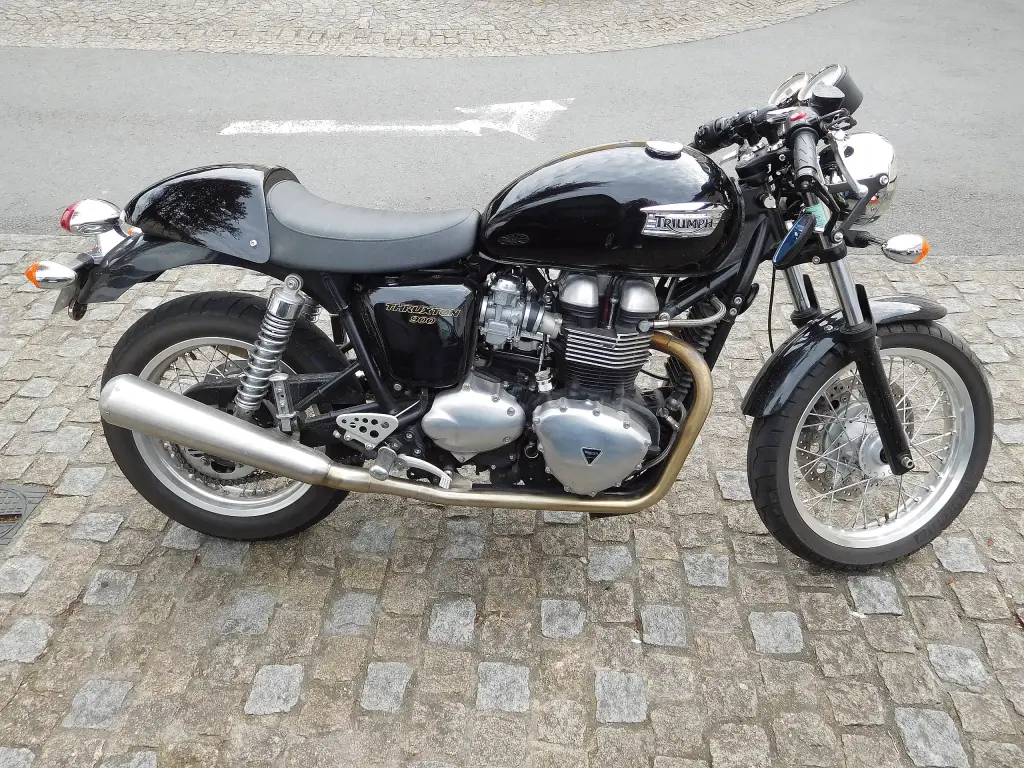
The Triumph Thruxton is a name used for British parallel twins with sports styling. It first appeared on a hand-built endurance racer of the mid-1960s, was revived on the Thruxton 900 in 2004, and since 2016 has meant a pair of 1200 cc café racers.
Triumph Thruxton at a glance
| Name from | Thruxton Circuit, Hampshire |
|---|---|
| Why | Triumph took the top three places in the 1969 Thruxton 500 |
| First model | Thruxton Bonneville, 1965, built at Meriden |
| Numbers | 52 tuned Thruxton Bonnies from May 1965 |
| Revival | Thruxton 900, 2004 |
| 900 engine | 865 cc, 70 bhp |
| 1200 models | Thruxton and Thruxton R, 2016 |
| Top speed, original | over 140 mph |
| Top speed, 900 | about 120 mph |
Based on the English Wikipedia article on the Thruxton.
History of the Triumph Thruxton
1965: the Thruxton Bonneville
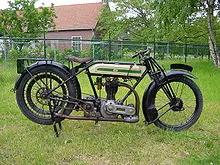
The first bike to use the name was the Thruxton Bonneville, a limited-edition production-class racer hand-built in 1965 by the Triumph Engineering factory race shop at Meriden, based on the Bonneville T120. It was developed for homologation and raced in British endurance events by local agents. From May 1965 Triumph built 52 tuned Thruxton Bonnies to homologate the type for production racing, and the original was capable of more than 140 mph. The name comes from Thruxton Circuit in Hampshire, where Triumph won the top three places in the 1969 Thruxton 500 mile endurance race.
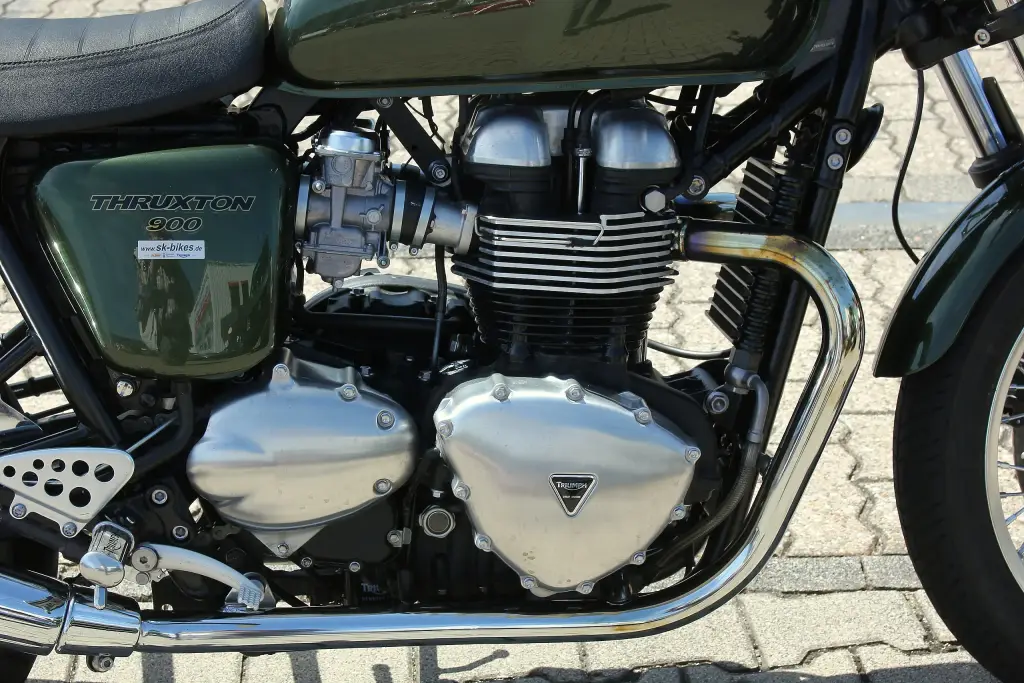
2004: the Thruxton 900
The reborn Hinckley factory adopted the name in 2004 for the Thruxton 900, an air-cooled 360-degree twin derived from the Bonneville with café-racer modifications: rearset footrests, a small flyscreen, analogue instruments, reverse-cone silencers and a seat cowl. Carburetted 900s were built at Hinckley between 2004 and 2008. The engine was upgraded from the Bonneville of the same year with new camshafts and pistons increased to 90 mm, taking capacity to 865 cc and power to 70 bhp. The frame was a tubular steel cradle with a twin-sided swingarm and traditional spoked wheels, 36-spoke 18 x 2.5 inch at the front and 40-spoke 17 x 3.5 inch at the rear. Front suspension used 41 mm forks with adjustable preload, the rear chrome-spring twin shocks were also adjustable, and the brakes were a single 320 mm floating front disc and a 255 mm rear disc with twin-piston callipers.
2016: the 1200s
In 2016 the 900 was replaced by two 270-degree 1200 cc water-cooled café racers, the Thruxton and the Thruxton R. The standard 1200 has conventional cartridge forks and fixed discs, while the R gets Öhlins rear suspension, Showa upside-down big-piston forks and Brembo radial front callipers with floating discs. Both have traction control, ABS and ride-by-wire throttles with sport, road and rain modes. At a similar weight to the 900 but with 42 per cent more power the 1200 has a much better power-to-weight ratio, although at over 200 kg dry neither is light. The modern Thruxtons and Bonnevilles are softer than the original, and the Thruxton 900 manages about 120 mph against the original’s 140-plus. Both 900 and 1200 models are built at John Bloor’s Chonburi plant.
Design and features
- Homologation racer — 52 hand-built Thruxton Bonnies from May 1965.
- Café-racer kit — rearsets, flyscreen, reverse-cone silencers and a seat cowl on the 900.
- 865 cc twin — new cams and 90 mm pistons for 70 bhp.
- Thruxton R — Öhlins, Showa big-piston forks and Brembo radial brakes.
Triumph Thruxton versions
- Thruxton Bonneville (1965): the original hand-built racer.
- Thruxton 900 (2004–2015): carburetted then injected café racer.
- Thruxton 1200 (2016–): water-cooled 270-degree twin.
- Thruxton R (2016–): uprated suspension and brakes.
The Thruxton is part of the Bonneville family, with the Scrambler and Speedmaster. More in the Triumph collection.
Sources
- Triumph Thruxton, English Wikipedia: 1965 racer, Thruxton 900, Thruxton 1200