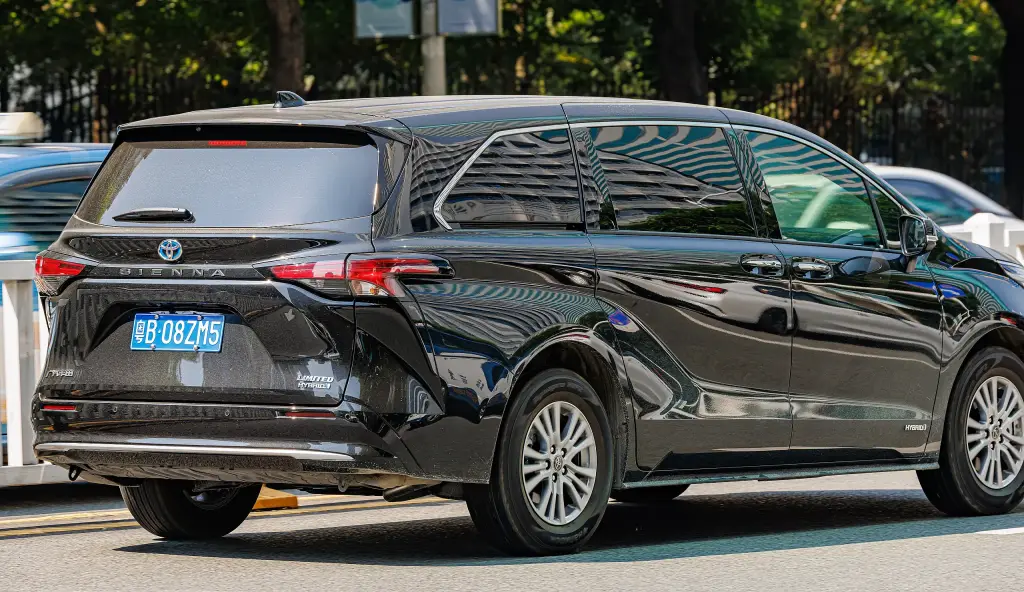
The Toyota Sienna is a minivan built mainly for the North American market and named after the Italian city of Siena. It replaced the mid-engined Previa and the Camry estate for 1998 with a conventional front-wheel-drive layout on a heavily revised Camry platform, and it was marketed as the “Camry of minivans”.
Toyota Sienna at a glance
| Maker | Toyota |
|---|---|
| Production | Since 1997 |
| Market | North America, with exports to some Asian and European markets |
| Class | Minivan |
| First generation | XL10, 1998 model year |
| Platform | Extended Toyota Camry platform |
| Engines | 3.0-litre V6, later 3.3-litre V6 and a hybrid |
| Seats | Seven or eight |
| Drive | Front-wheel drive, all-wheel drive available |
| Built in | Georgetown, Kentucky, then Indiana, then Texas |
| Name | The Italian city of Siena |
Based on one source: the English Wikipedia article on the Toyota Sienna.
History of the Toyota Sienna
First generation (XL10; 1998)
The front-wheel-drive Sienna went on sale in 1997 for the 1998 model year with a 3.0-litre 1MZ-FE V6 of 194 hp and 284 N·m, built on an extended XV20 Camry platform at Georgetown, Kentucky. It came in CE, LE and XLE trims; the LE and XLE had second-row captain’s chairs while the CE used a two-passenger bench, and all seats could be folded or removed. The driver-side sliding door and roof rack were standard on the XLE and optional elsewhere, and the XLE offered leather and wood trim. Fuel economy was best in class at 16 mpg city and 22 highway. It was one of the few minivans of the time to offer front side torso airbags and stability control, with ABS standard, and the Insurance Institute for Highway Safety rated it Good in all six frontal measures. A 2001 facelift brought VVT-i, raising output to 210 hp, and made the driver-side sliding door standard. The first generation was also affected by a class-action settlement over engine oil sludge in Toyota V6 engines.
Second generation (XL20; 2003)
Unveiled at the Detroit auto show on 6 January 2003, the second-generation Sienna moved production to Indiana. Chief engineer Yuji Yokoya and his family drove the previous model more than 85,000 km across North America to find its weaknesses. The new car had 45 per cent more volume and 39 per cent more cargo space, 60/40 split seats and a flat-folding third row that could be ordered even with all-wheel drive. It used an updated ULEV-certified 3.3-litre 3MZ-FE V6 with a five-speed automatic, and the gear lever moved from the steering column to a gated centre console. Eight seats were optional on lower trims, and the flat-folding third row allowed the van to carry 4 by 8 foot building materials.
Later generations
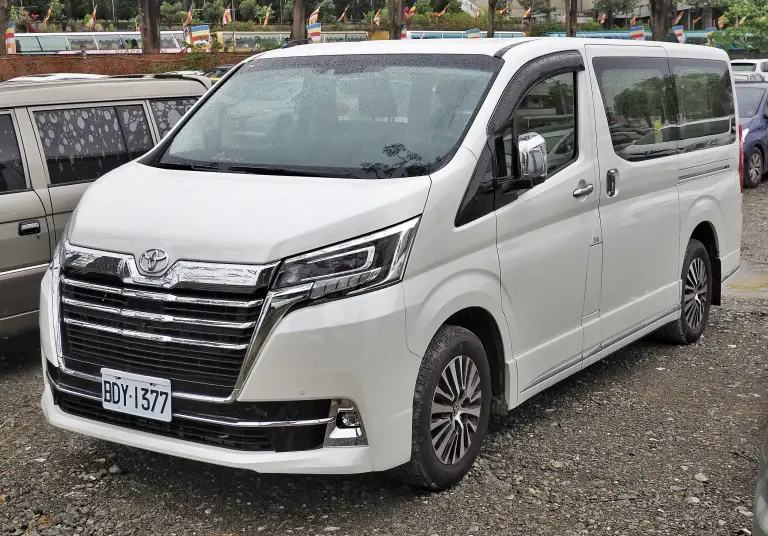
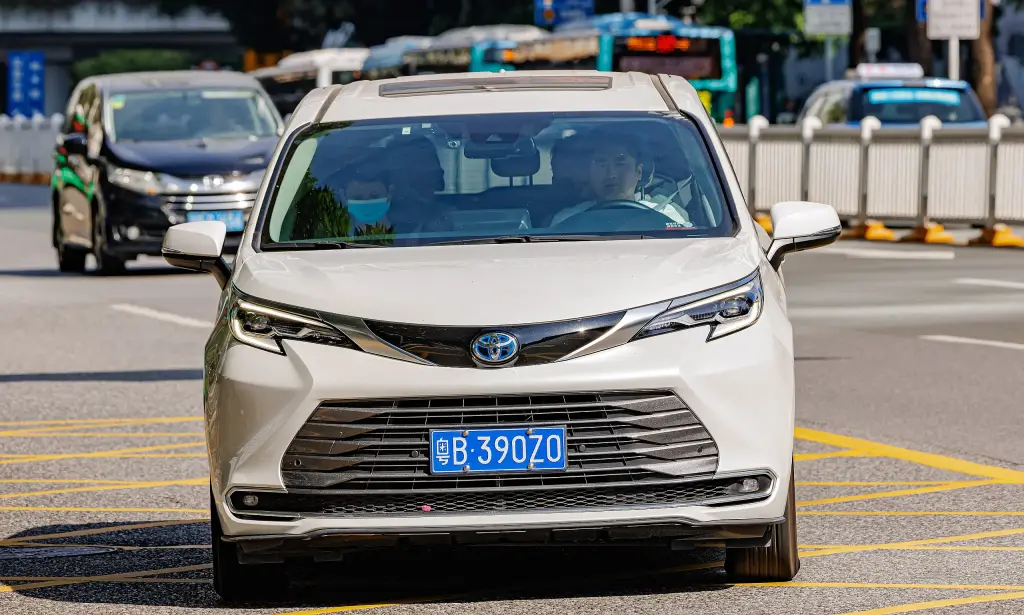
A 2010 redesign for the 2011 model year brought the third generation, which was the first Sienna to win a Top Safety Pick award from the Insurance Institute for Highway Safety. The 2020 redesign made the fourth generation a hybrid only, and it was the first Sienna produced outside the United States, with Chinese production starting in July 2021 through two Toyota joint ventures; in China it is also sold as the Toyota Granvia. After General Motors stopped building all-wheel-drive minivans in 2006, the Sienna was the only minivan in its class with all-wheel drive in North America until the 2021 Chrysler Pacifica offered one in 2020. The Sienna is not built in right-hand drive and is not sold in right-hand-drive markets, where the Alphard, Vellfire and HiAce take its place.
Design and features
- Camry base: the extended Camry platform and V6 made it the “Camry of minivans”.
- All-wheel drive: long the only minivan in its class with four driven wheels.
- Flat-folding third row: available even with all-wheel drive from 2003.
- Hybrid fourth generation: from 2020, built in China as well as the United States.
Toyota Sienna versions
- XL10 (1998): CE, LE and XLE trims with the 3.0-litre V6.
- 2001 facelift: VVT-i engine of 210 hp and a standard driver-side sliding door.
- XL20 (2003): larger body with a 3.3-litre V6 and five-speed automatic.
- Third generation (2010): first Sienna with a Top Safety Pick award.
- Fourth generation (2020): hybrid only, also built in China as the Granvia.
The Sienna replaced the Previa and shares its platform thinking with the Camry; in China the fourth generation is also sold as the Granvia. More cars are in the Toyota collection.
Sources
- Toyota Sienna, English Wikipedia: generations, engines, markets