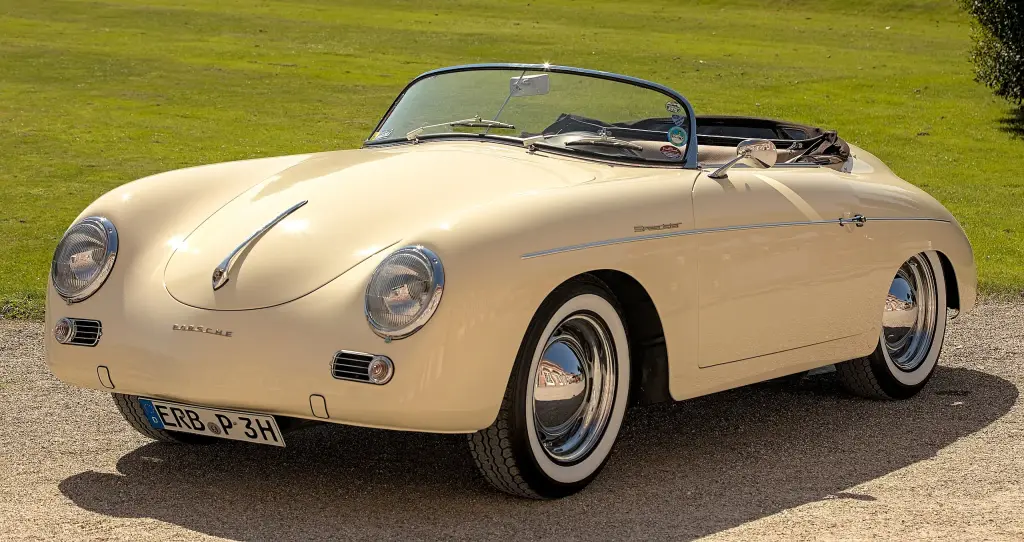
The Porsche 356 is a rear-engine sports car and the first production model to carry the Porsche name. About 76,000 were built between 1948 and 1965, as hardtop coupés and as open cars, and roughly half are said to survive.
Porsche 356 at a glance
| Maker | Porsche (Porsche Konstruktionen GesmbH in Austria 1948–1949, then Dr. Ing. h. c. F. Porsche GmbH) |
|---|---|
| Production | 1948 to April 1965 |
| Built at | Gmünd, Austria (about 50 cars, from 1948); Zuffenhausen, Germany (from 1950) |
| Total built | about 76,000 (the German Wikipedia gives 76,302) |
| Layout | rear-engine, rear-wheel drive, two-door |
| Engine | four-cylinder, air-cooled boxer |
| Body styles | coupé, cabriolet, Speedster (from 1954) |
| Body designer | Erwin Komenda |
| Series | 356 (pre-A), 356 A, 356 B, 356 C |
| Price in 1948 | US$3,750 for the coupé, US$4,250 for the cabriolet |
| Successor | 911 (September 1964); the 912 took over the entry-level role from April 1965 |
Figures come from the English, German and Italian Wikipedia pages listed under Sources. The 1948 prices are those stated on the English page.
History of the Porsche 356
From Gmünd to Zuffenhausen
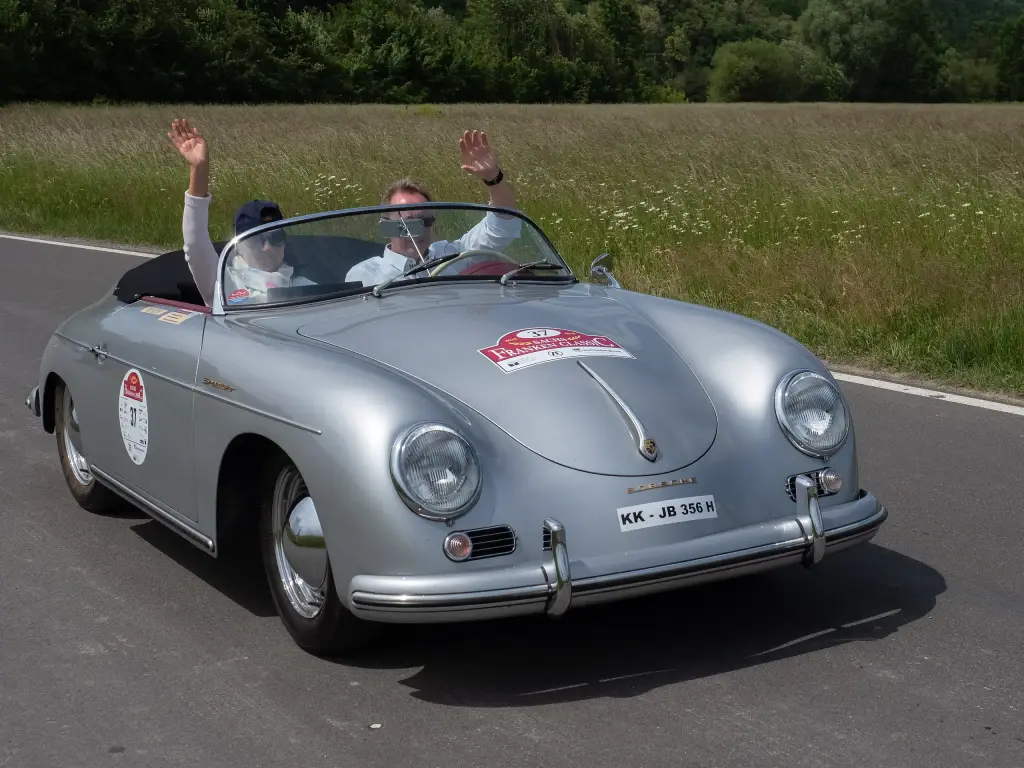
Ferry Porsche, son of company founder Ferdinand Porsche, created the 356. The first prototype, the mid-engine 356/1, was finished in 1948, and the first 356 was road-certified in Austria on 8 June 1948 and won its class in a race at Innsbruck. The production car moved the engine to the rear. Its chassis was new, the body was designed by Erwin Komenda, and some mechanical parts, such as the engine case and suspension components, were based on Volkswagen parts.
Porsche hand-built the first bodies in aluminium at Gmünd; about 50 cars were made there. In 1950 production moved to Zuffenhausen in Germany, where the bodies were steel and built by Reutter, a company Porsche eventually bought in 1963. The Reutter seat-making business was kept apart and renamed Recaro.
Four series
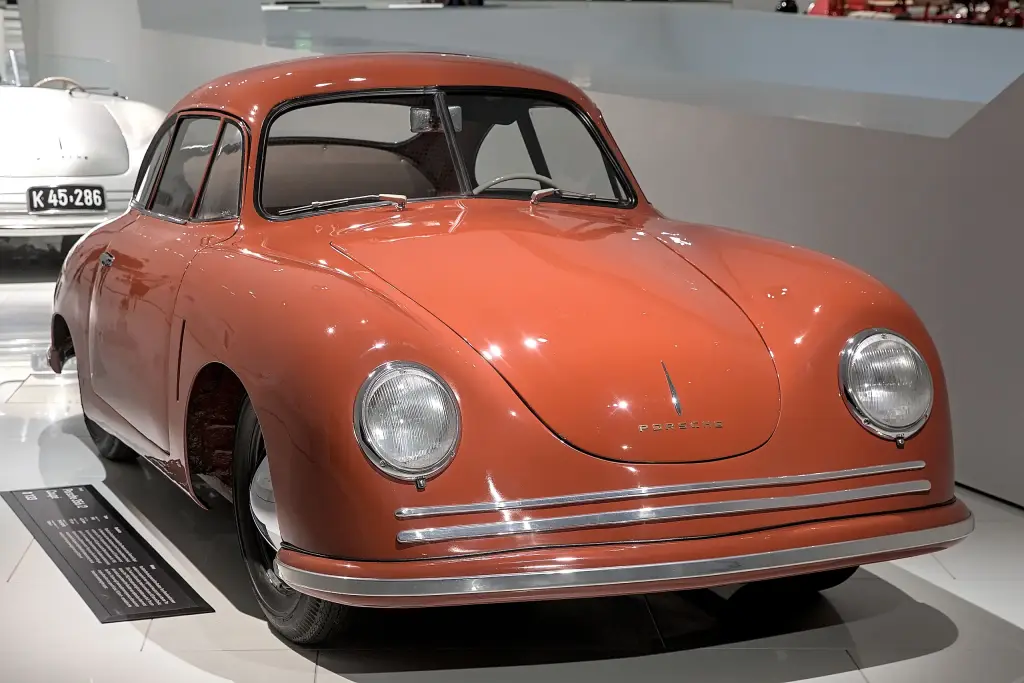
The 356 was built in four series: the original, known as the pre-A, then the 356 A (late 1955, with a curved windscreen), the 356 B (late 1959) and the 356 C, which was little changed from the late B but had disc brakes instead of drums. Coupés and cabriolets up to 1955 are recognised by a split windscreen (1948–1952) or a bent, centre-creased one (1953–1955). The four-cam Carrera engine arrived in late 1954 and became an option on the 356 A.
The Speedster
In late 1954 the US importer Max Hoffman persuaded Porsche to build a stripped-down open version with minimal equipment and a cut-down windscreen. This was the Speedster. According to the German Wikipedia it had a flat windscreen, a lower fully retractable top, side screens in place of wind-up windows and bucket seats, and sold in the US for US$2,995 in 1954. Production of the Speedster peaked at 1,171 cars in 1957 and then declined. Replicas of the 356 A have also become very popular in the last 25 years, which is worth remembering when you see a Speedster at a roadside: not every one is an original.
The end of the line
Production ran until April 1965, after the 911 had already appeared in September 1964. Porsche had meanwhile developed the 912, which used a 356-derived four-cylinder engine in a 911 body; nearly 33,000 were sold.
Design and features
- Rear engine, air cooling: a four-cylinder boxer behind the rear axle, with no radiator and no front air intake to spoil the shape.
- Light and low: a unitised pan and body construction, and handling praised from the early 1950s.
- Racing record: a class win at Le Mans in 1951 helped build the car’s reputation, and many owners raced them as well as drove them on the road.
- Typical 356 A engine: 1,582 cc, 60 PS at 4,500 rpm.
Porsche 356 versions
- Pre-A (1948–1955): split or bent windscreen; 1,100 cc engine at first, then 1,300 and 1,500 cc from 1951.
- 356 A (1955–1959): curved windscreen; coupé, cabriolet and Speedster, with the Carrera engine as an option.
- 356 B (1959–1963): restyled, with the T6 series from 1962.
- 356 C (1963–1965): disc brakes.
- Speedster and Convertible D: the stripped-down Speedster, then the Convertible D, whose “D” refers to the coachbuilder Drautz (Italian Wikipedia).
More Porsches are in our Porsche collection, for example the Speedster, the later 356 C and 356 SC, and the racing 550.
Porsche 356 questions and answers
Was the 356 the first Porsche?
Yes. It was the first production Porsche; the earlier 356/1 prototype was a one-off mid-engine roadster.
What is a Porsche Speedster?
A stripped-down open 356 introduced in late 1954 at the request of US importer Max Hoffman, with a cut-down windscreen and minimal equipment.
How many 356s were built?
About 76,000 between 1948 and 1965; the German Wikipedia gives 76,302.
What replaced the 356?
The 911, introduced in September 1964, with the four-cylinder 912 as the cheaper car from 1965.
Are all Speedsters original?
No. Replicas of the 356 A have become very popular, so condition and documents matter.
Sources
- Porsche 356, English Wikipedia: history, series, Speedster, production
- Porsche 356, German Wikipedia: production total, Speedster details
- Porsche 356, Italian Wikipedia: Convertible D and development