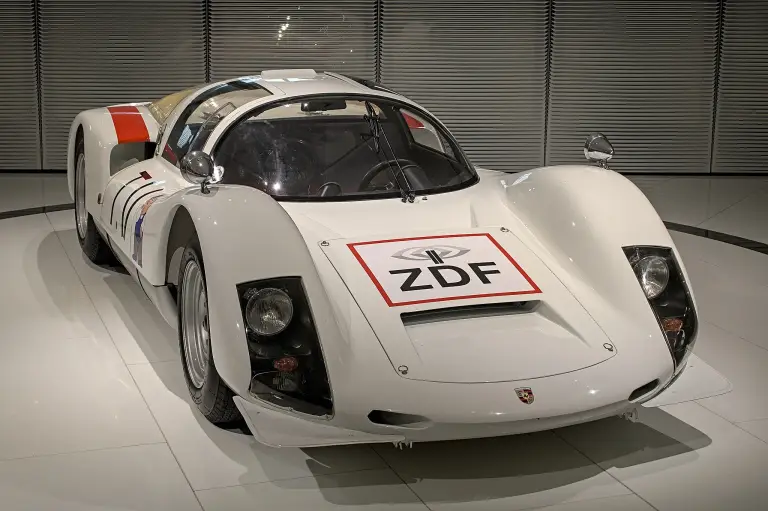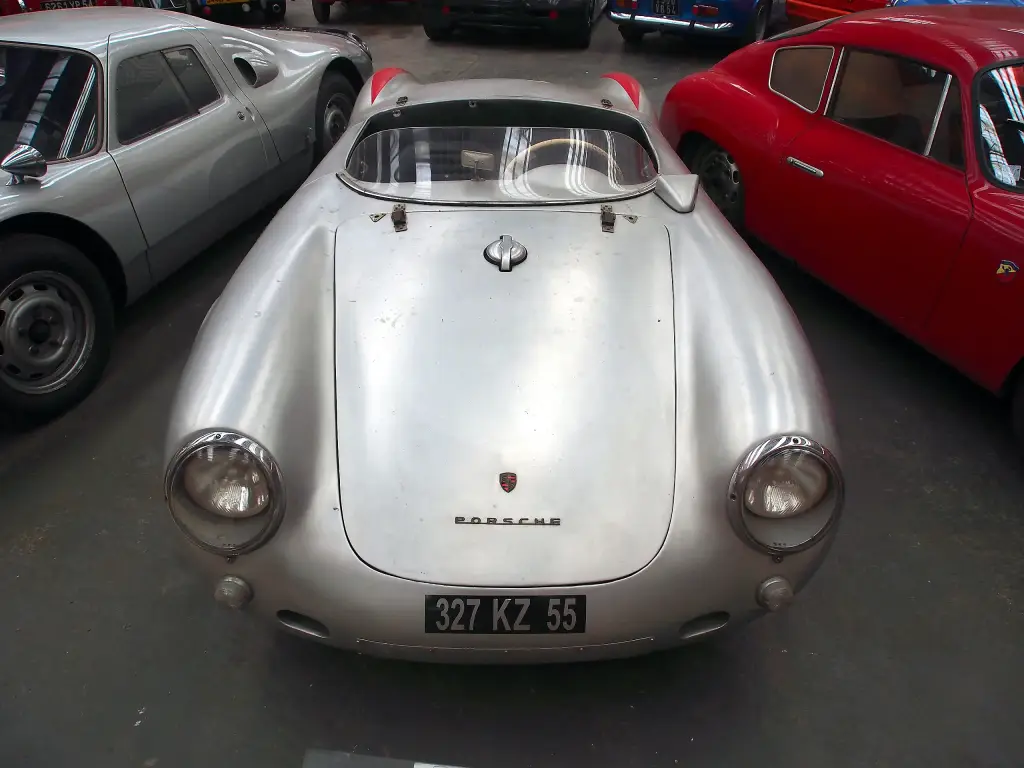
The Porsche 550 is a racing sports car built from 1953 until 1956. Only 90 were produced, and they quickly dominated the 1.1- and 1.5-litre classes. Its mid-engined layout, air-cooled four-cylinder engine and low body established the shape of Porsche’s racing cars for the next decade.
Porsche 550 at a glance
| Maker | Porsche, Stuttgart |
|---|---|
| Production | 1953–1956 |
| Built | 90 |
| Engine | 1,498 cc air-cooled flat-four, Type 547 “Fuhrmann” |
| Valvetrain | double overhead camshaft per bank, two valves per cylinder |
| Power | 110 PS at 6,200 rpm in the first version |
| Torque | 121 N·m at 5,000 rpm |
| Carburettors | twin two-barrel Solex 40 PII, dual ignition |
| Gearbox | four-speed fully synchronised; five-speed from 1956 |
| Layout | rear mid-engine, rear-wheel drive |
| Differential | limited slip |
| Debut | Paris Auto Show, 1953 |
History of the Porsche 550
The 550 followed the idea of the 1948 Porsche 356/1 prototype, which had its engine in the middle, and of the Spyder specials that Walter Glöckler raced from 1951. The factory decided to build a mid-engined car for racing, and the Porsche 550 Spyder was shown at the 1953 Paris Auto Show. The first three hand-built prototypes came as coupés with a removable hardtop; the first of them, 550-03, raced as a roadster at the Nürburgring Eifel Race in May 1953 and won on its first outing.
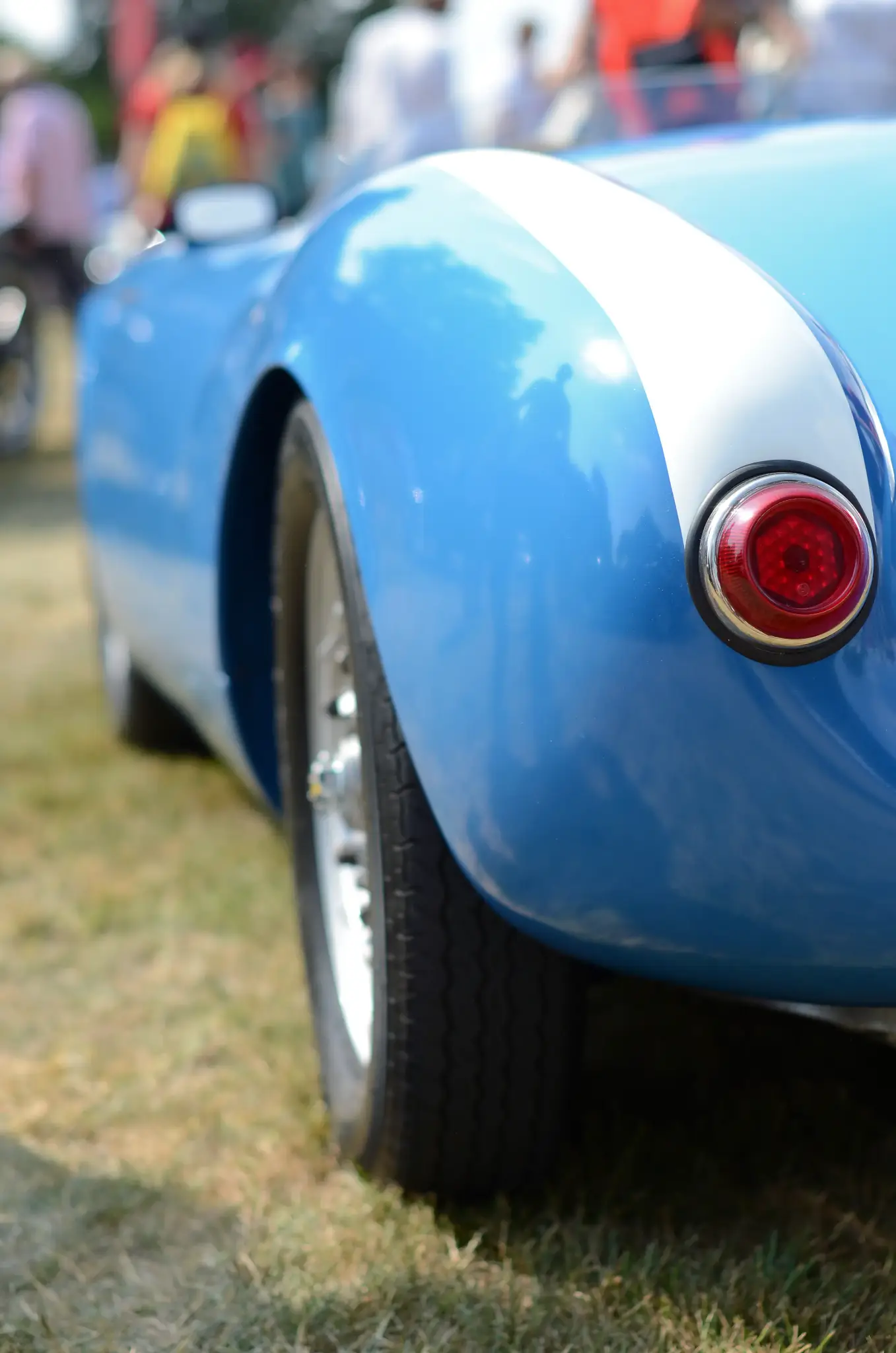
Under the skin sat the Type 547 engine, known as the Fuhrmann engine after its designer Ernst Fuhrmann: an all-aluminium, naturally aspirated air-cooled flat-four with double overhead camshafts driven by vertical shafts and two valves per cylinder. Most 547s in the 550s had an 85 mm bore and a 66 mm stroke, for 1,498 cc. Twin Solex carburettors and dual ignition helped it produce 110 PS at 6,200 rpm. The engine sat in front of the rear axle, which gave a balanced weight distribution and largely neutral handling, though the low moment of inertia about the vertical axis could make the car spin suddenly.
The first cars had a fully synchronised four-speed gearbox; from 1956 a five-speed was used, with an unsynchronised first gear reserved for starts. A limited-slip differential limited wheelspin out of corners, and the whole car was built very low to the ground for racing.
The racing record came quickly. In 1953, its first season, the 550 took class wins at the 24 Hours of Le Mans and in the Carrera Panamericana, a result later commemorated by the Carrera name on Porsche road cars. From 1953 to 1957 the works team raced the 550 with great success; the silver cars carried coloured spears on the rear wings so the pits could tell them apart, and Hans Herrmann’s red-tailed number 41 was especially famous. The 1.5-litre 550 was beaten in its class at Le Mans only twice: an OSCA MT4 finished ahead in 1954 but was disqualified, and a 1.1-litre Lotus Eleven trailed the winning 550 by a lap in 1957.
For 1956 came the 550A, with a lighter and more rigid spaceframe chassis; it gave Porsche its first overall win in a major sports car race, the 1956 Targa Florio. Privateers kept the type racing after the works team moved to the 718 in 1957, often driving the car to the circuit, racing it and driving home. A 1958 550A Spyder sold by Bonhams in 2018 for $5,170,000 remains the highest price paid for a 550 at auction.
Design and features
- Mid-mounted four-cam engine: the Fuhrmann flat-four, the technical heart of the car.
- Very low body: built to slip under the air; at the 1954 Mille Miglia Hans Herrmann drove one under closed railway crossing gates.
- Balanced handling: mid-engine weight distribution, with a limited-slip differential to keep the rear wheels in line.
- Race numbers on gumballs: each Spyder carried its number on doors, nose and tail so it could be read from any angle.
Porsche 550 versions
- 550 coupé prototypes: the first three hand-built cars, with a removable hardtop.
- 550 Spyder: the open customer and works car, the standard form.
- 550A (1956): lighter spaceframe chassis and the Targa Florio overall win.
- 718 (1957): the successor, usually called the RSK.
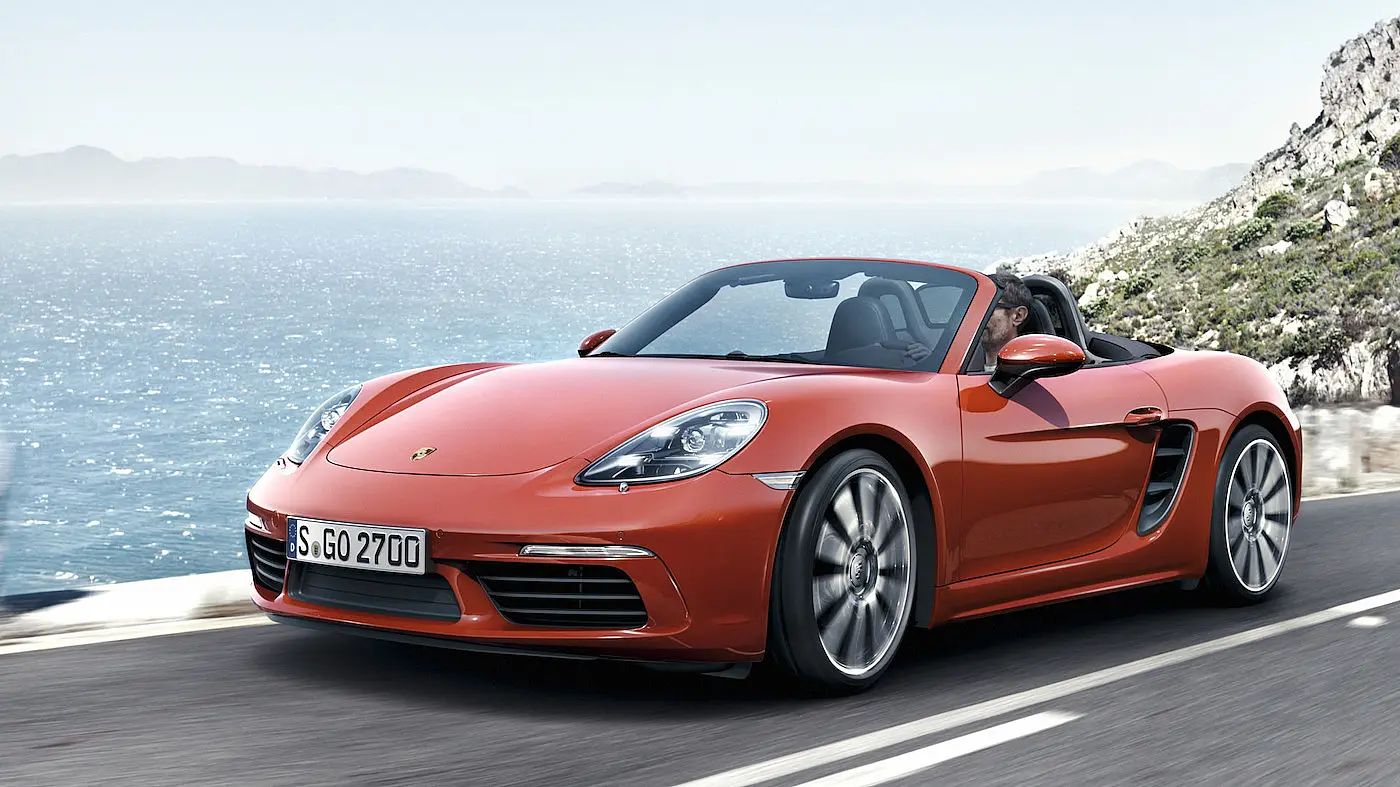
The 550 was developed into the Porsche 718 of 1957, and its name returned on the modern Boxster generation. More cars are in the Porsche collection.
Sources
- Porsche 550, English Wikipedia: engine, production, racing record