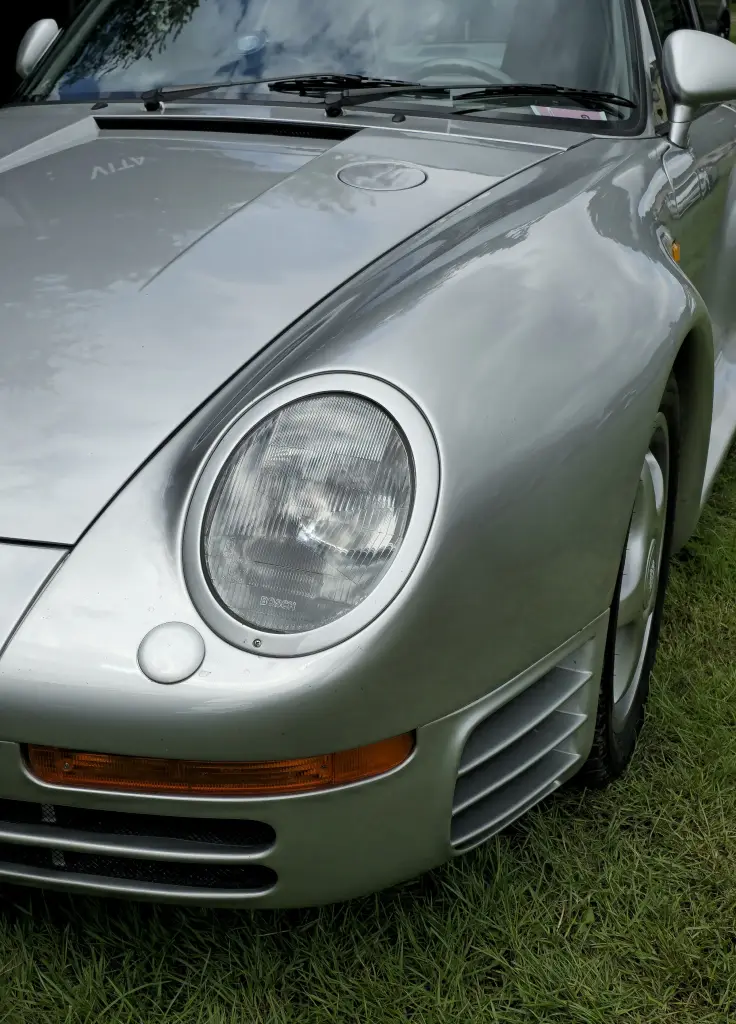
The Porsche 959 is a sports car made from 1986 to 1993, first as a Group B rally car and then as a road-legal production car built to satisfy FIA rules requiring at least 200 units. When it was introduced it was the fastest street-legal production car in the world, with a top speed of 317 km/h.
Porsche 959 at a glance
| Maker | Porsche, assembled by Karosserie Baur |
|---|---|
| Production | 1986–1993 |
| Homologation | Group B, at least 200 cars |
| Engine | 2,849 cc twin-turbo flat-six, four valves per cylinder |
| Bore and stroke | 95 mm × 67 mm |
| Power | 450 PS at 6,500 rpm |
| Torque | 500 N·m at 5,000 rpm |
| Fuel system | Bosch Motronic 2.1 |
| Gearbox | six-speed manual, first gear marked “gelände” |
| Top speed | 317 km/h; up to 339 km/h in testing |
| Drag coefficient | 0.31 |
| Drive | PSK all-wheel drive, up to 80% of power to the rear |
History of the Porsche 959
Development began in 1981, shortly after Peter Schutz became managing director, when chief engineer Helmuth Bott brought him ideas for a new 911. Bott wanted a sports car the company could keep developing for years, and he proposed research into a new all-wheel-drive system. Knowing that a racing programme usually speeds up development, he also won approval to build a competition car for Group B rallying on the basis of the development mule. The car was originally called the Gruppe B.
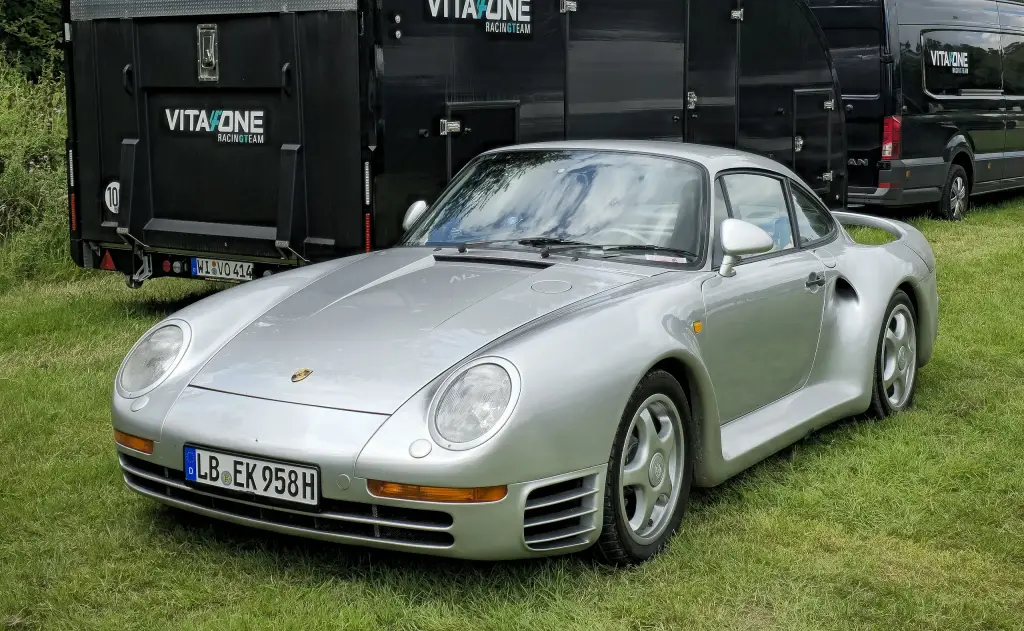
The Group B prototype was unveiled at the 1983 Frankfurt Motor Show, with finishing touches still being applied in the closing hours of 9 October. After the first two prototypes the bodywork gained air vents in the front and rear wheel housings and intake holes behind the doors; the first car so modified, code-named F3, was destroyed in the first crash test.
The engine was a sequential twin-turbocharged double-overhead-camshaft flat-six with four valves per cylinder, Bosch Motronic 2.1 injection, air-cooled cylinders and water-cooled heads. It was largely based on the four-camshaft 24-valve unit of the 956 and 962 racers, and produced 450 PS at 6,500 rpm and 500 N·m at 5,000 rpm. Sequential turbos instead of identical units gave smooth power across the rev range, unlike the abrupt on-off delivery of Porsche’s other turbo engines. The gearbox had six forward speeds, the first marked “gelände” (terrain) so the car could pass noise regulations.
To keep the shell light and strong Porsche used aluminium and Aramid (Kevlar) composite for the body and chassis, with a Nomex floor instead of steel. Aerodynamics were developed for stability, giving a drag coefficient as low as 0.31 with no lift, and the road car had automatic ride-height adjustment. The PSK all-wheel-drive system could shift torque between the rear and front wheels, sending as much as 80% to the rear under hard acceleration and adjusting the bias as grip changed; the dashboard showed rear differential slip and the power sent forward. The magnesium wheels were hollow, forming a sealed chamber continuous with the tyre and carrying a built-in pressure monitoring system.
The road version debuted at the 1985 Frankfurt Motor Show as a 1986 model, but problems delayed production by more than a year. Cars were built at Karosserie Baur rather than at Zuffenhausen, on a line overseen by Porsche inspectors, in two trims, Komfort and Sport. The 959 brought all-wheel drive to a pure high-performance sports car and provided the basis for the 911 Carrera 4, its twin-turbo system passed to later Porsche turbos, and all-wheel drive became standard on turbocharged 911s from the 993. In 2004 Sports Car International named it the best sports car of the 1980s.
Design and features
- PSK all-wheel drive: variable torque split, up to 80% to the rear under acceleration.
- Sequential twin turbos: smooth power delivery from a racing-derived flat-six.
- Aluminium and Kevlar body: light and strong, with a Nomex floor.
- Hollow magnesium wheels: sealed chambers with built-in tyre pressure monitoring.
Porsche 959 versions
- Gruppe B prototype (1983): the rally study shown at Frankfurt.
- 959 Komfort: the better-equipped road trim.
- 959 Sport: the more track-focused trim.
- 961: the racing version with fixed suspension.
The 959 came after the Porsche 953 Dakar car and before the Porsche 964, which took its all-wheel-drive ideas. More cars are in the Porsche collection.
Sources
- Porsche 959, English Wikipedia: development, engine, four-wheel drive, production