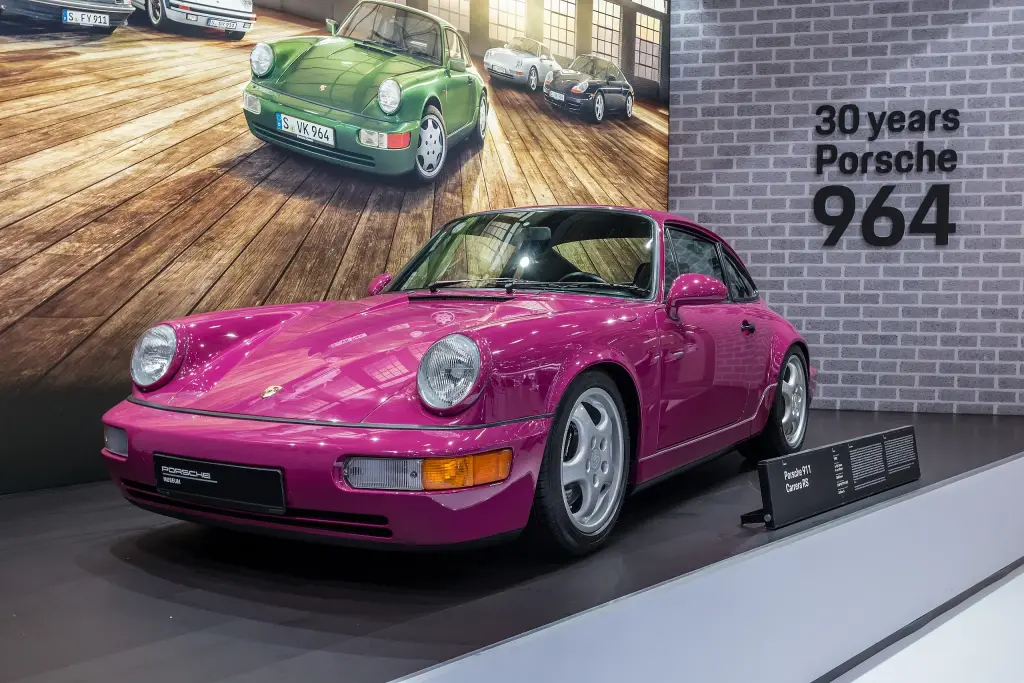
The Porsche 964 is the 911 generation sold between 1989 and 1994, known by its internal code and badged simply as Carrera 2 and Carrera 4. It was 85% new compared with the Carrera 3.2, and it was the first car offered with Porsche’s Tiptronic automatic transmission and all-wheel drive as options.
Porsche 964 at a glance
| Maker | Porsche, Stuttgart |
|---|---|
| Production | 1989–1994 |
| Designer | Benjamin Dimson, design frozen in January 1986 |
| Badged | Carrera 2 and Carrera 4 |
| Engine | 3.6-litre M64 air/oil-cooled flat-six, dry sump |
| Bore and stroke | 100 mm × 76.4 mm |
| Power | 250 PS at 6,100 rpm |
| Torque | 310 N·m at 4,800 rpm |
| Compression | 11.3:1 |
| Suspension | coil springs instead of torsion bars; MacPherson front, semi-trailing rear |
| Top speed | 260 km/h |
| New for the 911 | power steering, ABS, Tiptronic, all-wheel drive |
History of the Porsche 964
The 964 was designed by Benjamin Dimson, with the design frozen in January 1986, and it brought significant styling changes, most prominently bumpers that were integrated into the body and fog lamps flush with the surface for better aerodynamics. A new electric rear spoiler rose above 80 km/h and lay flush with the engine lid at lower speeds.
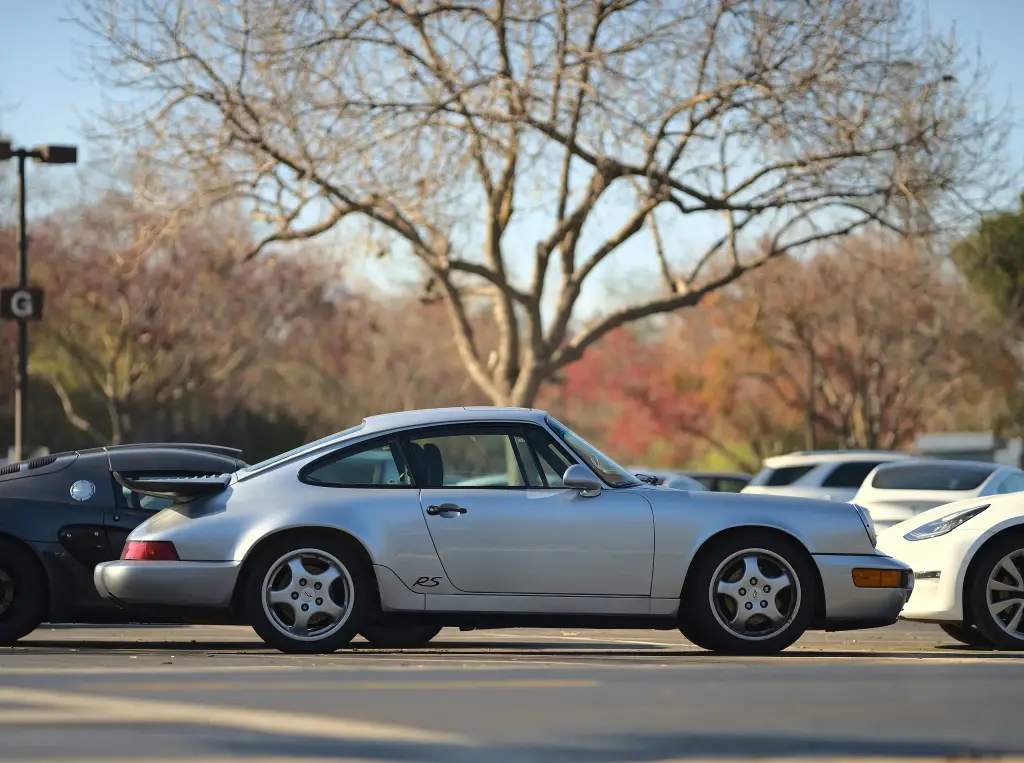
Porsche considered the car 85% new. The first 964s in 1989 were all-wheel-drive Carrera 4 models; the rear-wheel-drive Carrera 2 joined the range in 1990, and both came as coupé, Targa or cabriolet. The 964 Carrera was the last generation sold with the traditional removable Targa roof until the 991 of 2011, because the 993, 996 and 997 used a glass-roof “greenhouse” system instead.
The new naturally aspirated M64 engine displaced 3.6 litres, with a 100 mm bore and a 76.4 mm stroke, an 11.3:1 compression ratio, single overhead camshafts per bank driven by double chains, electronic fuel injection with twin-spark ignition and knock regulation, and a forged crankshaft in seven main bearings. It produced 250 PS at 6,100 rpm and 310 N·m at 4,800 rpm up to a 6,700 rpm limit.
The chassis was redesigned around coil springs and shock absorbers instead of torsion bars, the first major engineering change since the original 911. The front used MacPherson struts, a layout kept for all later versions, while the rear retained semi-trailing arms. Power steering and ABS brakes were added to the 911 for the first time and both were standard. The interior was revised with dual airbags standard from late 1989 on North American 1990 cars, automatic climate control and a central warning system for the enlarged set of instruments. Top speed was 260 km/h, or 256 km/h with Tiptronic, and the drag coefficient was 0.32.
In 1992 Porsche added a super-lightweight, rear-wheel-drive Carrera RS for Europe, based on the Carrera Cup race car and recalling the 2.7 and 3.0 RS and RSR models. Its M64/03 engine gave 260 PS, with a light flywheel, a close-ratio G50/10 gearbox, an asymmetrical limited-slip differential and steel synchromesh. The suspension sat 40 mm lower with stiffer springs, dampers and adjustable anti-roll bars, and there was no power steering except on right-hand-drive British cars. Buyers chose the standard RS, a heavier Touring with thin carpets, some sound deadening and leather-lined bucket seats, or the Clubsport with a stripped interior, roll cage, aluminium bonnet, seam-welded chassis, magnesium wheels and thinner glass; 290 cars were built with the M003 Clubsport option. Towards the end of the run came the Carrera 3.8 RS with the wider Turbo body and a 300 PS 3.8-litre M64, bored out by 2 mm to 3,746 cc and also offered as the more powerful 3.8 RSR.
Design and features
- Integrated bumpers: flush panels and fog lamps, and a rear spoiler that rose at speed.
- Coil-spring chassis: the first major change since the original 911, with power steering and ABS.
- New options: Tiptronic automatic and all-wheel drive offered for the first time.
- Carrera RS: a 260 PS lightweight for Europe, with a stripped Clubsport version.
Porsche 964 versions
- Carrera 4 (1989–1994): the all-wheel-drive model that came first.
- Carrera 2 (1990–1994): the rear-wheel-drive version.
- Cabriolet and Targa: open and removable-roof bodies.
- Carrera RS (1992): lightweight European model, with Touring and Clubsport specs.
- Carrera 3.8 RS and 3.8 RSR: wider Turbo-bodied 300 PS cars at the end of the run.
The 964 replaced the classic Porsche 911 and was replaced by the Porsche 993. More cars are in the Porsche collection.
Sources
- Porsche 911 (964), English Wikipedia: design, engine, chassis, RS variants