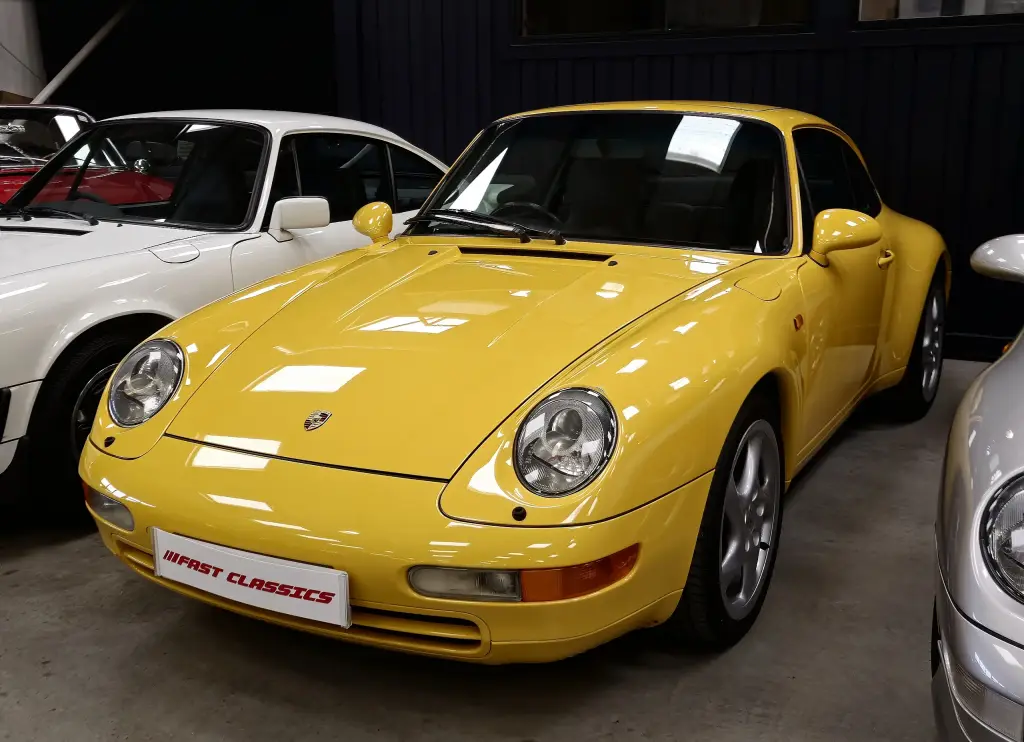
The Porsche 993 is the fourth generation of the 911, made and sold between 1994 and 1998. It replaced the 964, and its discontinuation marked the end of air-cooled 911 models. Porsche says every part was designed from the ground up and only 20% of the parts carried over from the previous car.
Porsche 993 at a glance
| Maker | Porsche, Stuttgart |
|---|---|
| Production | 1994–1998 (US model years 1995–1998) |
| Exterior design | Tony Hatter |
| Engine | 3.6-litre air-cooled flat-six, M64 development |
| Induction | VarioRam, 15% more power than the 964 |
| Gearbox | six-speed manual, standard for the first time |
| Automatic | four-speed Tiptronic, Tiptronic S from 1995 |
| Rear suspension | all-alloy multi-link on a subframe, the Weissach axle |
| All-wheel drive | viscous coupling instead of the 964’s centre differential |
| Coupé weight | 1,370 kg |
| Notable | a 993 GT2 was the 1995 Formula One safety car |
History of the Porsche 993
The 993 was designed outside by the English designer Tony Hatter. It kept the core cabin and body shell architecture of the 964 and earlier 911s, but the exterior panels were revised with much more flared wheel arches, smoother front and rear bumpers, an enlarged retractable rear wing and teardrop-shaped mirrors.
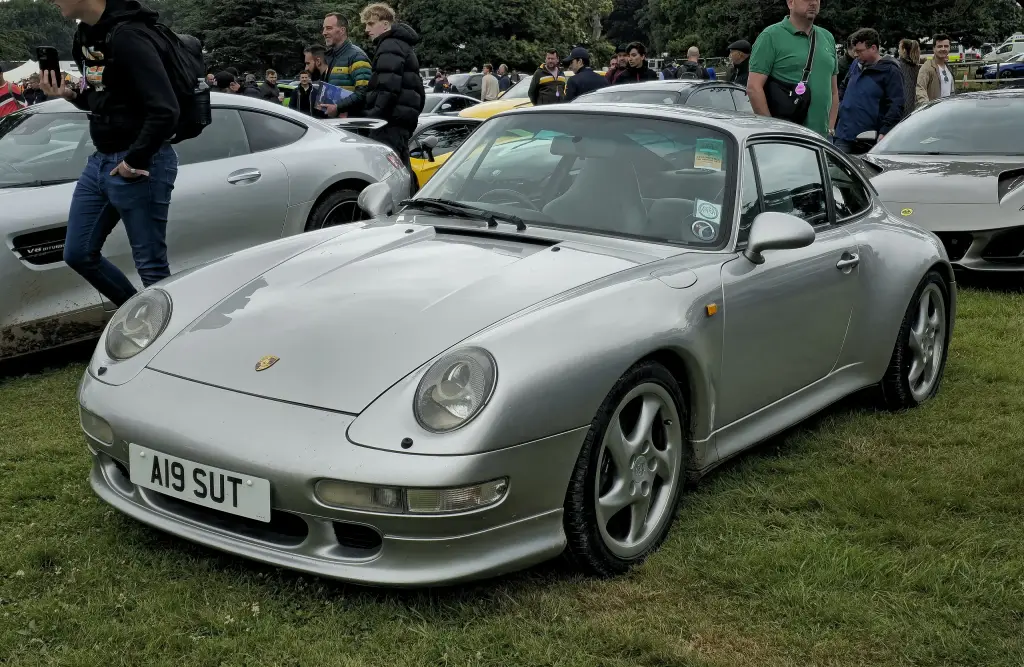
The biggest engineering change was at the back. Porsche built a new light-alloy rear subframe with an entirely new multi-link, coil-sprung wishbone rear suspension called the Weissach axle. It was derived from the 989, a four-door saloon that never reached production, and it later continued in the 996. The new layout reduced the effect of the engine on handling, putting behind the lift-off oversteer of earlier 911s, and it required wider rear arches, which improved stability. It also cut interior noise and improved the ride.
Power came from a further-developed 3.6-litre M64 flat-six with a new dual-flow exhaust system and two catalytic converters. The VarioRam induction system added power mainly in the mid-range and brought a 15% increase over the 964, at the cost of more throttle noise at high revs. The 993 was the first 911 with a six-speed manual as standard, and in almost every situation the engine could be kept above 4,500 rpm in its best torque range. Rear-wheel-drive Carrera, Carrera S, Cabriolet and Targa models could be ordered with the four-speed Tiptronic; from 1995 the Tiptronic S added steering-wheel controls and software that recognised climbs and descents, though automatic cars were slightly slower and 25 kg heavier.
All-wheel drive was optional and refined over the 964’s three-differential system. Taking the layout of the 959, Porsche replaced the centre differential with a viscous coupling, which improved handling in bad weather with fewer compromises and less weight, although a Carrera 4 still weighed 50 kg more than a rear-wheel-drive car, at 1,420 kg against 1,370 kg. Other improvements over the 964 included larger drilled brakes and revised power steering.
The Carrera came in rear- and all-wheel drive, in coupé, cabriolet and Targa forms. The cabriolet, launched alongside the coupé in April 1994 for the 1995 model year, had a fully electric, hand-stitched soft top reinforced with metal sheets, an automatic wind blocker and a small rear spoiler carrying the third brake light; it weighed 1,420 kg. The coupé was the stiffest, tightest and lightest of the 993 models, with 110 mm of ground clearance, 120 mm in the United States and 90 mm with the M030 sport chassis. A 993 GT2 served as the safety car during the 1995 Formula One season.
Design and features
- Weissach axle: a new all-alloy multi-link rear suspension that cured much of the old oversteer.
- VarioRam: variable intake geometry worth 15% more power than the 964.
- Six-speed manual: standard on a 911 for the first time.
- Simpler all-wheel drive: a 959-style viscous coupling replacing three differentials.
Porsche 993 versions
- Carrera coupé: the lightest and stiffest 993.
- Carrera cabriolet (1994): electric soft top and wind blocker.
- Carrera 4: all-wheel drive with a viscous coupling.
- Carrera S and Targa: the wider and glass-roofed versions.
- 993 GT2: the racing-derived model used as the 1995 F1 safety car.
The 993 replaced the Porsche 964 and was replaced by the water-cooled Porsche 996. More cars are in the Porsche collection.
Video: PS Profis – Porsche 911 993 Carrera 2 Coupé
Video by PS Profis on YouTube.
Sources
- Porsche 911 (993), English Wikipedia: design, suspension, engines, variants