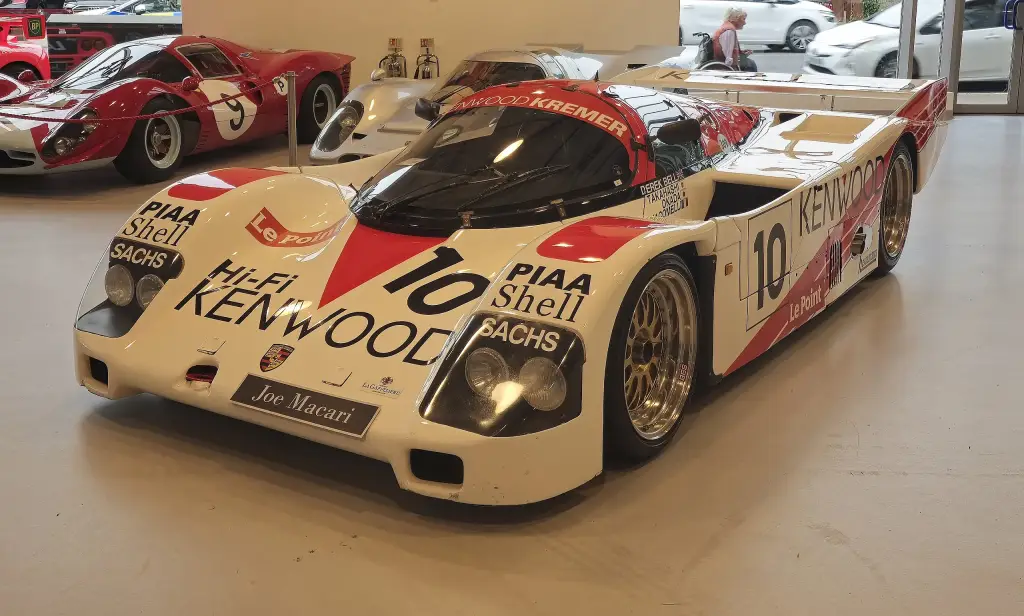
The Porsche 962 is a sports prototype designed and built to replace the 956, introduced at the end of 1984 after American IMSA rules made the earlier car obsolete. Over a decade it won Le Mans twice in Group C form and took nineteen constructor’s championships across various series.
Porsche 962 at a glance
| Maker | Porsche, Stuttgart |
|---|---|
| Introduced | end of 1984 |
| Classes | IMSA GTP and Group C |
| Chassis | aluminium monocoque with an integrated steel roll cage |
| Wheelbase | longer than the 956, to put the front wheels ahead of the pedal box |
| Engines | 2.8, 3.0 and 3.2-litre turbocharged flat-six |
| Turbochargers | single KKK K36 in IMSA, twin K27 in Group C |
| Built | 91 between 1984 and 1991 |
| Factory cars | 16; 75 sold to customers |
| Le Mans | Group C wins twice, plus the Dauer 962 in 1994 |
| Titles | nineteen constructor’s championships |
History of the Porsche 962
The 962 was created to replace the 956 after IMSA rejected the earlier car. When the 956 was developed in late 1981 Porsche intended to run it in both the World Sportscar Championship and IMSA GTP, but the American rules differed from Group C and the 956 was banned in the United States on safety grounds, because the driver’s feet were ahead of the front axle centre line. Running under IMSA rules also meant replacing the water-cooled twin-turbo engine with the older, simpler air-cooled single-turbo unit until a compromise was found.
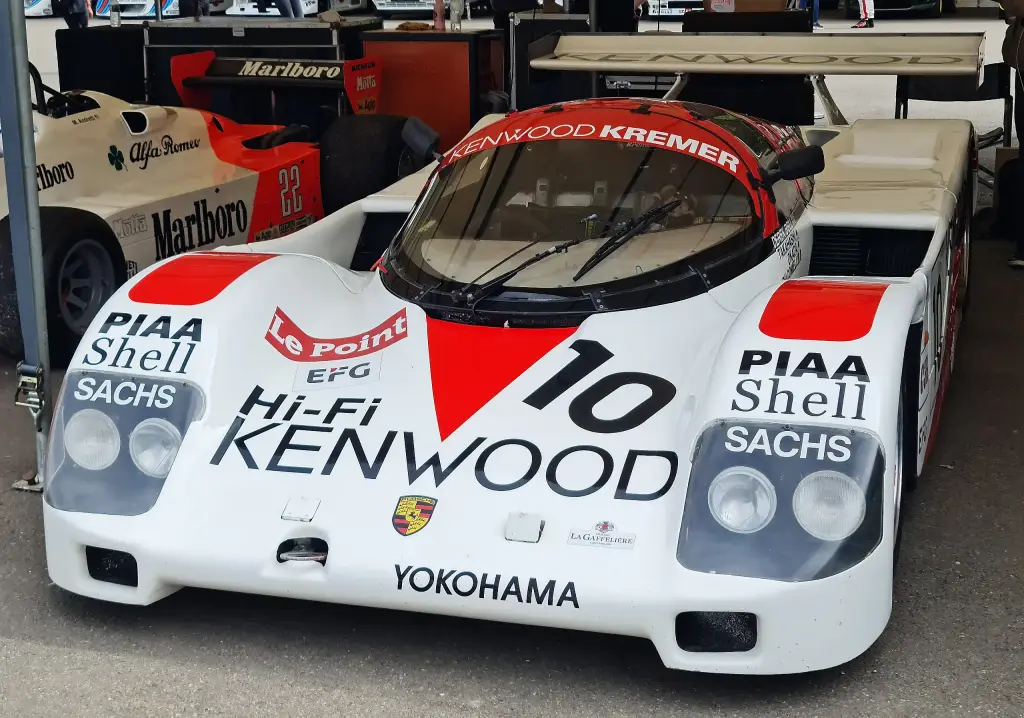
To make the car eligible, Porsche extended the 956’s wheelbase so that the front wheels sat ahead of the pedal box, and integrated a steel roll cage into the aluminium chassis. The engine was the 934-derived Type 935 2.8-litre flat-six, air-cooled and with a single KKK K36 turbocharger instead of the Group C car’s twin K27s, because twin turbos were not allowed in IMSA GTP at the time.
Development continued: by the middle of 1985 an Andial-built 3.2-litre fuel-injected flat-six went into the 962 for IMSA GT, making it more competitive against Jaguar, and the World Sportscar Championship cars kept the 2.6-litre unit until 1986, when 2.8, 3.0 and 3.2-litre versions with twin turbos arrived. Cars run to world championship rules were designated 962C to separate them from the IMSA GTP cars. The 3.2-litre engine, allowed under IMSA’s Group 3 rules, was banned there in 1987, and in 1988 water-cooled twin-turbo Porsche engines returned with 36 mm restrictors.
Porsche built 91 cars between 1984 and 1991: 16 used by the factory team and 75 sold to customers. Some 956s were rebuilt as 962s, two of them after being written off and four simply rebuilt, and three badly damaged 962s were rebuilt with new chassis numbers. Demand for parts was so high that Fabcar in the United States built some aluminium chassis before they were shipped to Germany for completion. Derek Bell, a five-time Le Mans winner who took 21 victories in the 962 between 1985 and 1987, called it a fabulous car that was, given how thorough Norbert Singer and the team were, really quite easy to drive.
With so many cars, teams modified them freely: some changed bodywork for aerodynamic efficiency, others mechanical parts, and Joest Racing heavily reworked a pair of 962s for the 1993 IMSA GTP season, taking the car’s final sprint win at Road America. A weakness was the stiffness of the aluminium chassis, so private teams built their own: Kremer’s 962 CK6 used a carbon fibre tub and eleven chassis were made, John Thompson built eight for Brun Motorsport and two for Obermaier, Richard Lloyd’s GTI Engineering produced five 962C GTis with revised aerodynamics and aluminium honeycomb tubs, and Vern Schuppan built five TS962s. In America Holbert Racing rebadged its own chassis as 962 HR, and Fabcar became the de facto factory tub supplier, combining sheet aluminium with honeycomb and billet bulkheads for greater stiffness and crashworthiness. In its Group C form the 962 won Le Mans twice, and a derivative, the Dauer 962 Le Mans, won again in 1994; in total the car took nineteen constructor’s championships.
Design and features
- Longer wheelbase: the front wheels moved ahead of the pedal box to satisfy IMSA.
- Steel roll cage: built into the aluminium monocoque for American safety rules.
- Flexible engines: 2.8, 3.0 and 3.2-litre flat-sixes with one or two turbos.
- Customer programme: 75 cars sold, and many more rebuilt by specialists.
Porsche 962 versions
- 962 (1984): the original IMSA GTP car with a single turbo.
- 962C: the Group C version with twin turbos.
- 962 CK6: Kremer’s carbon-tub car, eleven built.
- 962C GTi: Richard Lloyd’s five cars with revised aerodynamics.
- Dauer 962 Le Mans: the road-car-derived version that won Le Mans in 1994.
The 962 replaced the Porsche 956 and raced alongside the Porsche 936. More cars are in the Porsche collection.
Video: Flat Out In a Le Mans Winning Porsche 962 – /CHRIS HARRIS ON CARS
Video by Chris Harris on Cars on YouTube.
Sources
- Porsche 962, English Wikipedia: development, engines, production, private cars