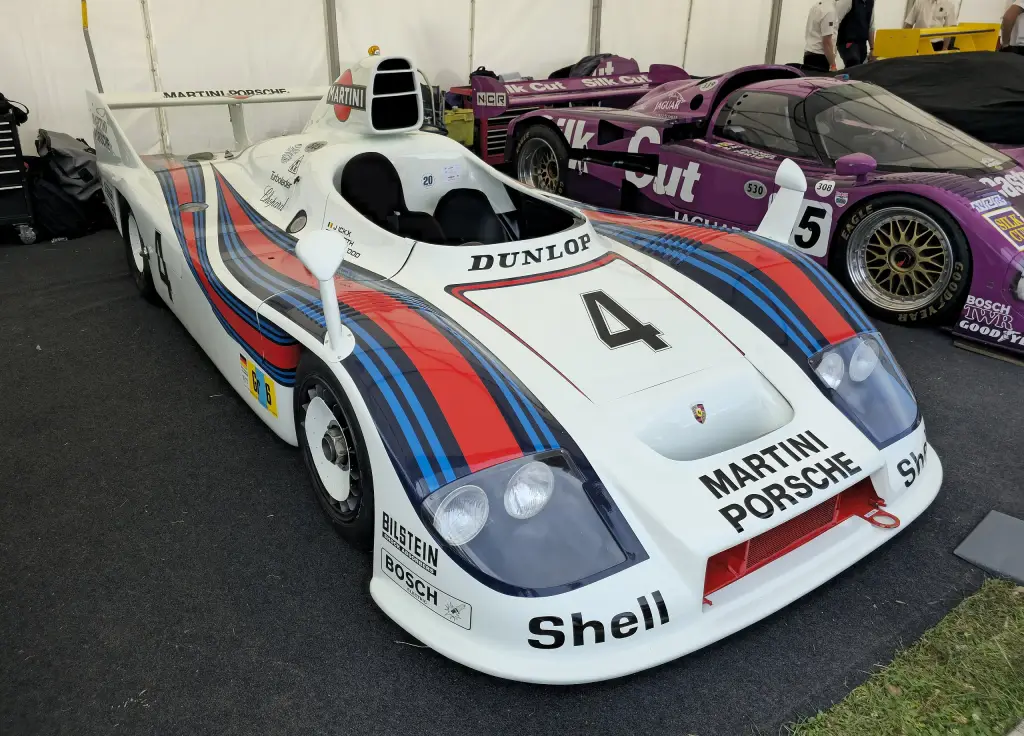
The Porsche 936 is a Group 6 sports prototype introduced in 1975 as a delayed successor to the 917 and the 908. Its name came from its use of a turbocharged engine from the 930 and from its Group 6 class, and between 1976 and 1981 the works cars won the 24 Hours of Le Mans three times.
Porsche 936 at a glance
| Maker | Porsche, Stuttgart |
|---|---|
| Introduced | 1975 |
| Class | Group 6 prototype, two-seat open spyder |
| Engine | 2,140 cc air-cooled two-valve flat-six, single turbocharger |
| Power | 540 hp |
| Handicap | 2,140 cc counted as 3,000 cc at the 1.4 turbo factor |
| Chassis | spaceframe based on the 917 |
| Le Mans wins | 1976, 1977 and 1981 |
| Winning drivers | Ickx and van Lennep (1976), Ickx and Bell (1981) |
| 936/81 engine | 2.65 litres, about 640 hp, four-speed gearbox |
History of the Porsche 936
The 936 was introduced in 1975 as Porsche’s return to the top of sports car racing after the factory retired the 917 and the 908 at the end of 1971. It shared its name with the 930 only indirectly: the car used a variant of the 930’s turbocharged engine, and it raced in Group 6.
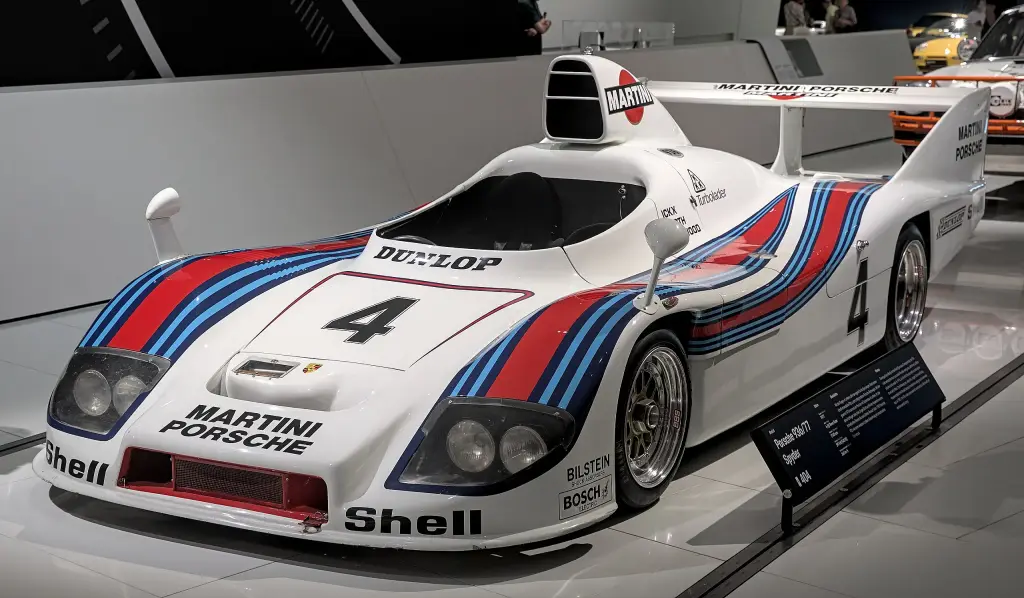
It was an open two-seater spyder powered by an air-cooled, two-valve flat-six of 2,140 cc with a single turbocharger, producing 540 hp; with the 1.4 turbocharging handicap factor that counted as 3,000 cc. The spaceframe chassis was based on the 917, and many parts came from that car. Early in its life the Martini Racing car was still black with a flat engine cover behind the roll bar; the large hump and air box above the engine were added later in the season, mostly for the intercooler rather than for the engine’s air intake or cooling.
In 1976 the 936 won both the World Sportscar Championship and the 24 Hours of Le Mans. Chassis 002, number 20, won at Le Mans with Jacky Ickx and Gijs van Lennep, while the number 18 car of Reinhold Joest and Jürgen Barth retired with engine failure. The 936 shared those victories with its production-based sibling, the 935, which won Group 5.
For 1981 Porsche planned to enter the Le Mans 24 Hours with modified 924s, which had no chance of winning. The new chief executive Peter Schutz insisted that Porsche enter with a car capable of winning or not at all. Engineer Peter Falk suggested an Indy engine that had been developed but never raced because United States rules had made it uncompetitive; it could produce 900 hp in an Indycar, and Porsche withdrew from American formula racing before the first race rather than lower the boost. For endurance racing the boost was reduced and a 2.65-litre version of the engine, about 640 hp, went into a Le Mans car with a stronger four-speed gearbox instead of the five-speed. A few 936s were taken out of the Porsche museum and rebuilt as the 936/81, and two works cars were entered. Jacky Ickx was coaxed out of retirement and asked for Derek Bell as his teammate; the pair won, while the sister car of Mass, Schuppan and Haywood retired.
The three original chassis therefore each won Le Mans once, with Ickx in 1976, 1977 and 1981. In 1978 the two previously winning chassis finished second and third behind a Renault, while the new pole-setting chassis 003 crashed. Porsche never sold the 936 to customers, preferring them to use the 935 and the updated 908s, and in 1979 a half-hearted Essex-sponsored entry with two 936s failed. The type was replaced in 1982 by the 956, whose engine had been tested in the 1981 winning chassis.
Design and features
- Turbocharged flat-six: the 930 engine line, 2,140 cc and 540 hp in 1976.
- 917-based spaceframe: a light chassis with parts carried over from the older prototype.
- Intercooler hump: the bodywork added behind the roll bar to house the intercooler.
- Works-only car: never sold to customers, unlike the 935.
Porsche 936 versions
- 936 (1976–1977): the original 2,140 cc turbo car.
- 936/78: a developed version of the 935 engine, second and third at Le Mans in 1978.
- 936/81: museum cars rebuilt around the 2.65-litre Indy-derived engine, winners in 1981.
- 908/80: Joest’s privately assembled car from a spare 936 chassis, second at Le Mans in 1980.
The 936 succeeded the Porsche 917 and the Porsche 908, and it was replaced by the Porsche 956. More cars are in the Porsche collection.
Sources
- Porsche 936, English Wikipedia: design, Le Mans wins, 936/81