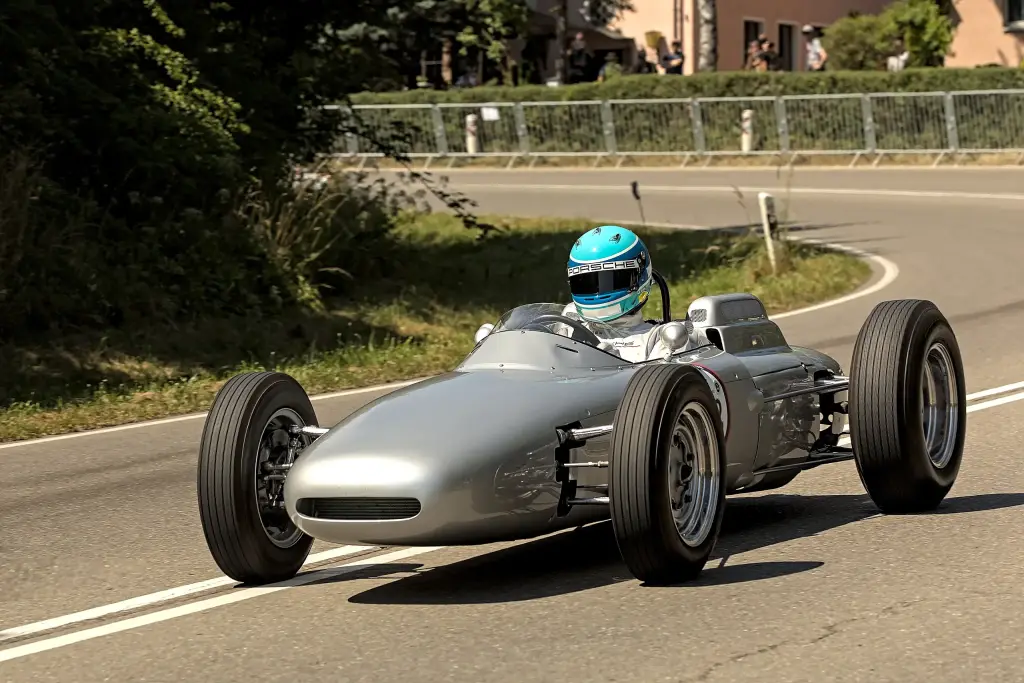
The Porsche 804 is a single-seat, open-wheel racing car built for Formula One in 1962, the 1.5-litre formula. It was the company’s first purpose-built Formula One design with its own eight-cylinder engine, and it remains the only Porsche to win a World Championship Grand Prix as a constructor.
Porsche 804 at a glance
| Maker | Porsche, Stuttgart |
|---|---|
| Season | 1962 |
| Designer | Ferdinand Alexander “Butzi” Porsche |
| Engineers | Wilhelm Hild and Hubert Mimler |
| Racing director | Fritz “Huschke” von Hanstein |
| Chassis | tubular steel frame, aluminium body |
| Engine | 1.5-litre air-cooled flat-eight, Type 753 |
| Cooling fan | horizontal, on top of the engine |
| Weight | about 455 kg, against a 450 kg minimum |
| Fuel | 150 litres in tanks in the nose and beside the driver |
| Brakes | disc brakes, a Porsche first as standard |
| Built | four cars, the fourth never raced |
| Wins | 1962 French Grand Prix and Solitude, both with Dan Gurney |
History of the Porsche 804
The 804 followed a line of Formula cars that began with Porsche entering 550/1500RS Spyders in the 1957 German Grand Prix Formula Two event with little more than the passenger seat and spare wheel removed. For 1958 came the 718 RSK Mittellenker with a centre-mounted seat; Jean Behra won the Formula Two race at Reims in it, Edgar Barth was second in class at the Nürburgring and Masten Gregory won his heat and the class at AVUS. When the FIA limited Formula One to 1.5 litres from 1961, the 718/2 and then the 787 followed, but the 787’s four-cylinder engine was not enough, and Porsche turned to a new car with an eight-cylinder engine.
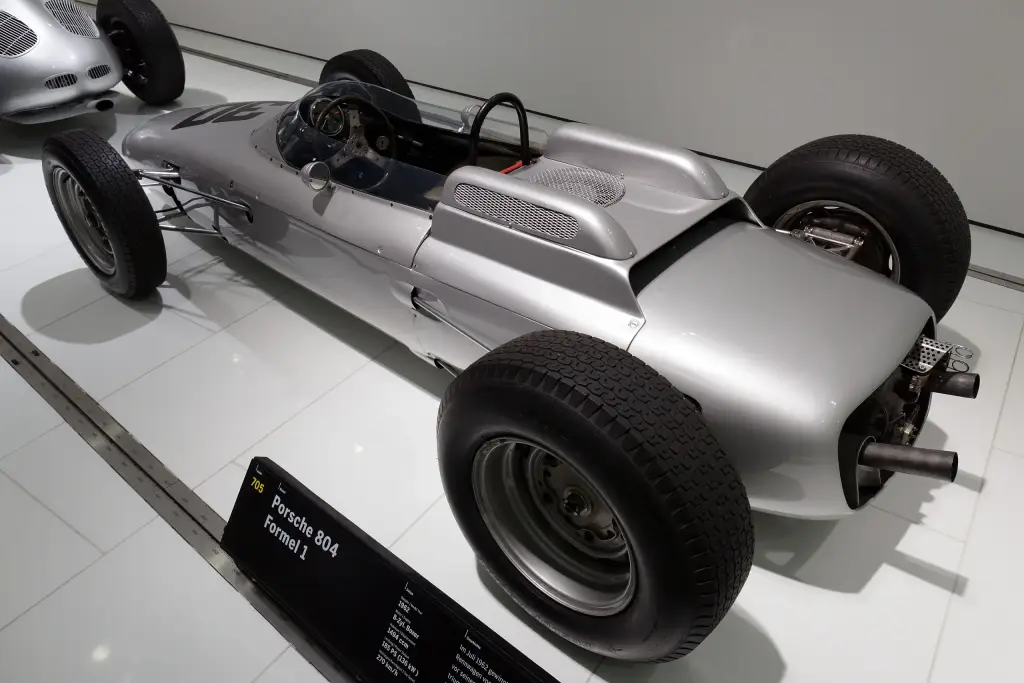
The 804 was designed by Ferdinand Alexander “Butzi” Porsche, son of Ferry and grandson of the founder, who was assigned the project by chief body engineer Erwin Komenda. The design was carried out for the racing department engineers Wilhelm Hild and Hubert Mimler, with Fritz “Huschke” von Hanstein as racing director. Four cars were built; the fourth chassis was never raced.
The chassis was headed by Helmuth Bott. Like the 787, the 804 had a tubular steel frame and an aluminium body, but it was narrower, lower and smoother, helped by a horizontal cooling fan on top of the new flat-eight engine instead of the vertical fan of the Fuhrmann four. It was the first Porsche with some factory body panels in synthetic material: the nose and cockpit surround were made of fibreglass later in the season.
The 150-litre fuel tanks sat in the nose and on both sides of the driver, and the narrow cockpit held only the seat, wheel, gear lever and pedals, with a central tachometer and oil pressure and temperature gauges. The car weighed about 455 kg, only slightly above the regulated minimum of 450 kg. Suspension front and rear used unequal-length upper and lower A-arms, with longitudinal torsion bars and inboard Koni twin-tube or Bilstein monotube dampers, plus a front anti-roll bar. The 804 was the first Porsche to come as standard with disc brakes.
The results were brief but important. Dan Gurney won the 1962 French Grand Prix and the non-championship Solituderennen at Castle Solitude in Stuttgart, Porsche’s only Formula One victories as a constructor. At the end of 1962 Porsche withdrew from Formula One and turned back to sports cars, where the 904 soon followed. One 804 is in the Porsche Museum; after an eight-month restoration it appeared at the Grand Prix Historique in Monaco in 2016 and at the Goodwood Festival of Speed in 2018.
Design and features
- Flat-eight engine: the Type 753, with a horizontal cooling fan on top for a lower, smoother body.
- Disc brakes as standard: the first Porsche so equipped.
- Fibreglass panels: nose and cockpit surround in synthetic material later in 1962.
- Lightweight build: 455 kg, close to the 450 kg formula minimum.
Porsche 804 versions
- 804 (1962): the works Formula One car, four chassis built.
- Solitude winner: Gurney’s car in the non-championship race at Castle Solitude.
- Museum car: restored over eight months and shown at Monaco in 2016.
The 804 followed the Porsche 787 into Formula One, and its flat-eight engine line later appeared in the Porsche 904/8. More cars are in the Porsche collection.
Sources
- Porsche 804, English Wikipedia: design, chassis, results, museum car