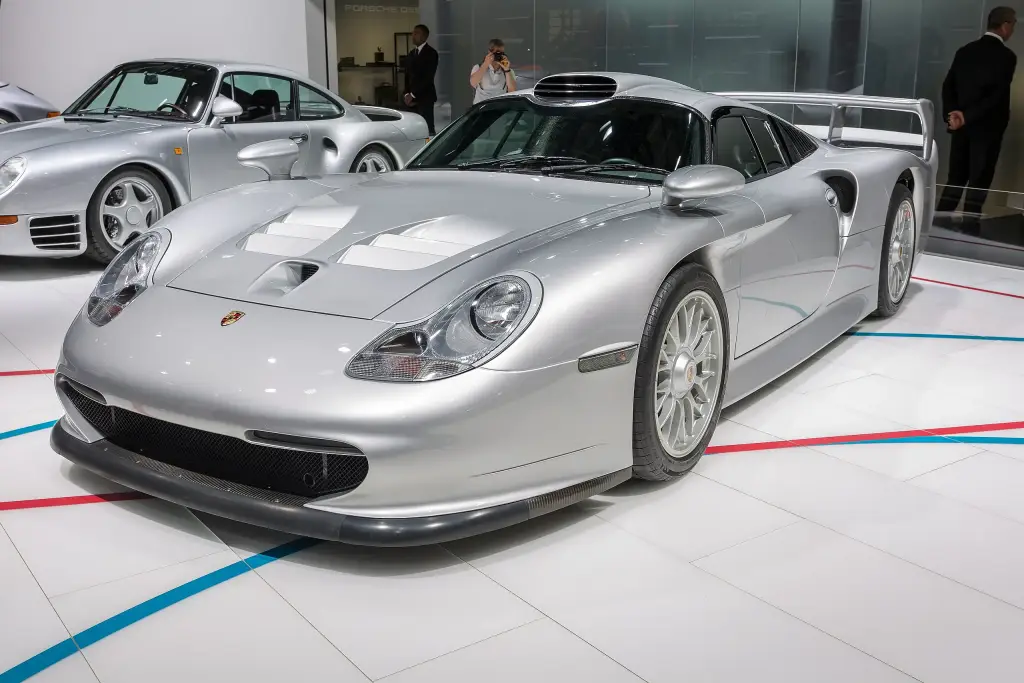
The Porsche 911 GT1 is a car designed by Porsche to compete in the GT1 class of sportscar racing, which also required a street-legal version for homologation purposes. The limited-production road car was named the 911 GT1 Straßenversion, and the racing version won Le Mans in 1998.
Porsche 911 GT1 at a glance
| Class | GT1, sportscar racing, 1996 to 1998 |
|---|---|
| Homologation rule | 25 road cars had to be built |
| Road cars built | about 20 in 1997, plus one 911 GT1-98 Straßenversion in 1998 |
| Layout | rear mid-engine, rear-wheel drive; front chassis from the 993, rear subframe from the 962C |
| Engine | 3,164 cc water-cooled twin-turbo flat-six |
| Race output | about 600 PS (441 kW) |
| Road output | 544 PS (400 kW) at 7,000 rpm and 600 N·m at 4,250 rpm |
| 0–100 km/h | 3.9 seconds (road car) |
| Top speed | 308 km/h (191 mph), road car; 330 km/h (205 mph) for the 1996 racer on the Mulsanne Straight |
| Le Mans 1998 | first and second overall, Porsche’s 16th win |
History of the Porsche 911 GT1
With the revival of international sportscar racing in the mid-1990s, through the BPR Global GT Series and later the FIA GT Championship, Porsche wanted to return to the top level. Cars in the GT1 class had been heavily modified road cars such as the McLaren F1 and the Ferrari F40. Porsche first modified the 993 GT2 into an Evo version and homologated it as a GT1 car, but it proved uncompetitive.
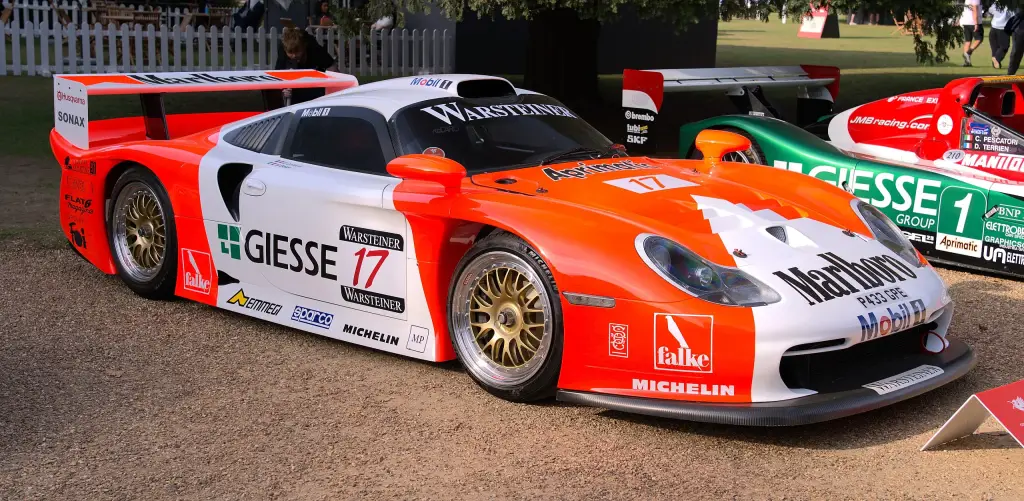
Despite the 911 name the new car had little in common with the road 911, sharing only its head- and tail-lights. Its front chassis was based on the 993, the rear subframe came from the 962C Group C prototype, and the water-cooled, twin-turbocharged 3.2-litre flat-six was mounted longitudinally behind the driver, where a conventional 911’s air-cooled engine was behind the rear axle. It made about 600 PS, against the air-cooled 993 GT2’s two valves per cylinder.
The three racing versions
The 1996 car made its debut at the Brands Hatch four hours, where Hans-Joachim Stuck and Thierry Boutsen won comfortably as an invitational entry, ineligible for points. It went on to win at Spa and Zhuhai. In practice at Le Mans in 1996 it clocked exactly 330 km/h on the Mulsanne Straight. For 1997 the front end was revised with headlights that previewed the 996 generation of the 911, creating the 911 GT1 Evo; the works cars led at Le Mans but did not last the distance, and a privately entered 1996-specification car finished fifth overall and third in class.
For 1998 Porsche built an all-new car, the 911 GT1-98, with a sequential gearbox and bodywork closer to a sports prototype, to match the new Toyota GT-One and the Mercedes-Benz CLK LM. It struggled against the Mercedes over the FIA GT season, partly because air-restrictor rules were unfavourable to a turbo engine. At Le Mans, though, the faster rivals had trouble: the BMW retired with wheel-bearing trouble, the Mercedes had oil-pump failures and the Toyota gearbox problems. The GT1-98 took first and second overall on reliability, giving Porsche a record 16th overall Le Mans win. With Mercedes dominating, the other entries withdrew for 1999 and the GT1 class was cancelled.
The road version
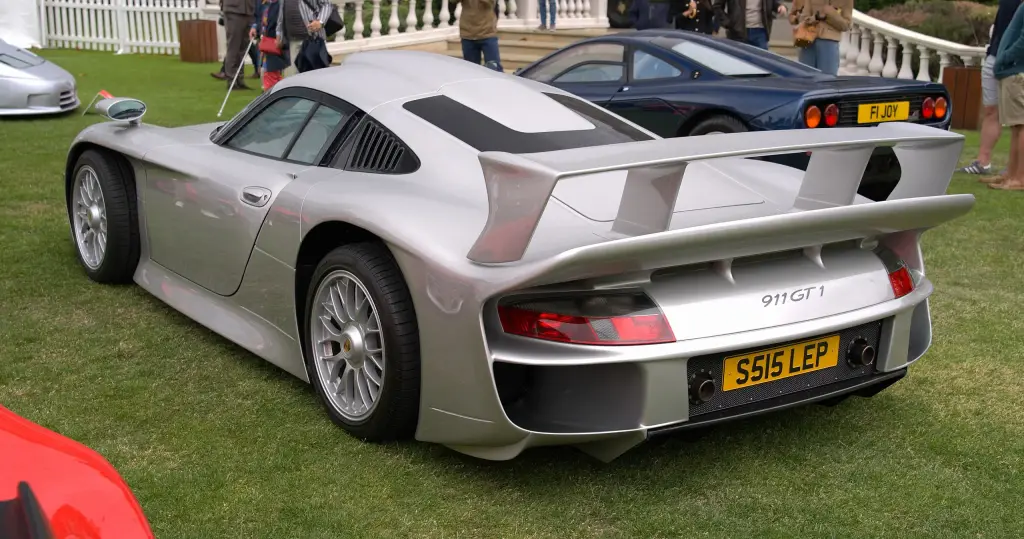
GT1 regulations stipulated that 25 cars be built for road use. Porsche developed two fully road-legal prototypes; the first, delivered in early 1996 to the German transport ministry, passed compliance testing. The production car of 1997 had 996-style headlights, and about 20 were built, most finished in Arctic Silver or Fern White. For the new rules a single 911 GT1-98 Straßenversion was built in 1998, which was believed to be enough to satisfy the regulations. The road engine was slightly detuned for European emissions law to 544 PS, which still gave 0–100 km/h in 3.9 seconds and a top speed of 308 km/h.
Design and features
- Engine: a water-cooled twin-turbo 3.2-litre flat-six behind the cockpit.
- Structure: a front chassis from the 993 and a rear subframe from the 962C prototype.
- Road versions: built only to satisfy the rule requiring 25 road cars.
Porsche 911 GT1 versions
- 911 GT1 (1996): the original racer.
- 911 GT1 Evo (1997): revised nose with 996-style headlights.
- 911 GT1-98 (1998): the all-new car that won Le Mans.
- Straßenversion: about 20 road cars in 1997 and one in 1998.
The 911 GT1 sits in the line of Le Mans cars covered in our Porsche 911 GT3 and Porsche Carrera GT articles. More Porsches are in our Porsche collection.
Sources
- Porsche 911 GT1, English Wikipedia: history, versions, street version