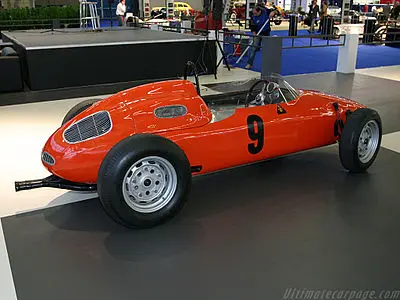
The Porsche 787 is a Formula One racing car built and raced by Porsche for one season, in 1961. Two chassis were made. Both were scrapped by the factory in 1964, and the model was replaced by the 804, Porsche’s first serious Formula One design.
Porsche 787 at a glance
| Maker | Porsche, Stuttgart |
|---|---|
| Season | 1961 |
| Class | Formula One, 1.5 litres |
| Chassis | tubular frame, open wheel |
| Engine | 1.5-litre air-cooled four-cam flat-four, Type 547/3 |
| Fuel system | Kugelfischer fuel injection |
| Front suspension | upper and lower A-arms with coil-over dampers |
| Rear suspension | upper A-arm, lower reversed A-arm, radius rod, coil springs |
| Built | two chassis, 78701 and 78702 |
| Best result | tenth and eleventh in the 1961 Dutch Grand Prix |
| Fate | both scrapped in 1964 |
History of the Porsche 787
The 787 existed because of a rule change. In October 1958 the FIA announced that from 1961 Formula One engines would be limited to 1.5 litres, the same as Formula Two, which meant Porsche could take its Formula Two cars into Formula One almost unchanged. The company had already built the 718/2, an open-wheel car using the mechanicals of the 718 sports racer; five were made, and some later raced in Formula One under the 1.5-litre formula.
For 1961 Porsche launched the Type 787, and Ferdinand Alexander “Butzi” Porsche, the founder’s grandson, was involved in its design. The new chassis was 100 mm longer than the 718/2’s to make room for the Type 753 flat-eight engine then under development. The eight-cylinder never came: the 787 ran the air-cooled, double-overhead-camshaft Type 547 flat-four designed by Ernst Fuhrmann, the engine of the 550 Spyders and the 718.
The suspension was new at the front, where upper and lower A-arms with coil-over dampers replaced the earlier trailing arms and torsion bars, while the rear kept the 718/2 layout of an upper A-arm, a lower reversed A-arm with a radius rod and helical coil springs over dampers.
The first chassis was finished in April 1961 and appeared at the Monaco Grand Prix soon afterwards, powered by a 547/3 with Kugelfischer fuel injection; it retired when the injection cut out. A second car, also with the 547/3, was ready for the Dutch Grand Prix on 22 May, and the two 787s finished tenth and eleventh. A single 787 driven by Edgar Barth took eighth place at the non-championship Solitude Grand Prix, fitted with Porsche’s annular disc brakes, and a car entered by Ecurie Maarsbergen for Ben Pon raced in the 1962 Dutch Grand Prix, retiring after a spin on lap two.
Only two 787s were ever built. The lack of power and poor handling persuaded Ferry Porsche to drop the model and keep the 718/2 as a stopgap, while the racing department concentrated on the 804 and its flat-eight engine for 1962. Both 787s were scrapped by the factory in 1964, so no original survives.
Design and features
- First Porsche Formula One car: the 787 was the marque’s first single-seater designed for Formula One.
- Fuhrmann four: the proven 1.5-litre four-cam flat-four instead of the intended flat-eight.
- New front suspension: A-arms and coil-over dampers replacing trailing arms and torsion bars.
- Disc brakes: annular discs were tried on the Solitude car.
Porsche 787 versions
- 787 (1961): the two works chassis, 78701 and 78702.
- Solitude car: fitted with annular disc brakes for Edgar Barth.
- Ecurie Maarsbergen car (1962): a private entry for Ben Pon in the Dutch Grand Prix.
- 718/2: the four-cylinder Formula car that carried on as a stopgap.
The 787 was replaced by the Porsche 804, and its engine came from the Porsche 718 programme. More cars are in the Porsche collection.
Sources
- Porsche 787, English Wikipedia: design, races, fate of the cars