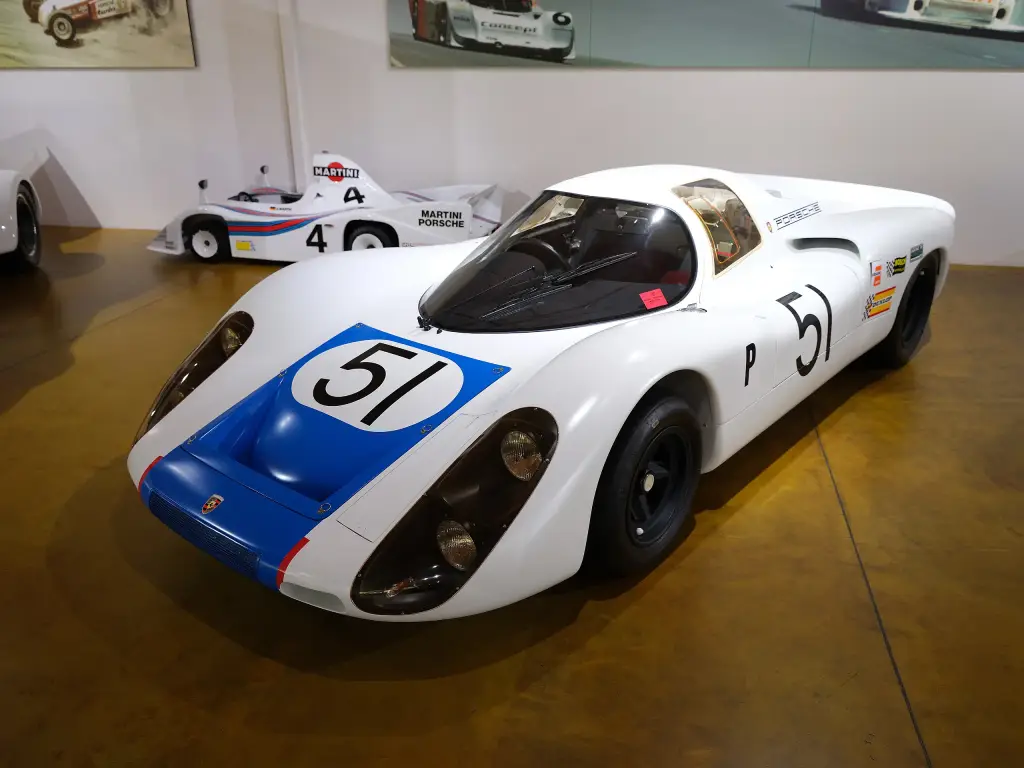
The Porsche 907 is a sports car racing prototype built for the 1967 World Sportscar Championship to succeed the 910, and raced by the factory into 1968. It came with flat-six or flat-eight engines of 2.0 or 2.2 litres, and it gave Porsche its first back-to-back outright wins at Daytona and Sebring.
Porsche 907 at a glance
| Maker | Porsche, Stuttgart |
|---|---|
| Introduced | late 1967, at the 24 Hours of Le Mans |
| Engines | 2.0-litre flat-six, 220 hp; 2.2-litre Type 771/1 flat-eight, 270 hp |
| Body | long tail, closed cockpit |
| Driving position | right-hand drive, on Ferdinand Piéch’s suggestion |
| Top speed | 302 km/h on the Le Mans straight |
| Brakes | vented discs as standard |
| Best 1967 result | fifth at Le Mans |
| 1968 wins | Daytona and Sebring, first and second |
History of the Porsche 907
The 907 was introduced late in the 1967 World Sportscar Championship at the Le Mans 24 Hours, as the successor to the 910. On a suggestion from Ferdinand Piéch, the driver’s position moved from the traditional left of German road cars to the right, which gives an advantage on the mainly clockwise race tracks.
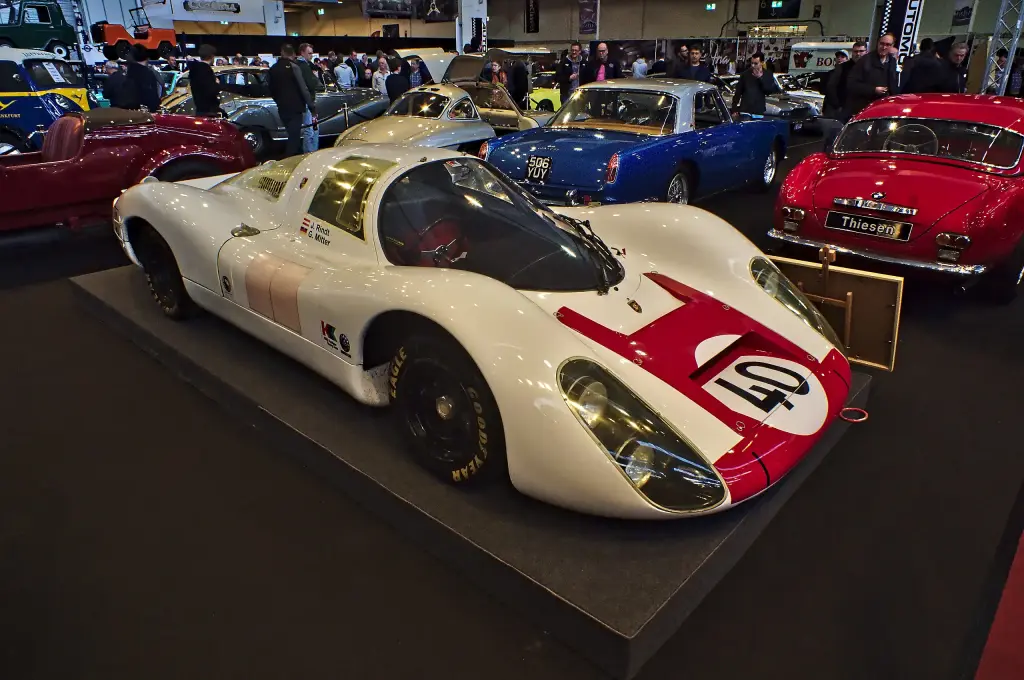
With a new long-tail body the 907s reached 302 km/h on the straight, though all of them used the reliable 220 hp two-litre flat-six of the 910 rather than the more powerful but complicated 2.2-litre flat-eight Type 771. Ventilated brake discs became standard from that point. The best 907 finished fifth at Le Mans, beaten only by pairs of 7-litre V8 Ford GT40 Mk.IVs and 4-litre V12 Ferrari 330 P4s with far bigger engines.
Porsche had begun preparing for a rule change in the summer of 1967, when the record speeds of the Ford GT40 Mk.IVs triggered talk of a three-litre limit for prototypes from 1968. The 907 was given the enlarged 270 hp 2.2-litre Type 771/1 flat-eight, which was then modified for the new three-litre prototype category. A full three-litre Porsche engine still had to be developed, and it arrived in the 908.
From 1968 the big V8 and V12 prototypes of Ford and Ferrari were banned, and Porsche hoped for the championship and perhaps an outright Le Mans win, since Ford, Matra and Alfa Romeo had no suitable three-litre cars ready and Ferrari sat out the season in protest. Five-litre sports cars were still admitted if at least 50 had been built, which let in the older Ford GT40 and Lola T70.
Porsche took the new season seriously: four cars were entered at the 1968 24 Hours of Daytona with 20 mechanics and engineers, and the drivers wore cooling vests developed by NASA because the oil cooler and hot oil pipes made the closed cockpit uncomfortable. After the number 53 car of Gerhard Mitter crashed with a tyre failure on the banking, the race turned into a team effort; five drivers ended up winning, and the number 51 car completed a 1-2-3 parade finish. At the 12 Hours of Sebring the 907 finished first and second, with Jo Siffert and Hans Herrmann winning. Those two races were Porsche’s first back-to-back major outright wins, and a French journalist wrote that it was hard to imagine anyone beating Porsche to the championship that year. Brands Hatch and the faster circuits then brought the old Wyer Ford GT40s back into contention, and the 907 was succeeded by the three-litre 908.
Design and features
- Right-hand drive: the driver sat on the inside of clockwise corners, on Piéch’s suggestion.
- Long-tail body: low drag for the long straights, good for 302 km/h at Le Mans.
- Reliable flat-six: the 220 hp two-litre engine preferred over the fragile flat-eight.
- Vented disc brakes: standard equipment from the car’s debut.
Porsche 907 versions
- 907 flat-six (1967): the 2.0-litre long-tail car that finished fifth at Le Mans.
- 907 flat-eight (1967–1968): the 2.2-litre Type 771/1, 270 hp, prepared for the three-litre rules.
- 907 Langheck: the long-tail body used at fast circuits.
- Privateer cars: 907s continued with customers after the factory moved on.
The 907 succeeded the Porsche 910 and was replaced by the Porsche 908. More cars are in the Porsche collection.
Sources
- Porsche 907, English Wikipedia: design, engines, 1967 and 1968 seasons