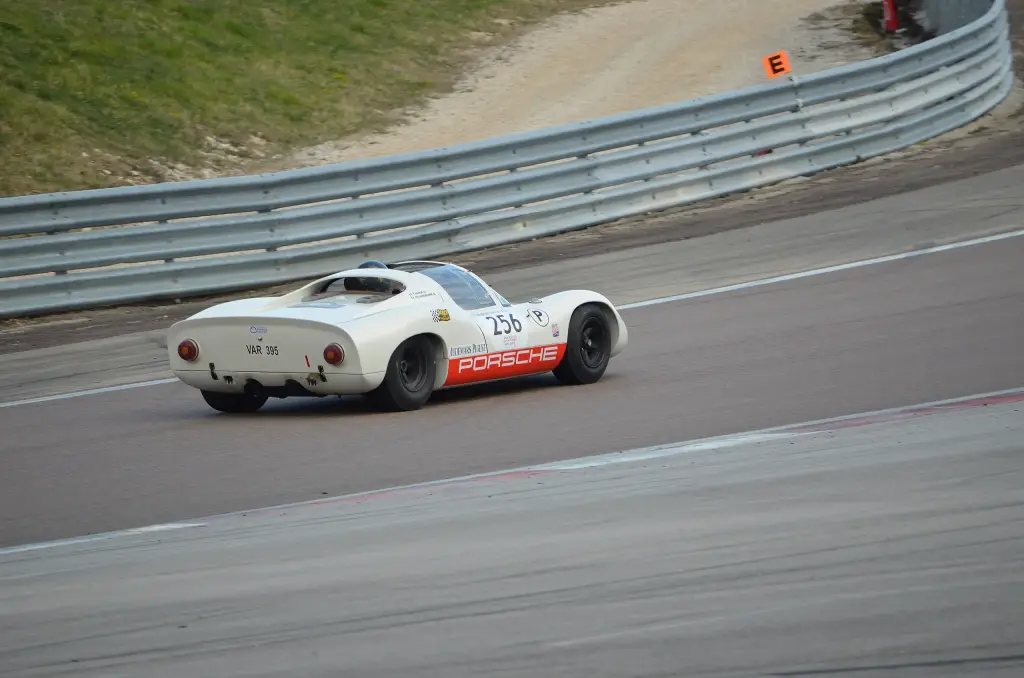
The Porsche 910, also called the Carrera 10, is a prototype racing car built in late 1966 and early 1967 as a less restricted evolution of the 906. Twenty-eight were built, in short-tail coupé and open spyder forms, and it was succeeded by the 907 at Le Mans in June 1967.
Porsche 910 at a glance
| Maker | Porsche, Stuttgart |
|---|---|
| Introduced | late 1966, at hill climbs |
| Based on | Porsche 906 Carrera 6 |
| Chassis | steel spaceframe with a light fibreglass body |
| Suspension | Formula One-style, 13-inch wheels all round |
| Engines | 2.0-litre flat-six Type 901/20, or 2.2-litre flat-eight Type 771 |
| Bodies | Kurzheck coupé, Langheck coupé, open Bergspyder |
| Doors | hinged forward, with a removable roof section |
| Built | 28 |
| Homologated as Group 4 | January 1969, under the 25-car rule |
| Best result | 1-2-3-4 at the 1967 Nürburgring 1000 km |
History of the Porsche 910
The 910 was developed from the 906, the road-legal two-litre Group 4 car of which 65 were built in early 1966. Unlike the 906, the 910 was not designed with homologation, road use, customer racing or economy in mind: it was a steel spaceframe covered by a light fibreglass body, fitted with up-to-date Formula One suspension parts, wheels and tyres, and available with different engines and bodies.
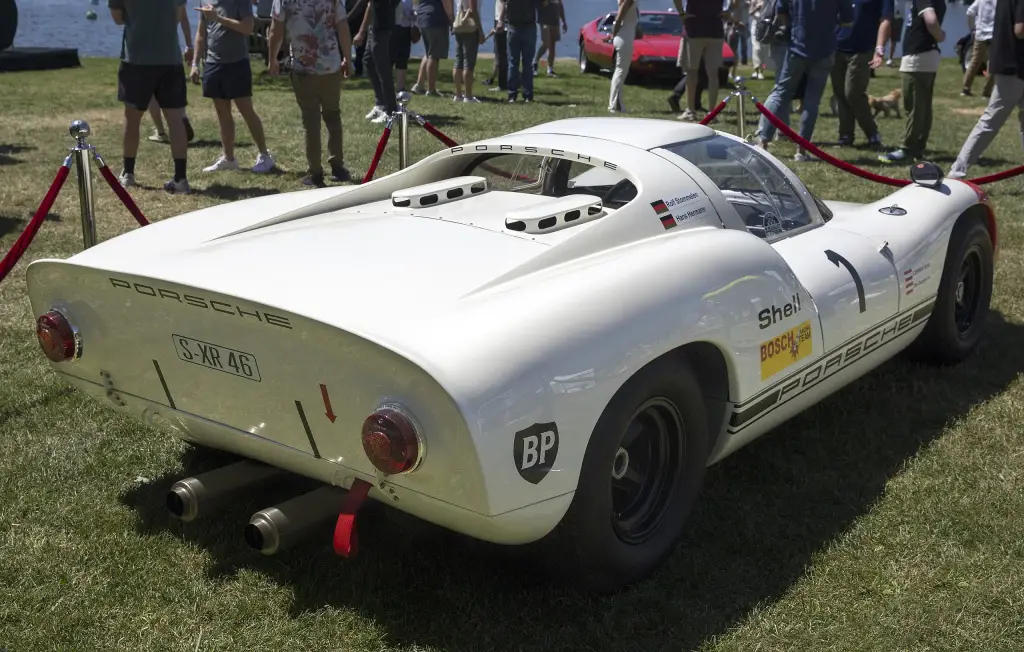
The body differed from the 906 in several ways. Because the car ran on 13-inch wheels the wheel arches could be smaller, which improved the view out of the windscreen; the 906’s big rear plastic window and roof-hinged gullwing doors were dropped. The 910’s doors hinged forward, the centre roof section could be removed to make it an open car, and the rear body still hinged backwards for access to the drivetrain. The windscreen was carried over from the 906.
There were two main versions: a Spyder with a 2.0-litre flat-eight, and a Coupé with either the 2.0-litre 901/20 flat-six or the 2.2-litre Type 771 flat-eight. The Spyder, built as a hill-climb car, differed in small ways such as a two-gallon fuel tank. Cars were also built in short-tail (Kurzheck) form for twisty circuits and long-tail (Langheck) form for fast tracks such as Monza, Spa and Le Mans.
Twenty-eight examples were built. The type was introduced in the summer of 1966 at hill climbs and, with the 906, dominated the two-litre classes in 1967. Outgunned by the bigger Ford GT40 and Ferrari prototypes on long tracks, the 910s usually finished in the top five while winning their class: fourth at Daytona, third at Sebring and Monza and second at Spa, followed by overall wins at the Targa Florio and the Nürburgring 1000 km, and every hill climb that counted towards the world championship.
The Nürburgring win came from a fleet of six factory cars entered to take Porsche’s first overall victory at its home event. Two 910/8s retired with valve damage, the third lost time with an electrical problem and finished fourth, and the three six-cylinder cars finished ahead of it for a 1-2-3-4. In hill climbs the short, light open 910/8 Bergspyder with the Type 771 flat-eight won the European championship in both 1967 and 1968. When the FIA cut the minimum number of cars to 25 for 1969, the 910s built since 1966 were homologated as Group 4 sports cars in January 1969, and privateers raced them successfully into the 1970s.
Design and features
- Formula One suspension: contemporary single-seater parts and 13-inch wheels on a spaceframe.
- Three body styles: short tail, long tail and the open Bergspyder for hill climbs.
- Removable roof: forward-hinged doors and a centre roof panel that could come out.
- Two engine families: two-litre flat-six or 2.2-litre flat-eight.
Porsche 910 versions
- 910 Coupé Kurzheck: short-tail body for twisty circuits.
- 910 Coupé Langheck: long-tail body for Monza, Spa and Le Mans.
- 910 Spyder: open car with a 2.0-litre flat-eight.
- 910/8 Bergspyder: hill-climb car with the Type 771 flat-eight, European champion in 1967 and 1968.
The 910 grew out of the Porsche 906 and was replaced by the Porsche 907. More cars are in the Porsche collection.
Sources
- Porsche 910, English Wikipedia: design, bodies, racing history, homologation