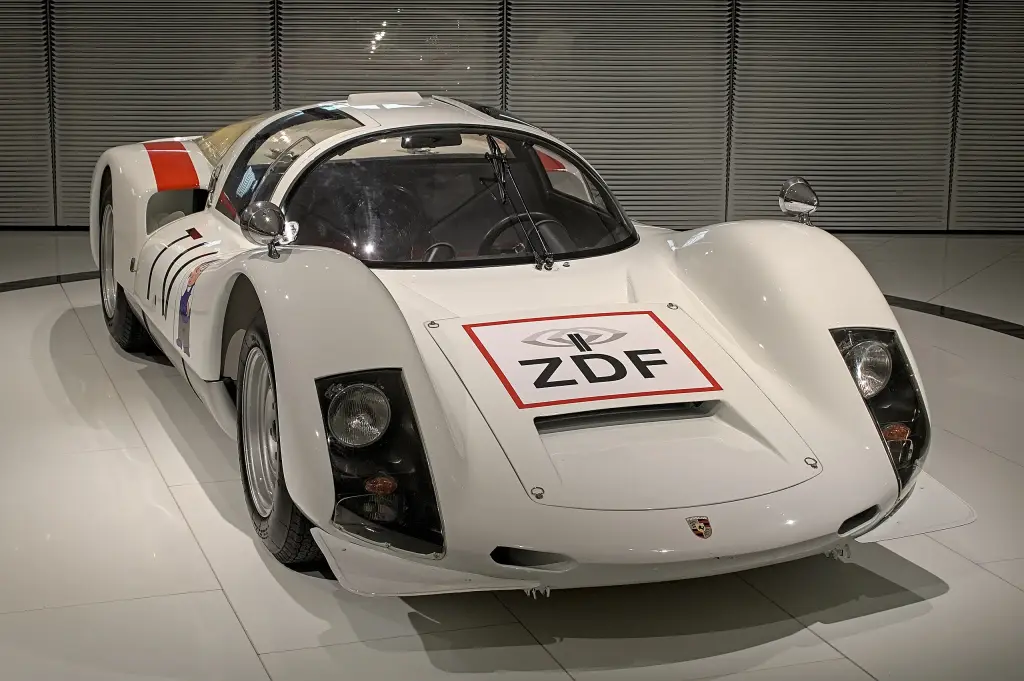
The Porsche 906, sold as the Carrera 6, is a two-litre Group 4 sports car announced in January 1966 for that year’s World Sportscar Championship. It replaced the 904 with a much lighter car built around an unstressed fibreglass body, and it was still legal for the road.
Porsche 906 at a glance
| Maker | Porsche, Stuttgart |
|---|---|
| Announced | January 1966 |
| Sold as | Carrera 6 |
| Class | Group 4 sports car, up to 2,000 cc |
| Homologation | 50 cars required, effective May 1966 |
| Built | 65 |
| Weight | about 580 kg, some 110 kg less than the 904 |
| Body | unstressed fibreglass on a tubular spaceframe |
| Engine | 2-litre flat-six, Type 901/20, 210 hp at 8,000 rpm |
| Optional engine | flat-eight, mainly for hill climbs |
| Best result | overall win at the 1966 Targa Florio |
| Championship | 1966 World Sportscar Championship, both 2-litre classes |
History of the Porsche 906
The 906 was the work of Ferdinand Piéch, grandson of Ferdinand Porsche, who at 28 was put in charge of developing Porsche’s new racing cars. His goal in reworking the 904 into the 906 was to make the car as light as possible, which meant stripping the heavy steel from the body and replacing it with unstressed fibreglass, laid up by hand rather than finished with paint.
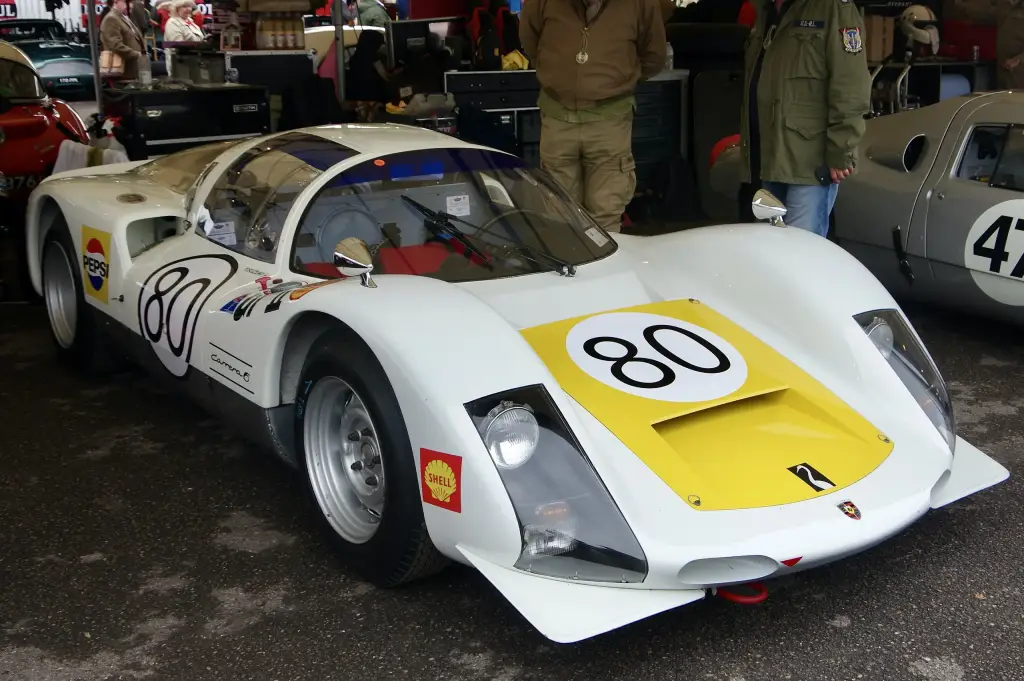
The finished car weighed about 580 kg, roughly 110 kg less than the 904. Part of the saving came from the lighter engine: normally a 901/20 flat-six with carburettors producing 210 hp at 8,000 rpm, though the factory team sometimes fitted a flat-eight for hill climbs, where altitude cost the six-cylinder car power against the Ferrari Dino.
The 906 was a road-legal Group 4 car and met the FIA requirements of luggage space and a spare wheel, as the 917 would later. Sixty-five were built, and homologation took effect in May 1966 once the required 50 existed. Before that, and afterwards for experimental parts, the cars had to run in the Group 6 prototype class; by summer 1966 new 906-like chassis from the factory were being called the 910.
The racing record was immediate. One 906 was in Florida by 6 February 1966 for the 24 Hours of Daytona, where the new Carrera 6 finished sixth overall behind the big-engined Fords and Ferraris and ahead of the works 904s, winning its class. At Sebring in late March five 906s were entered; Hans Herrmann and Herbert Müller finished fourth overall and won the class. At Monza the best 906 was fourth, on the same lap as the winning Ferrari, with more 906s in fifth and seventh beating Fords and V12 Ferraris. At the Targa Florio a private 906 won overall after the two works prototypes collided, and at Le Mans the long-tail prototypes finished fourth, fifth and sixth behind the 7-litre Ford GT40 Mk.IIs.
Together with the 904, the 910 and the 911, the 906 won every two-litre class of the 1966 World Sportscar Championship, taking the International Manufacturers Championship for prototypes over Ferrari and the Division II title over Alfa Romeo and Lotus, with a perfect score of 42 points. Ferrari’s rival Dino 206S was never homologated because only 18 were built, so it always ran as a prototype. Privateers in 906s also helped Porsche win the two-litre class of the 1967 championship, which was dropped in 1968.
Design and features
- Unstressed fibreglass body: hand-laid panels on a spaceframe, 110 kg lighter than the 904.
- Two-litre flat-six: 210 hp at 8,000 rpm from the Type 901/20.
- Road legal: luggage space and a spare wheel met Group 4 homologation rules.
- Prototype development: long tails, fuel injection and flat-eights were tried on works cars.
Porsche 906 versions
- 906 Carrera 6 (1966): the customer Group 4 sports car.
- 906 prototype: works cars with long-tail bodies, Formula One-style wheels and bigger engines.
- 906 Bergspyder: light open car for hill climbs, raced from late 1965.
- 910 (1966): the further-developed prototype that grew out of the 906.
The 906 followed the Porsche 904 and led to the Porsche 910. More cars are in the Porsche collection.
Sources
- Porsche 906, English Wikipedia: design, homologation, racing record