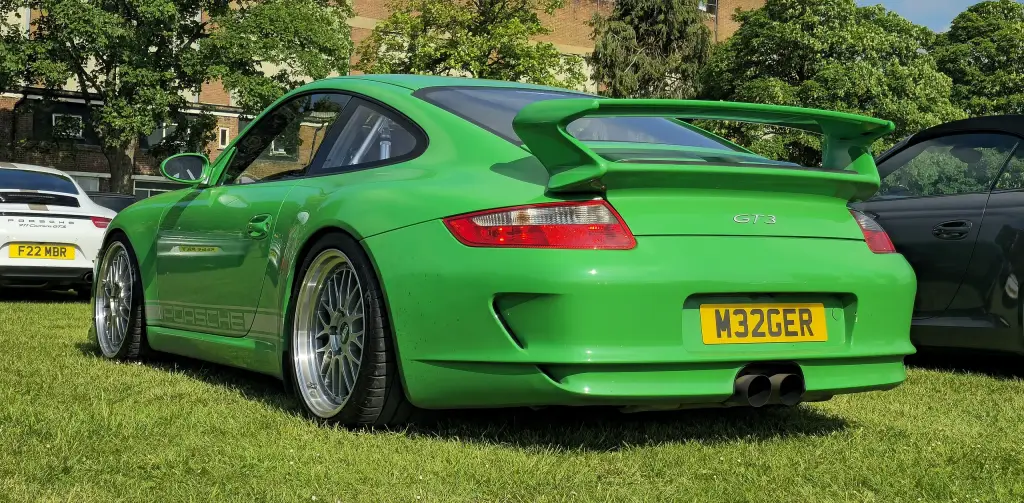
The Porsche 997 is the sixth generation of the 911, sold between 2004, for the 2005 model year, and 2013. It was an evolution of the 996 with substantially revised interior and exterior styling, most notably a return to the classic round headlamps.
Porsche 997 at a glance
| Maker | Porsche, Stuttgart |
|---|---|
| Production | 2004–2013 |
| Designer | Grant Larson |
| Starting point | development began in the fourth quarter of 1998 |
| Headlamps | round “bug eye” units with separate indicators |
| Wheels | 18-inch as standard |
| Drag coefficient | 0.28 Carrera, 0.29 Carrera S |
| Rear body | 88 mm wider than the 996 |
| New model | Carrera S with a larger engine, sports suspension and exhaust |
| 2009 facelift | direct injection and PDK dual-clutch gearbox |
| Bodies | coupé, cabriolet and Targa with a glass roof |
| Notable | only the Targa 4 and 4S versions were offered |
History of the Porsche 997
Development began in the fourth quarter of 1998. By February 1999 designers were working on the body, full-size clay models followed in 2000 and 2001, and the final design by Grant Larson was approved; prototypes were running by late 2001. The styling was close to the 996’s, but the rear bodywork was 88 mm wider and the face returned to oval headlights like those of pre-996 Carreras, with separate indicator units. The interior was redesigned and looked more like the classic 911 cabins than the 996’s did. The body kept a low drag coefficient of 0.28 for the Carrera and 0.29 for the Carrera S.
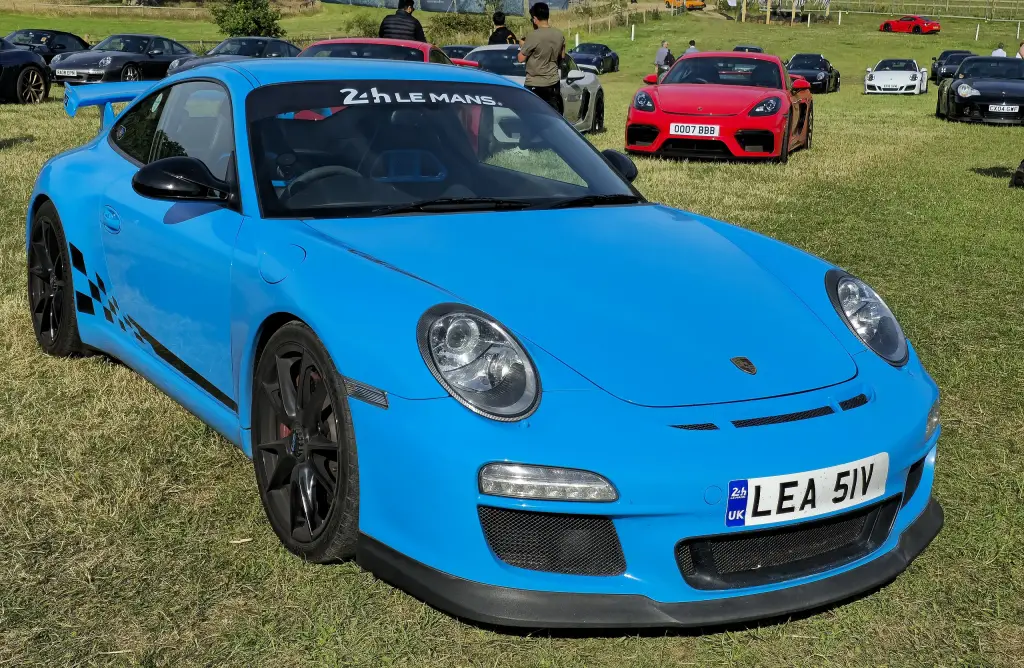
Production of the Carrera and Carrera S coupés began in early 2004, and the all-wheel-drive Carrera 4 and 4S reached customers in November 2005; the Turbo and GT3 followed in late 2006 and the GT2 in 2007. Larger 18-inch wheels were standard, power was slightly increased, and a new S version offered more power from a slightly larger engine together with a sports suspension and sports exhaust. Despite the many revisions the car remained technically very similar to its predecessor.
The cabriolet led the development for the first time at Porsche, on the reasoning that solving the harder open-car problems such as chassis stiffness would leave the coupé more rigid still. The cabriolets matched the coupés almost exactly in performance, their rear wing rose slightly higher to compensate for the drag of the canvas roof, and there was an optional factory hardtop. The Targa 4 and 4S arrived in 2006 with the glass roof system of the 993 and 996: the roof drops 25 mm and slides a metre back under the rear window, raising a small glass deflector above the windscreen when open. Because the roof adds 60 kg, the suspension was modified. Unlike earlier Targas, the 997 version came only in all-wheel-drive 4 and 4S form.
In 2005 Porsche also built a limited run of 50 Club Coupés for the 50th anniversary of the Porsche Club of America, based on the Carrera S with the X51 Powerkit, in an Azurro California colour recalling the 356, at US$99,911. The first car went to the Porsche Museum, one was won in a sweepstakes and the rest went to PCA members in the United States and Canada.
During 2009 Porsche refreshed the range with styling changes, a new direct-injection engine replacing the Mezger unit and the PDK dual-clutch gearbox in place of the Mercedes-sourced five-speed Tiptronic. The revised cars were faster, lighter and more economical, with better handling, and the Turbo gained a retuned all-wheel-drive system with optional torque vectoring. The motoring press was mostly positive: even Jeremy Clarkson, no admirer of Porsches, wrote that the 997 would make love to your fingertips and stir your soul.
Design and features
- Round headlamps: a return to the classic 911 face after the 996’s fried-egg units.
- Wider rear body: 88 mm more than the 996, with 18-inch wheels as standard.
- Carrera S: a new model with a larger engine, sports suspension and exhaust.
- 2009 update: direct injection and the PDK dual-clutch gearbox.
Porsche 997 versions
- Carrera and Carrera S (2004): the first coupés, with a new S model.
- Carrera 4 and 4S (2005): all-wheel-drive versions.
- Turbo and GT3 (2006), GT2 (2007): the high-performance derivatives.
- Targa 4 and 4S (2006): glass-roof cars, all-wheel drive only.
- Club Coupé (2005): 50 cars for the Porsche Club of America’s anniversary.
The 997 followed the Porsche 996, and its engine architecture links it to the Porsche Cayman. More cars are in the Porsche collection.
Video: JP Performance – Porsche 997 Turbo
Video by JP Performance on YouTube.
Sources
- Porsche 911 (997), English Wikipedia: development, design, bodies, 2009 facelift