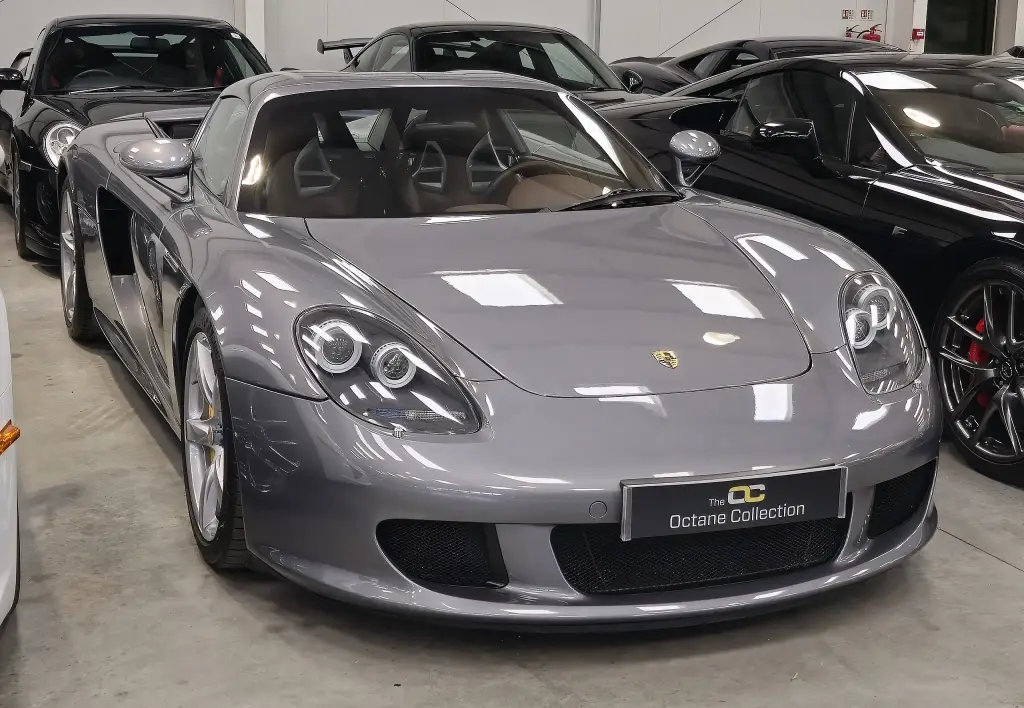
The Porsche Carrera GT (project code 980) is a mid-engined sports car that Porsche manufactured from 2003 to 2006. It combined a 5.7-litre V10 engine with a carbon-fibre monocoque, a manual gearbox and no driver aids to speak of, and Sports Car International ranked it first among the top sports cars of the 2000s.
Porsche Carrera GT at a glance
| Produced | 2003 to 2006; production ended on 6 May 2006 |
|---|---|
| Built | 1,270 cars; 1,500 had been planned |
| Engine | 5.7 L (5,733 cc) 68° V10, 980/01 |
| Output | 612 PS (450 kW) at 8,000 rpm and 590 N·m at 5,750 rpm |
| Gearbox | 6-speed manual; twin-plate ceramic dry clutch |
| 0–60 mph | 3.5 seconds (Car and Driver, June 2004) |
| Top speed | 330 km/h (205 mph), official |
| Structure | carbon-fibre monocoque and subframe made by ATR Composites in Italy |
| Brakes | carbon-ceramic (C/SiC) discs, 380 mm |
| Weight | 1,380 kg (3,042 lb) |
| Length | 4,613 mm |
| Nürburgring Nordschleife | 7:28 |
History of the Porsche Carrera GT
The Carrera GT can be traced back to the 911 GT1 and the LMP1-98 racing cars. When FIA and ACO rule changes in 1998 ended both designs, Porsche planned a new Le Mans prototype for 1999. It was first meant to use a turbocharged flat-six, but was redesigned around a new V10 based on an engine Porsche had secretly built for the Footwork Formula One team in 1992, which pushed completion back to 2000. The LMP 2000 was cancelled in November 1999, amid rumours that it had been dropped as part of a deal with the Volkswagen Group over the Porsche Cayenne, which also let Audi race at Le Mans without Porsche competition.
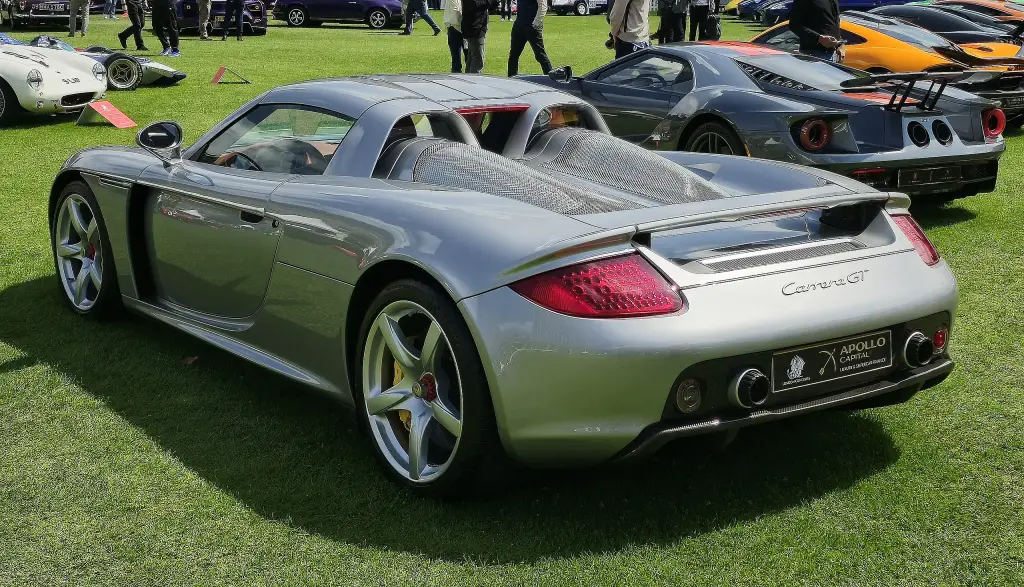
Porsche kept part of the project alive. It put the 5.5-litre V10 from the prototype into a concept car called the Carrera GT, shown at the 2000 Paris Motor Show, mainly to draw attention to its stand. Surprising interest in the show car, and revenue from the Cayenne, led Porsche to put it into production in small numbers at its new Leipzig plant. The first Carrera GT went on sale in the United States on 31 January 2004.
Production
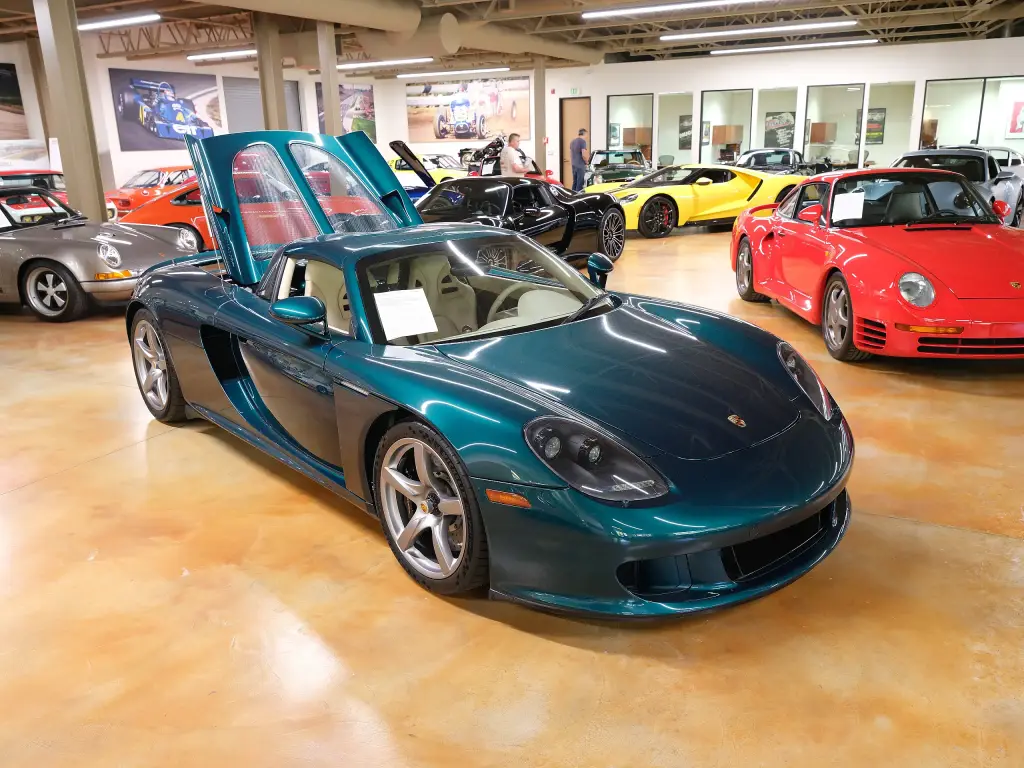
A run of 1,500 cars was planned, but in August 2005 Porsche announced that it would stop early, citing changing airbag regulations in the United States. By the end of production on 6 May 2006, 1,270 cars had been made; 644 were sold in the United States, 31 in Canada and 49 in the United Kingdom. The car was offered in five basic colours: Guards Red, Fayence Yellow, Basalt Black, GT Silver metallic and Seal Grey, with custom colours added later.
Design and technology
The Carrera GT was the first production car whose monocoque and engine subframe were both made entirely of carbon-fibre reinforced plastic, according to the German source. The structure was produced by ATR Composites in Italy. The roof was made of two carbon shells that could be stored in the boot, the wheels were held by centre-locking nuts, as in racing, and an electronically operated rear wing rose at speeds above 113 km/h. The suspension used pushrod-actuated shock absorbers and inboard dampers, the engine used dry-sump lubrication, and its radiator was about five times the size of that of a contemporary 911 Turbo.
The 5.7-litre V10 produced 612 PS and was mated to a traditional six-speed manual, the only transmission offered, through a ceramic clutch. The brakes were carbon-ceramic discs. As on other Porsches the ignition was to the left of the steering wheel, a hold-over from the days when Le Mans drivers had to make a running start. The interior was trimmed in leather, with a Bose audio system and navigation as standard. Walter Röhrl, the former world rally champion, led much of the chassis tuning at the Nürburgring, according to the German source.
Awards and later versions
Popular Science gave the car its Best of What’s New award in 2003, and Sports Car International placed it eighth on its list of the top sports cars of all time. In 2013 Zagato introduced the Porsche Carrera GTZ, based on the Carrera GT and commissioned by a Swiss collector and former racing driver; it had a modified carbon body and the same technical specification, and six were built.
Design and features
- Structure: a carbon-fibre monocoque and subframe, the first in a Porsche road car.
- Engine: a V10 derived from the cancelled Le Mans prototype and an earlier Formula One engine project.
- Gearbox: six-speed manual only, with a ceramic dry clutch.
- Aerodynamics: an electronically operated rear wing and an underbody airflow kit.
Porsche Carrera GT versions
- Carrera GT concept (2000): shown at the Paris Motor Show with a 5.5-litre V10 of 566 PS.
- Carrera GT (2003–2006): the production car with a 5.7-litre engine of 612 PS.
- Carrera GTZ (2013): a Zagato-bodied special; six were built.
The Carrera GT sits between the track-bred Porsche 911 GT3 and the hybrid Porsche 918, and carries on from the earlier Porsche 959. More Porsches are in our Porsche collection.
Porsche Carrera GT questions and answers
When was the Porsche Carrera GT built?
From 2003 to 2006 at Porsche’s Leipzig plant.
How many were made?
1,270, fewer than the 1,500 originally planned.
How fast was it?
Porsche’s official top speed was 330 km/h (205 mph), and Car and Driver recorded 0–60 mph in 3.5 seconds.
Where did the engine come from?
From a V10 that Porsche developed for a Le Mans prototype that was cancelled in 1999, itself based on an engine built for Footwork in 1992.
Did it have an automatic gearbox?
No. The six-speed manual was the only gearbox offered.
Sources
- Porsche Carrera GT, English Wikipedia: history, production, design and specifications
- Porsche Carrera GT, German Wikipedia: development, body and carbon structure
- Porsche Carrera GT, Italian Wikipedia: cross-check