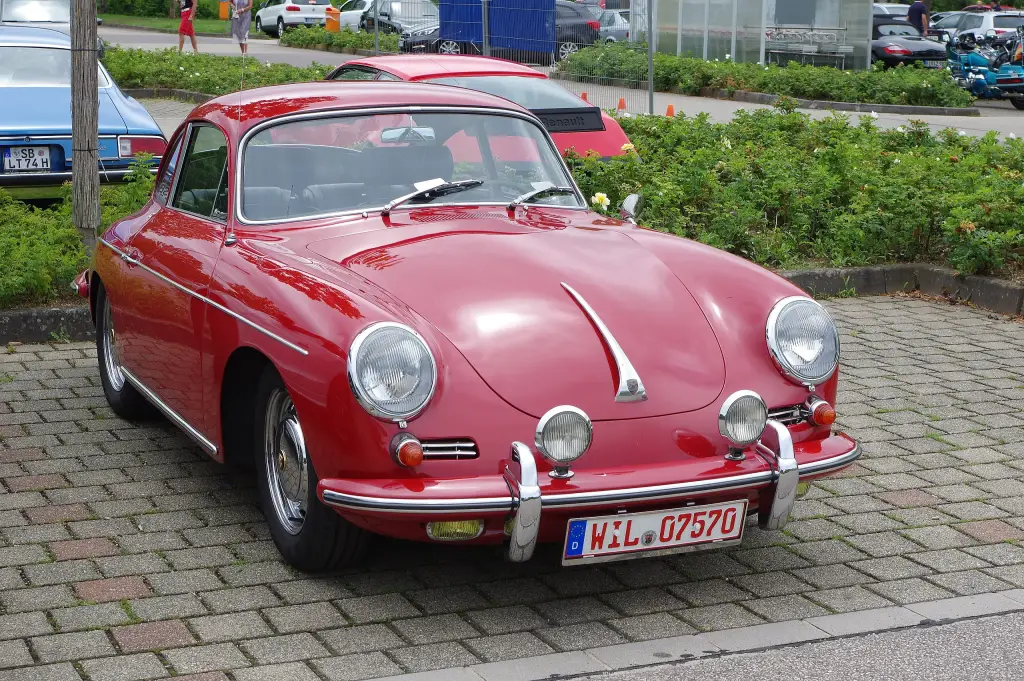
The Porsche 356C was the last development of the car that made Porsche a manufacturer. It was little changed from the late T6 356B, but disc brakes replaced the drum brakes of the earlier cars. Production of the 356 series ended in April 1965, well after the 911 had made its debut in September 1964.
Porsche 356C at a glance
| Maker | Dr. Ing. h. c. F. Porsche GmbH, Zuffenhausen |
|---|---|
| Series | 356 pre-A, 356A, 356B, 356C |
| Place in the series | final version, little changed from the late T6 356B |
| Main change | disc brakes instead of drums |
| Engine | 1.6-litre air-cooled pushrod flat-four |
| Layout | rear engine, rear-wheel drive |
| Bodies | coupé and cabriolet, steel from 1950 |
| Body supplier | Reutter, bought by Porsche in 1963 |
| Production ended | April 1965 |
| Total 356 production | about 76,000, of which roughly half survive |
The English Wikipedia article covers the whole 356 series rather than the C alone; this page takes the C generation from it.
History of the Porsche 356C
The 356 was Porsche’s first production automobile. It began in 1948 at Gmünd in Austria, where Porsche built about 50 cars in aluminium, and moved to Zuffenhausen in Germany in 1950, when the bodies became steel and were contracted to Reutter. The car was a four-cylinder, air-cooled, rear-engined two-seater with unitised pan and body construction, designed by Erwin Komenda, and it shared some mechanical parts with the Volkswagen Beetle at the start.
Porsche built the 356 in four distinct series: the original “pre-A”, then the 356A, the 356B and finally the 356C. Buyers and historians tell them apart by details: the pre-A cars have a split windscreen up to 1952 and a bent, centre-creased one from 1953 to 1955; the 356A of late 1955 brought a curved windscreen and was the first road-going Porsche to offer the four-cam Carrera engine; the T5 356B arrived in late 1959 and the redesigned T6 356B in 1962.
The 356C closed the line in 1963–1965. It followed the late T6 356B closely, and the visible difference under the skin was the switch from drum to disc brakes. That was a modest end for a car that had grown from a small Austrian workshop into Porsche’s main product: by the time production stopped in April 1965, approximately 76,000 had been built, of which about half are thought to survive.
The 356 had already proved itself in racing, and its reputation was built on events as much as on showrooms. A class win at Le Mans in 1951 helped sales on both sides of the Atlantic, the four-cam Carrera engine arrived in late 1954, and owners commonly raced the cars as well as driving them on the road. Orders passed 10,000 units in 1964, at the very end of the model’s life.
The replacement was already in the showroom. The 911 made its debut in September 1964, and Porsche also prepared a cheaper four-cylinder car, the 912, using a higher-revving 616/36 version of the 356’s pushrod engine. The 912 was priced at the level of a 356 1600 SC and was not intended as the 356’s successor in name, only in the showroom.
Design and features
- Disc brakes: the C’s main technical step forward over the drum-braked 356B.
- Familiar body: the T6 shape, with the bigger front boot and rear engine compartment opening introduced with the 356B.
- Pushrod flat-four: the simple air-cooled engine that made the 356 cheap to run and easy to tune.
- Steel body by Reutter: the coachbuilder Porsche bought in 1963; its seat division became Recaro.
Porsche 356C versions
- 356C coupé: the closed body, the most common form.
- 356C cabriolet: the open version, offered through the series.
- 356SC: the higher-output C, sold alongside the standard car.
- 912 (1965): the four-cylinder 911-shaped car that used the 356 engine line after the C ended.
The C was the end of the line that began with the Porsche 356; its four-cylinder engine lived on in the Porsche 912. More cars are in the Porsche collection.
Sources
- Porsche 356, English Wikipedia: series, C specification, production figures