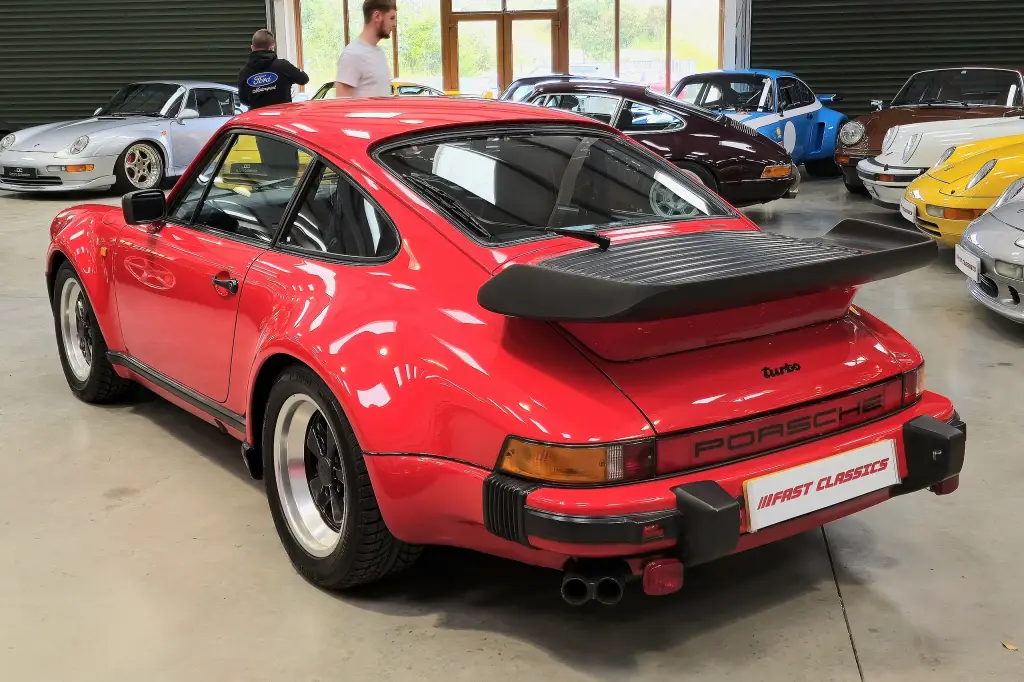
The Porsche 911 Turbo, known internally as the 930, was made from 1975 to 1989 as the top of the 911 range. At its launch it was the fastest production car in Germany, and it was built at first mainly to satisfy the rules that let Porsche race a turbocharged 911.
Porsche 930 at a glance
| Maker | Porsche, Stuttgart |
|---|---|
| Production | 1975–1989 |
| Badge | “Turbo”; early US cars were “Turbo Carrera” |
| Shown | Paris Auto Show, October 1974 |
| On sale | spring 1975; US exports from 1976 |
| Engine | 3.0-litre turbocharged flat-six, single KK&K turbocharger |
| Power | 260 PS at 5,500 rpm |
| Torque | 329 N·m at 4,000 rpm |
| Compression | 6.5:1 |
| From 1978 | 3,299 cc with air-to-air intercooler, 300 PS |
| Gearbox | four-speed manual |
| Body | flared arches, wider rear wheels, whale tail spoiler |
History of the Porsche 930
Porsche had been experimenting with turbocharging on its racing cars since the late 1960s and began work on a turbocharged 911 in 1972. The car was originally needed to satisfy homologation rules, and Porsche intended to market it as a street-legal racing car like the 1973 Carrera 2.7 RS. The FIA’s rules changed for 1975 and 1976: Group 4 and Group 5 cars had to be production models available through dealer networks, and from 1976 manufacturers had to build 400 cars within 24 months for Group 4. Porsche homologated the 911 Turbo RSR (934) for Group 4 on 6 December 1975, and 400 Turbos had been built by the end of that year.
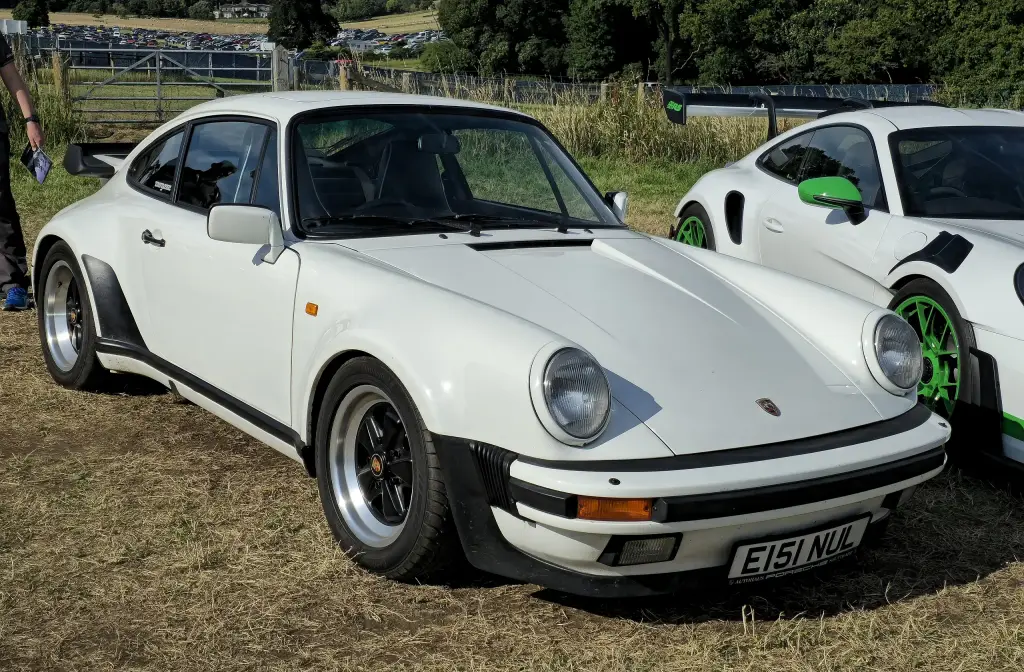
Ernst Fuhrmann adapted the turbocharging technology developed for the 917/30 Can-Am car to the 3.0-litre flat-six of the Carrera RS 3.0, creating what Porsche called the 930. It used a single KK&K turbocharger and produced 260 PS at 5,500 rpm and 329 N·m at 4,000 rpm on a 6.5:1 compression ratio. To cope, the car received revised suspension, larger brakes and a stronger gearbox, though customers complained that it had a four-speed transmission while the cheaper Carrera offered five. A “whale tail” rear spoiler vented air to the engine and added rear downforce, and flared arches with wider rear wheels and tyres increased width and grip.
Porsche badged the car simply as “Turbo”, although early American cars were sold as “Turbo Carrera”, and showed it at the Paris Auto Show in October 1974 before sales began in spring 1975. Ferry Porsche gave the first car to his sister Louise Piëch for her 70th birthday; it had the big rear spoiler of later cars but the narrower Carrera body, and a turbocharged 2.7-litre engine of 240 hp instead of the later 3.0-litre unit. The 1,000th 911 Turbo was finished on 5 May 1976.
The 930 was very fast and very demanding. Its short wheelbase and rear engine made it prone to oversteer and turbo lag, and too much throttle could swing the heavy rear end out like a pendulum. After several crashes and deaths it acquired the nickname “the Widowmaker”, and Porsche still requires employees who drive 911 Turbos on company business to take “Turbo Training”.
The biggest change came for 1978: the bore grew by 2 mm to 3,299 cc and an air-to-air intercooler was added, raising output to 300 PS at 5,500 rpm and 412 N·m at 4,000 rpm. The whale tail was reprofiled and raised to clear the intercooler and became known as the “tea tray”, the suspension gained new anti-roll bars, firmer dampers and larger rear torsion bars, and the brakes were upgraded to units similar to those of the 917. The extra weight, especially in the engine, changed the car’s character. Emissions rules forced Porsche to withdraw the 930 from Japan and the United States in 1980, though it stayed on sale in Canada and Europe, and it remained the top 911 until production ended in 1989.
Design and features
- Turbocharged flat-six: 260 PS from 3.0 litres, then 300 PS from the intercooled 3.3.
- Whale tail: the rear spoiler that vented engine air and pressed the tail down.
- Wide body: flared arches and bigger rear wheels for grip and stability.
- Turbo technology from racing: adapted from the 917/30 Can-Am car.
Porsche 930 versions
- 930 3.0 (1975–1977): 260 PS, no intercooler.
- 930 3.3 (1978–1989): intercooled engine, 300 PS, tea-tray spoiler.
- Turbo No. 1: the 70th-birthday car for Louise Piëch, with a 2.7-litre engine.
- US Turbo Carrera: early American badging and equipment.
The 930 is the turbocharged version of the Porsche 911, and it was developed into the racing Porsche 934 and Porsche 935. More cars are in the Porsche collection.
Sources
- Porsche 911 (930), English Wikipedia: homologation, engine, 1978 update, reputation