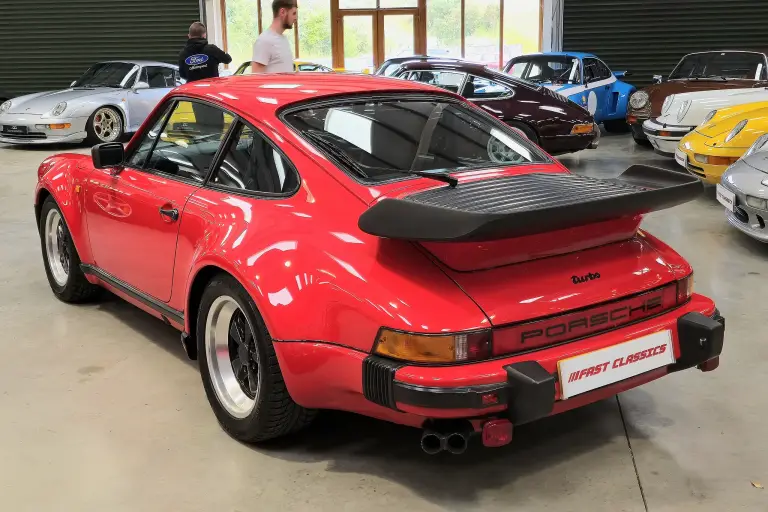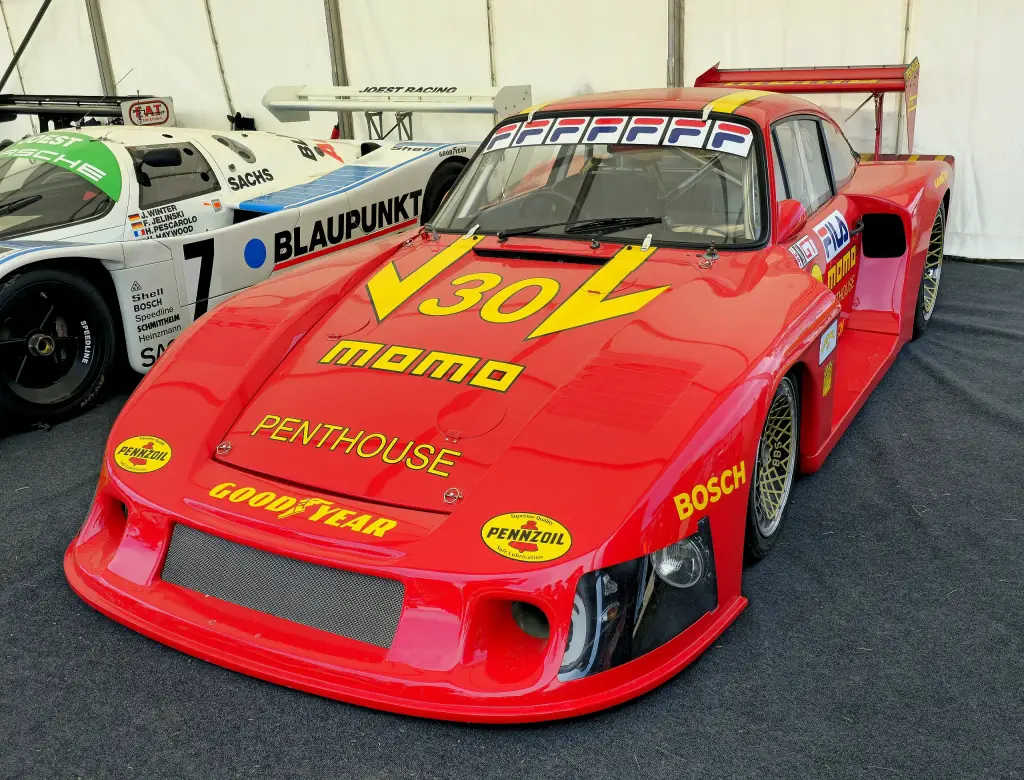
The Porsche 935 is a race car introduced in 1976 as the factory racing version of the 911 (930) Turbo, prepared to FIA Group 5 rules. It was an evolution of the Carrera RSR 2.1 turbo prototype that had finished second overall at Le Mans in 1974, and it became one of the most successful racing cars Porsche ever built.
Porsche 935 at a glance
| Maker | Porsche, Stuttgart |
|---|---|
| Introduced | 1976 |
| Class | FIA Group 5, silhouette rules |
| Basis | 911 (930) Turbo |
| Engine | 3.3-litre Type 935 twin-turbocharged flat-six |
| Fuel system | mechanical fuel injection |
| Power | up to 630 kW (857 PS) |
| 1976 engine | 3.0-litre, 418 kW at 7,900 rpm, capacity reduced to 2.85 litres |
| Weight, 1976 car | 900 kg empty, with 70 kg of ballast available |
| Best result | overall win at the 1979 24 Hours of Le Mans |
| Record | 123 wins from 370 races entered |
History of the Porsche 935
The 935 was the second half of Porsche’s two-pronged attack on 1976, alongside the new Group 6 Porsche 936, and both were sponsored by Martini Racing. Group 5, the “silhouette” rules, allowed major modifications — bodywork changes, larger wings, wider axles and even water cooling — provided the basic silhouette of the car was unchanged when seen from the front.
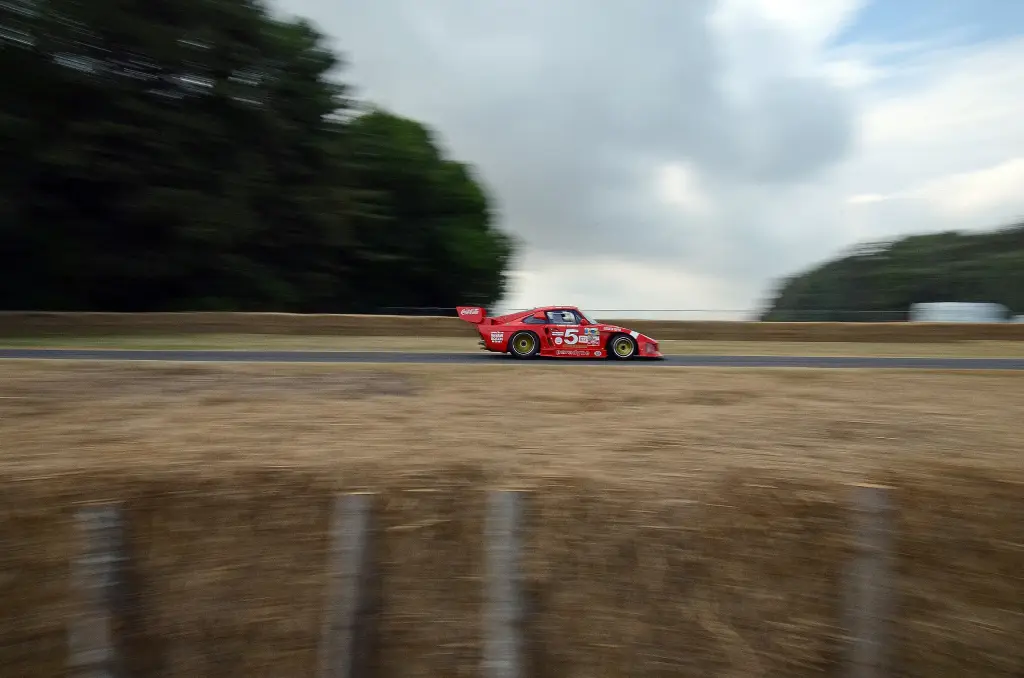
The 1976 engine was a 3.0-litre flat-six producing 418 kW at 7,900 rpm and 588 N·m at 5,400 rpm, with boost between 1.35 and 1.55 bar and fuel consumption of 52 litres per 100 km. Capacity was reduced to 2.85 litres and, with the 1.4 turbocharging factor, the car fitted the 4.0-litre class with a minimum weight of only 970 kg. The empty 935 weighed 900 kg and its balance could be adjusted with up to 70 kg of ballast; testing at Paul Ricard showed 295 km/h.
The car was developed under pressure. After the second race the rule makers insisted that the whale-tail engine cover of the road-going 930 must fit the race car, so the air-to-air intercooler had to be replaced with a more compact air-to-water layout, which cost Porsche several weeks of testing and half a million Deutsche Mark. Porsche engineers, notably Norbert Singer, then found a loophole in the fender rules that allowed the headlights to be removed, cutting drag and adding downforce through venting slits; the resulting flat nose, or slant nose, with the lights in the front spoiler became the 935’s signature and was later offered on the road-going 930 as the Flachbau.
From 1977 the 935 was sold to customers racing in the World Championship for Makes, IMSA and the Deutsche Rennsport Meisterschaft. Usually no other make could challenge it, because other manufacturers did not supply customer cars as Porsche did, and a typical race featured at least five 935s. The customer version used the 3.3-litre Type 935 twin-turbocharged flat-six with mechanical fuel injection, good for up to 630 kW, though the big turbos brought noticeable lag at low revs.
The record is remarkable: an overall win at the 1979 24 Hours of Le Mans, where Porsches filled the first four places, plus Sebring, Daytona and the 1,000 km Nürburgring, and 123 wins from 370 races entered. In 1976 the 935 and the 936 between them covered both world championships, and Porsches took the first seven places at Mugello ahead of the best BMW. The 935’s dominance ended when the FIA replaced the numbered groups with Groups A, B and C in 1982. A second generation of 935 was built in 77 units, delivered from June 2019.
Design and features
- Silhouette racer: Group 5 rules allowed a completely reworked car under an unchanged frontal outline.
- Twin-turbo flat-six: up to 630 kW from 3.3 litres with mechanical injection.
- Slant nose: headlights moved into the front spoiler for less drag and more downforce.
- Customer programme: sold to private teams, which is why the grids were full of them.
Porsche 935 versions
- 935/76: the first factory car, 2.85-litre engine, 418 kW.
- 935 customer cars (from 1977): 3.3-litre twin-turbo, up to 630 kW.
- 935 K-series: Kremer-developed cars such as the K1.
- 2019 935: a second-generation tribute built in 77 units.
The 935 was the Group 5 sister of the Porsche 934, built from the Porsche 930, and it raced alongside the Porsche 936. More cars are in the Porsche collection.
Sources
- Porsche 935, English Wikipedia: rules, engines, results, slant nose