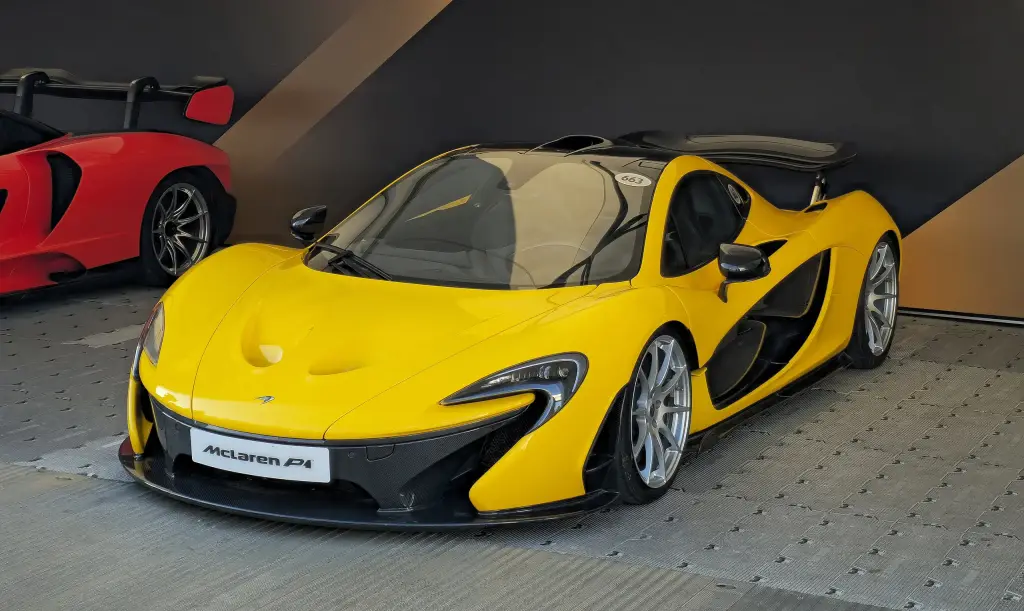
The McLaren P1 (codenamed P12) is a flagship sports car made by McLaren Automotive, styled by the American designer Frank Stephenson. It is the second installment in McLaren’s Ultimate Series after the F1 and is considered its spiritual successor. It was first shown as a concept at the 2012 Paris Motor Show and made its debut at the 2013 Geneva Motor Show.
McLaren P1 at a glance
| Maker | McLaren Automotive, United Kingdom |
|---|---|
| Concept | 2012 Paris Motor Show |
| Debut | 2013 Geneva Motor Show |
| Designer | Frank Stephenson |
| Layout | mid-engine, rear-wheel drive, carbon-fibre monocoque |
| Engine | 3.8 L (3,799 cc) twin-turbo V8, 737 PS at 7,500 rpm |
| Electric motor | 132 kW (179 PS), 260 N·m |
| Combined output | 916 PS (903 hp) and 900 N·m |
| Gearbox | 7-speed dual-clutch by Graziano |
| Battery | 324-cell lithium-ion, full charge in two hours |
| Electric range | at least 10 km (European cycle) |
| Production | 375 units |
English Wikipedia is the only source used here, so the facts were not cross-checked against a second source; figures are the maker’s claims.
History of the McLaren P1
A successor to the F1
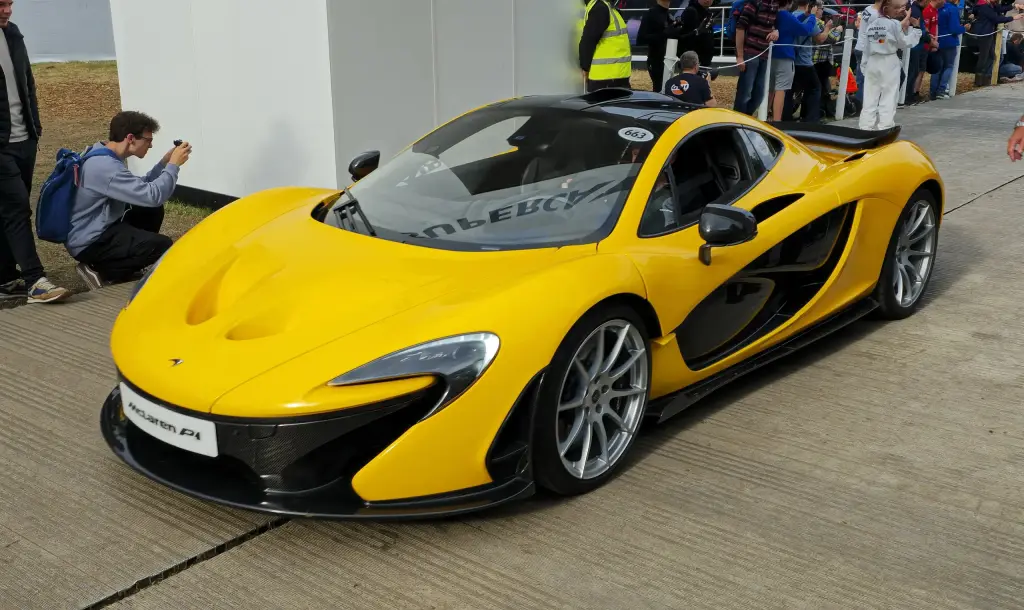
After the McLaren F1 ended production in 1998, McLaren Automotive was dormant until 2010, and the 12C of 2011 was its first production car since. Autocar reported that a flagship, internally the “Mega Mac”, was planned, with production limited to 500 units. The first teaser appeared in September 2012, with Frank Stephenson in charge of the exterior; he drew inspiration from a sailfish he saw on holiday in Miami. The Paris concept quoted 600 kg of downforce “well below maximum speed”, a drag coefficient of 0.34 and active aerodynamics. The P1 was one of the first high-performance sports cars with hybrid technology, with the Porsche 918 Spyder having begun taking orders earlier and the LaFerrari introduced alongside it.
Powertrain
The 3.8-litre twin-turbo V8 boosts at 1.4 bar to 737 PS and 720 N·m, combined with an in-house electric motor of 179 PS and 260 N·m. Together they give 916 PS and 900 N·m. The electric motor can be used manually or left in automatic mode, where it “torque fills” the gaps in the petrol engine’s output, that is the turbo lag, giving a powerband of almost 7,000 rpm. The battery, developed by Johnson Matthey Battery Systems, sits behind the cabin and can be charged by the engine or from a plug. In all 375 units were produced, with special editions such as the non-road-legal P1 GTR and the P1 LM in smaller runs; several pre-production prototypes were later refurbished and sold.
Design and features
- Torque fill: the electric motor fills the turbo lag.
- Structure: carbon-fibre monocoque, like the F1.
- Rivals: the Porsche 918 Spyder and the LaFerrari.
McLaren P1 versions
- P1 (2013): the road car, 375 built.
- P1 GTR (2015–2016): track-only.
- P1 LM (2016–2017): a smaller-run special edition.
More McLaren cars are in our McLaren collection and more grand tourers and flagships in Luxury Cars.
Sources
- McLaren P1, English Wikipedia: background, specifications, production