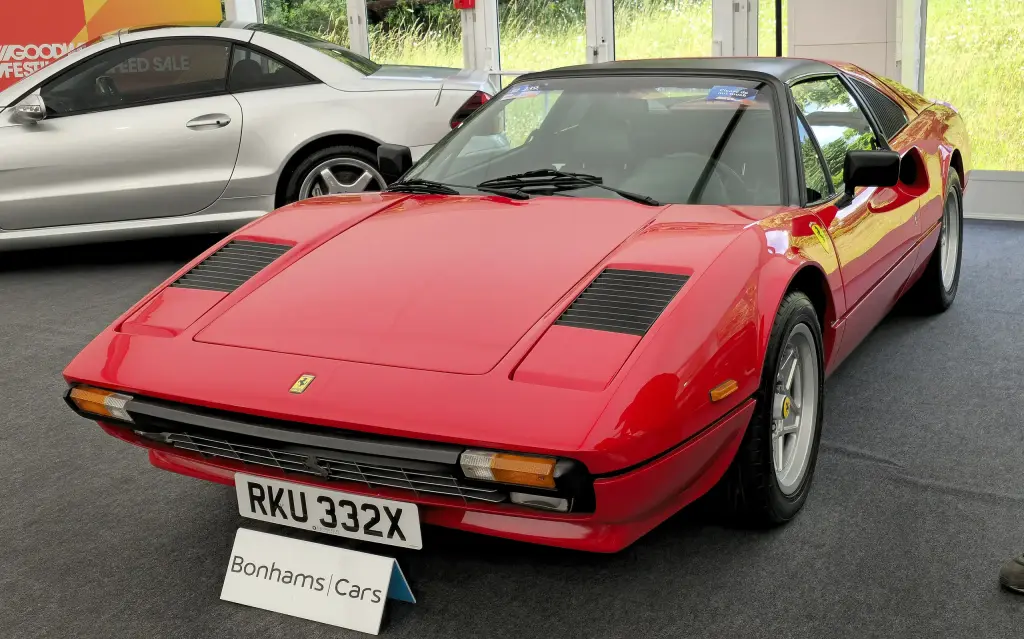
The Ferrari 308 GTB berlinetta and targa-topped 308 GTS are mid-engined V8 two-seater sports cars built from 1975 to 1985. The 308 replaced the Dino 246 GT and GTS and was itself updated into the 328 in 1985.
Ferrari 308 at a glance
| Production | 1975–1985 |
|---|---|
| Models | 308 GTB, 308 GTS, GTBi/GTSi, Quattrovalvole |
| Engine | F106 AB 90° V8, flat-plane crankshaft |
| Valve gear | two belt-driven overhead camshafts per bank |
| European power | 255 PS (188 kW) at 6,600 rpm |
| US power | 240 PS (177 kW) at 6,600 rpm |
| Carburettors | four Weber 40DCNF (early cars) |
| Gearbox | five-speed dog-leg manual transaxle |
| Chassis | tube frame with separate body |
| Body | Pininfarina design by Leonardo Fioravanti |
| GTB built, 1975–1980 | 2,897 |
| GTS built, 1975–1980 | 3,219 |
based on one source (English Wikipedia).
History of the Ferrari 308
The Pininfarina-styled 308 GTB was introduced at the Paris Motor Show in 1975 as a supplement to the Bertone-shaped 2+2 Dino 308 GT4 and a direct replacement for the two-seater Dino 246. Its body was drawn by Leonardo Fioravanti, who had already shaped the Daytona, the Dino and the Berlinetta Boxer, and it deliberately contrasted with the angular GT4. The 308 GTB and GTS shared a tubular platform and were mechanically similar to the GT4, which as a 2+2 rode on a longer wheelbase.
Engine and chassis
The engine was a 90° V8 with a flat-plane crankshaft and two belt-driven overhead camshafts per bank, mounted transversely in unit with the transaxle below and behind the sump. Early cars used four twin-choke Weber 40DCNF carburettors and single-coil ignition: European versions produced 255 PS at 6,600 rpm with a 7,700 rpm redline and dry-sump lubrication, while American cars were rated at 240 PS because of emission controls, and cars for Australia, Japan and the United States used the GT4’s wet-sump engine. All models had a fully synchromesh five-speed dog-leg gearbox and a clutch-type limited-slip differential. Suspension was independent all round with double wishbones, coil springs, hydraulic dampers and anti-roll bars at both ends, with ventilated disc brakes and unassisted rack-and-pinion steering.
Fibreglass, then steel
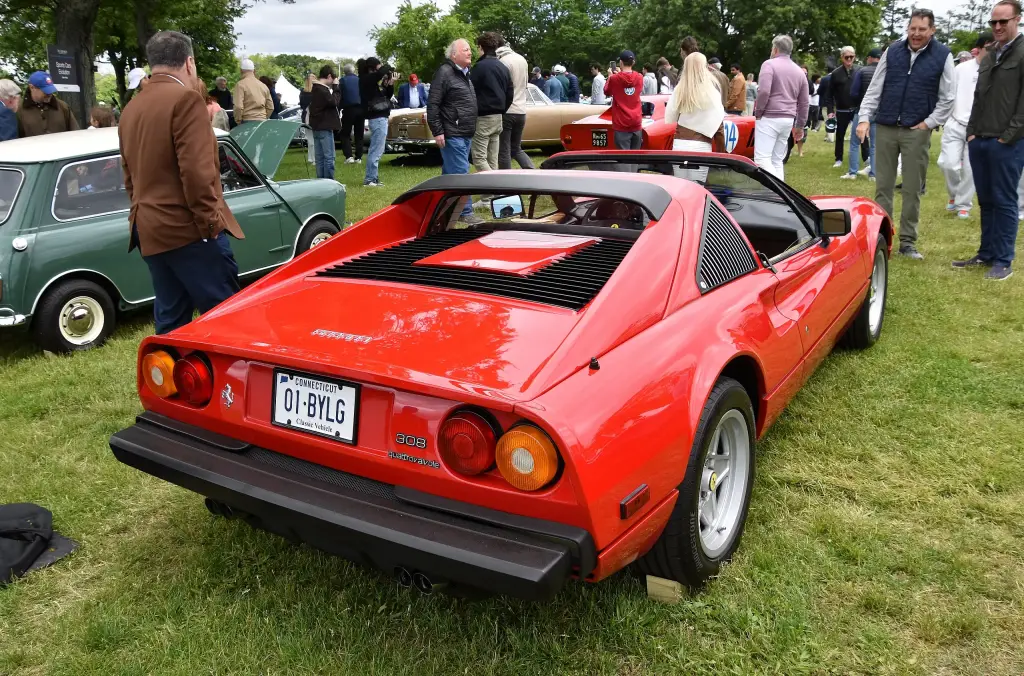
A notable feature of the early 308 GTB was its bodywork: although still built by Carrozzeria Scaglietti, it was made entirely of glass-reinforced plastic, which kept weight down to 1,050 kg. That lasted until June 1977, when the 308 switched to steel bodies and gained roughly 150 kg. Five-spoke 14-inch alloy wheels were standard, with 16-inch wheels, a sports exhaust, high-compression Borgo pistons, a high-lift camshaft and a deeper front spoiler offered later as the “Sprintpack”. The targa-topped 308 GTS arrived at the 1977 Frankfurt Motor Show with a removable roof panel that could be stowed in a vinyl cover behind the seats; all GTS cars had steel bodies and wet-sump engines, and European GTBs kept dry-sump lubrication until 1981. Between 1975 and 1980 Ferrari built 3,219 GTS and 2,897 GTB cars, of which only 808 were the fibreglass “vetroresina” berlinetta.
Fuel injection and four valves
In 1980 Bosch K-Jetronic mechanical fuel injection arrived with the names 308 GTBi and GTSi. It cut emissions but reduced power to 214 PS in Europe and 205 PS in the United States, and was paired with Marelli MED 803A Digiplex electronic ignition with a coil, distributor and module for each bank. Externally the cars were unchanged apart from metric wheels on Michelin TRX tyres; inside, the clock and oil temperature gauge moved to the centre console and a new three-spoke steering wheel appeared. Ferrari built 494 GTBis and 1,743 GTSis before the 308 Quattrovalvole of 1982 restored performance with four valves per cylinder, pushing output back to 240 hp.
Design and features
- Mid-mounted V8: a flat-plane 90° engine with two camshafts per bank and a transverse transaxle.
- Fioravanti styling: a wedge-shaped Pininfarina body that became one of Ferrari’s most recognisable shapes.
- Fibreglass body: the first 808 berlinettas weighed 1,050 kg before the switch to steel in 1977.
- Targa roof: the GTS’s removable panel stowed behind the seats.
- Quattrovalvole: four-valve heads from 1982 brought power back to 240 hp.
Ferrari 308 versions
- 308 GTB (1975–1980): berlinetta, fibreglass until June 1977 and steel afterwards.
- 308 GTS (1977–1980): targa-roof version with a wet-sump engine.
- 308 GTBi / GTSi (1980–1982): Bosch fuel injection, 214 PS in Europe.
- 308 Quattrovalvole (1982–1985): four valves per cylinder, 240 hp.
- 208 GTB / GTS: two-litre versions sold mainly in Italy.
The 308 replaced the Dino 246 and was developed into the Ferrari 328. More cars are in the Ferrari collection.
Video: 1981 Ferrari 308 GTSI – ROBIN 1
Video by theAFICIONAUTO on YouTube.
Sources
- Ferrari 308 GTB/GTS, English Wikipedia: design, engines, production numbers, model history