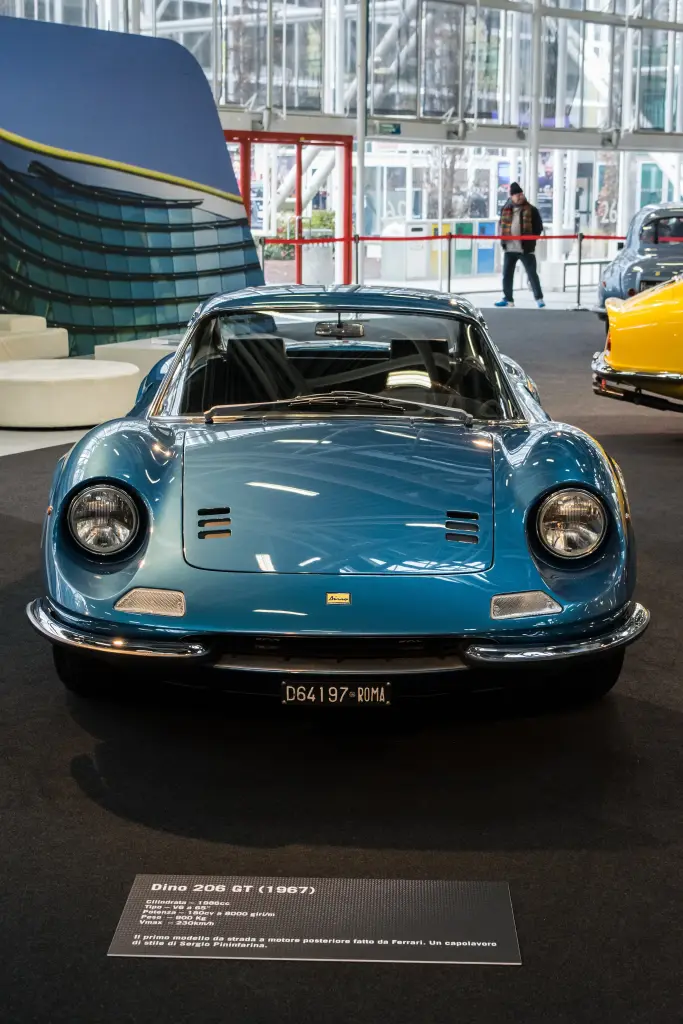
The Dino 206 GT, 246 GT and 246 GTS are V6 mid-engined sports cars produced between 1967 and 1974 and sold under the Dino marque. The 246 was the first automobile manufactured by Ferrari in high numbers.
Ferrari Dino at a glance
| Production | 1967–1974 |
|---|---|
| Marque | Dino |
| Models | 206 GT, 246 GT, 246 GTS |
| Layout | mid-mounted transverse V6 |
| 206 GT engine | 2.0 L all-aluminium 65° V6, DOHC |
| 206 GT power | 180 PS at 8,000 rpm |
| 246 GT engine | 2.4 L (2,419 cc) V6 |
| 246 GT power | 195 PS (143 kW) at 7,600 rpm |
| 246 GT torque | 226 N·m at 5,500 rpm |
| 206 GT production | 152 |
| Total production | 3,569 |
| Designers | Aldo Brovarone and Leonardo Fioravanti, Pininfarina |
based on one source (English Wikipedia).
History of the Ferrari Dino
The production Dino 206 GT was designed by Aldo Brovarone and Leonardo Fioravanti at Pininfarina and built by Scaglietti. It had the soft edges and curving lines typical of earlier Italian cars, in contrast to its angular successor, the 308 GT4. The 206 GT used a transverse-mounted 2.0-litre all-aluminium 65° V6 with dual overhead camshafts and a 9:1 compression ratio, making 180 PS at the 8,000 rpm redline and 187 N·m of torque at 6,500 rpm. The crankshaft had four main bearings, induction was through three Weber 40 DCN/4 two-barrel carburettors, and the engine was mounted behind the seats in the mid-engine layout.
Two technical firsts
The 206 GT was the first car sold by Ferrari with electronic ignition, a Dinoplex C capacitive discharge system developed by Magneti Marelli for the high-revving Dino V6. It was also the first Ferrari product with direct rack-and-pinion steering. The frame carried a lightweight aluminium body, full independent suspension and disc brakes all round, on a 2,290 mm wheelbase, for a top speed of 235 km/h. Altogether 152 were built between 1967 and 1969.
The 246 GT and GTS
The 246 GT enlarged the engine to 2.4 litres, 2,419 cc, producing 195 PS at 7,600 rpm and 226 N·m at 5,500 rpm. It was available as a fixed-top GT coupé or, after 1971, as the open 246 GTS Spyder. The GTS was built only after the Series III revision, from 1972 to 1974, and 274 were made; total production of the family reached 3,569 cars, making the Dino the first Ferrari-built automobile produced in large numbers. A 246 GTS won the Cannonball Baker Sea-to-Shining-Sea Memorial Trophy Dash in 1975, a result that added to the model’s reputation.
Reputation
Many enthusiasts praise the Dino for its driving qualities and ground-breaking design. In 2004 Sports Car International placed the car sixth on its list of top sports cars of the 1970s, and Motor Trend Classic put the 206/246 seventh among the ten greatest Ferraris of all time.
Design and features
- Mid-mounted V6: a compact 65° engine, 2.0 litres in the 206 and 2.4 in the 246.
- Pininfarina shape: soft, curving lines from Brovarone and Fioravanti, built by Scaglietti.
- Electronic ignition: the Dinoplex C system was a first for a car sold by Ferrari.
- Rack-and-pinion steering: direct, unassisted, and another first for Ferrari.
- Real volume: 3,569 cars made the Dino Ferrari’s first high-production model.
Ferrari Dino versions
- 206 GT (1967–1969): 2.0-litre V6, 152 built.
- 246 GT (1969–1974): 2.4-litre coupé.
- 246 GTS (1972–1974): removable-roof Spyder, 274 built.
The Dino led to the Ferrari 308, which replaced the 246 in 1975, and its mid-engine principles fed into the Berlinetta Boxer.
Video: Ride in a Ferrari Dino 246 GT
Video by DtRockstar1 on YouTube.
Sources
- Dino 206 GT and 246 GT, English Wikipedia: engines, design, firsts, production, reputation