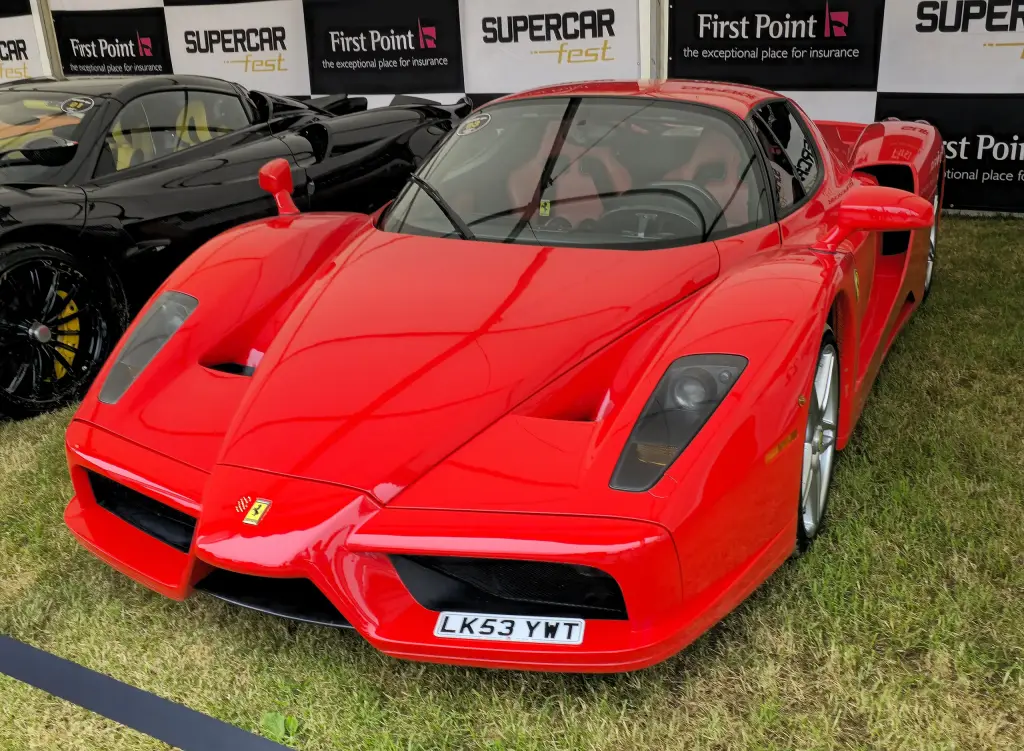
The Ferrari Enzo, officially marketed as Enzo Ferrari, is a mid-engine sports car built from 2002 and named after the company’s founder. It used Formula One technology such as a carbon-fibre body, an automated manual gearbox and carbon ceramic brakes, along with active aerodynamics that were not allowed in Formula One.
Ferrari Enzo at a glance
| Production | 2002–2004 |
|---|---|
| Type | F140 |
| Engine | 6.0-litre F140 B V12 |
| Power | 660 PS (485 kW; 651 hp) at 7,800 rpm |
| Torque | 657 N·m at 5,500 rpm |
| Gearbox | Formula One-style automated manual |
| Brakes | carbon fibre-reinforced silicon carbide (C/SiC) |
| Downforce | 343 kg at 200 km/h, 775 kg at 300 km/h |
| Designer | Ken Okuyama, Pininfarina |
| Announced | 2002 Paris Motor Show, 399 units planned |
| Built | 498 |
| Development mules | three, using 348 bodies |
based on one source (English Wikipedia). This article also covers the FXX and F60 records that redirect here, as the FXX is an Enzo-based track car.
History of the Ferrari Enzo
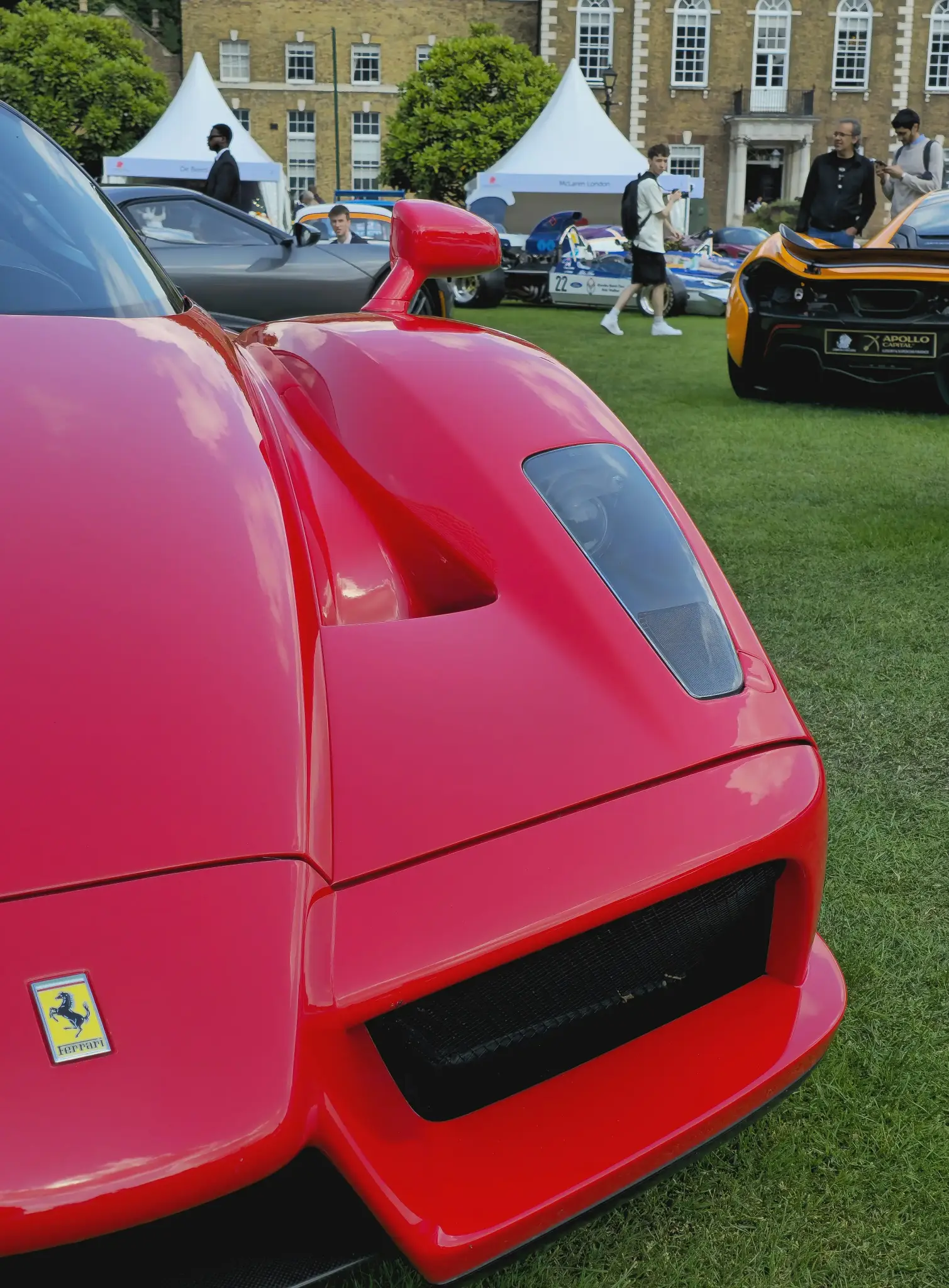
The Enzo was developed in 2002 using Formula One technology: a carbon-fibre body, a Formula One-style automated-shift manual transmission and carbon fibre-reinforced silicon carbide ceramic composite disc brakes, plus technologies not allowed in Formula One such as active aerodynamics. Its F140 B V12 was the first of a new generation of Ferrari engines. The car generates substantial downforce through front underbody flaps, a small adjustable rear spoiler and a rear diffuser, which together produce 343 kg at 200 km/h and 775 kg at 300 km/h, decreasing to 585 kg at top speed.
Production and the Vatican car
The Enzo was designed by Ken Okuyama, then Pininfarina’s head of design, and announced at the 2002 Paris Motor Show with a limited run of 399 units. Ferrari sent invitations to existing customers, specifically those who had previously bought an F40 and an F50. In 2004 the 400th production car was built and donated to the Vatican for charity; it was later sold at a Sotheby’s auction for US$1.1 million. A total of 498 units were built, and three development mules, M1, M2 and M3, were made using the bodywork of the 348.
Engine and performance
The 6.0-litre V12 produced 660 PS at 7,800 rpm and 657 N·m of torque at 5,500 rpm, driving through the automated manual gearbox that had become Ferrari’s signature in its road cars. The Enzo’s combination of a carbon-fibre chassis, race-derived brakes and active aerodynamics made it the benchmark supercar of its generation and the reference point for the later FXX programme and for the company’s hybrid hypercars.
Design and features
- Carbon-fibre body and chassis: Formula One thinking applied to a road car.
- Active aerodynamics: underbody flaps, an adjustable rear spoiler and a diffuser.
- 660 PS V12: the first engine of a new Ferrari generation.
- C/SiC brakes: carbon fibre-reinforced silicon carbide discs.
- 498 built: including a 400th car donated to the Vatican and sold for charity.
Ferrari Enzo versions
- Enzo (2002–2004): the production car, 498 built.
- Development mules M1, M2, M3: test cars with 348 bodywork.
- Vatican car (2004): the 400th example, donated to charity.
The Enzo followed the Ferrari F50 and F40; its engine family later powered the Ferrari 599 GTB Fiorano.
Video: Ferrari Enzo: Die bewegte Geschichte eines Supersportwagens und seines Besitzers
Video by Motorvision Deutschland on YouTube.
Sources
- Ferrari Enzo, English Wikipedia: technology, aerodynamics, production, engine