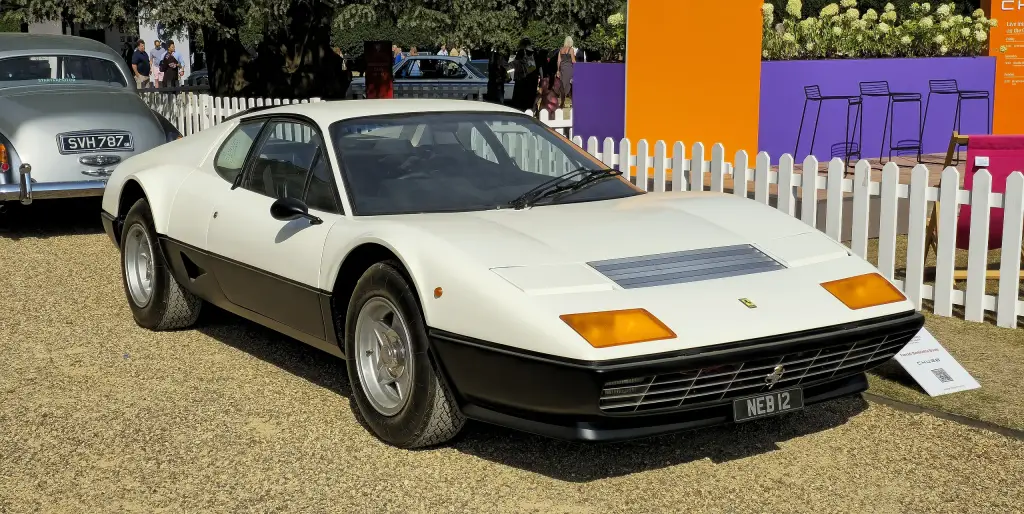
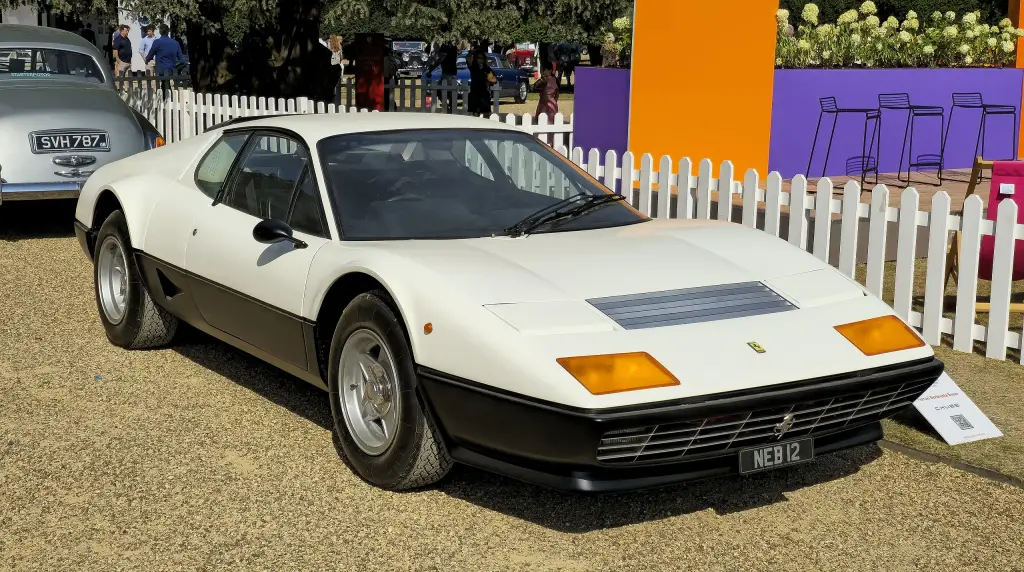
The Ferrari Berlinetta Boxer is a series of sports cars produced between 1973 and 1984, designed by Leonardo Fioravanti at Pininfarina. The first model, the 365 GT4 BB, replaced the front-engined Daytona and was the first road-going Ferrari with a mid-mounted flat-twelve engine.
Ferrari Berlinetta Boxer at a glance
| Production | 1973–1984 |
|---|---|
| Designer | Leonardo Fioravanti, Pininfarina |
| Models | 365 GT4 BB, BB 512, BB 512i |
| Engine | rear mid-mounted flat-twelve, longitudinal |
| 365 GT4 BB power | 360 bhp at 7,500 rpm (brochure figure) |
| Prototype power | 380 bhp at 7,100 rpm |
| Gearbox | five-speed transaxle, limited-slip differential |
| Clutch | Fichtel & Sachs single-plate dry clutch |
| Lubrication | wet sump, dry sump in the BB 512 |
| Replaced | Ferrari Daytona |
| Replaced by | Ferrari Testarossa, 1984 |
based on one source (English Wikipedia).
History of the Ferrari Berlinetta Boxer
The Boxer was a major step for Enzo Ferrari, who felt a mid-engined road car would be too difficult for his customers to handle; it took years for his engineers to persuade him. Attitudes changed as Ferrari lost racing dominance in the late 1950s to mid-engined rivals: the rear-mid-engined 246 P Formula One car appeared in 1960, followed by the Dino SP sports prototypes in 1961, and in 1963 the company moved its V12 engines to the rear in the P and LM racing cars. The Dino 206 GT and 246 GT of 1967 were the first road-going Ferraris with the layout, albeit under the cheaper Dino marque; the flagship V12 cars stayed front-engined through the Daytona and 365 GTC/4 until the 365 GT4 BB of 1973.
From racing to the road
Ferrari first used the flat-12 layout in racing cars, starting with the 1964 512 F1. That 1.5-litre engine, designed by technical director Mauro Forghieri, was developed through several Formula One and sports prototype cars — the 1968 212 E, the 1970–75 312B and the 1971 312PB — and those racing designs became the basis for the road-going flat-twelve of the 365 GT4 BB.
Design and development
After the production 365 GTB/4 Daytona of 1969, Ferrari engineers led by Angelo Bellei began work on its successor, the 365 GT4 BB. Although it shared its numerical designation with the Daytona, the layout was radically different: a rear mid-mounted flat-12 arranged longitudinally. The team drew on the chassis design of the mid-engined 250 LM and Dino 206/246 as well as the racing flat-twelves. The first prototype F102 A engine reportedly produced 380 bhp at 7,100 rpm and took the prototype to 302 km/h in testing, while Ferrari brochures quoted 360 bhp at 7,500 rpm for the production version, with figures varying between factory and press publications. The 365 GT4 BB had a five-speed manual transaxle with limited-slip differential mounted directly beneath the engine alongside the sump, the gearbox driven through drop gears and a horizontal shaft; the arrangement raised the centre of gravity but shortened the whole assembly, which helped packaging.
BB 512 and 512i
The 365 GT4 BB was succeeded in 1976 by the BB 512, which had a larger-displacement engine and a dry sump to avoid oil starvation. In 1981 came the fuel-injected BB 512i. The series ended in 1984, when the Testarossa replaced the 512i with a revised version of the flat-twelve engine.
Design and features
- Mid-mounted flat-twelve: a road-going version of the engine raced in the 512 F1, 312B and 312PB.
- Fioravanti design: a Pininfarina body that made the Boxer a 1970s icon.
- Compact transaxle: gearbox and differential under the engine, driven by drop gears.
- Dry sump from 1976: the BB 512 added it to prevent oil starvation.
- Three generations: 365 GT4 BB, BB 512 and fuel-injected BB 512i.
Ferrari Berlinetta Boxer versions
- 365 GT4 BB (1973–1976): the original, with a wet-sump engine and 360 bhp.
- BB 512 (1976–1981): larger engine and dry-sump lubrication.
- BB 512i (1981–1984): fuel-injected version, replaced by the Testarossa.
The Boxer replaced the Ferrari Daytona and was succeeded by the Ferrari Testarossa. Its racing flat-twelve came from the Ferrari 312B.
Video: Ferrari 512 BB Boxer driven hard
Video by DtRockstar1 on YouTube.
Sources
- Ferrari Berlinetta Boxer, English Wikipedia: background, design, engine, models