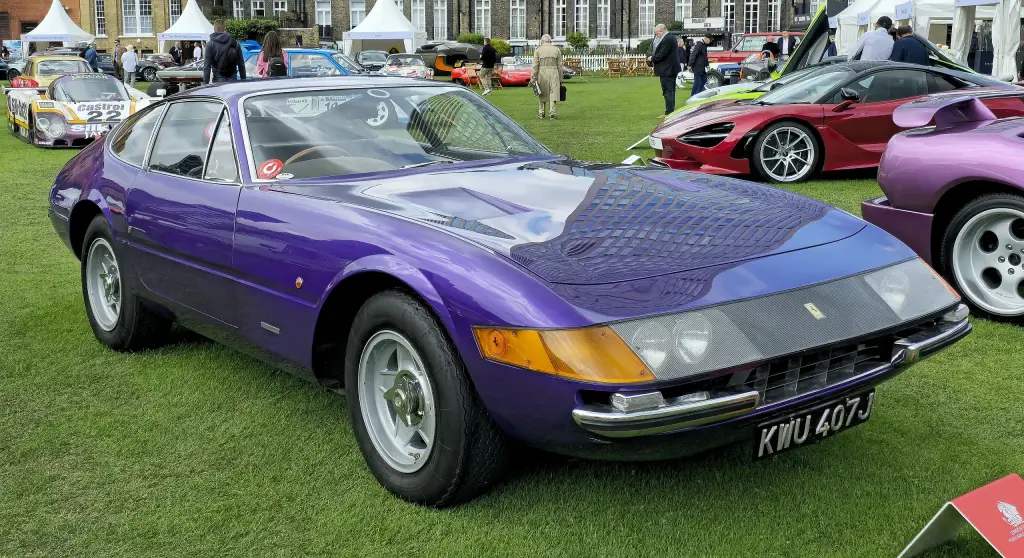
The Ferrari Daytona is a two-seat grand tourer produced from 1968 to 1973 and introduced at the Paris Auto Salon in 1968 to replace the 275 GTB/4. It came in two variants: the 365 GTB/4 coupé and the 365 GTS/4 convertible.
Ferrari Daytona at a glance
| Production | 1968–1973 |
|---|---|
| Variants | 365 GTB/4 coupé, 365 GTS/4 spyder |
| Introduced | Paris Auto Salon, 1968 |
| Engine | Tipo 251, 4,390 cc V12, DOHC, two valves per cylinder |
| Bore × stroke | 81 × 71 mm |
| Carburettors | six Weber 40 DCN/20 (Solex alternative) |
| Compression | 9.3:1 |
| Power | 352 PS (259 kW) at 7,500 rpm |
| Torque | 431 N·m at 5,500 rpm |
| Top speed | 280 km/h |
| 0–60 mph | 5.4 s |
| Replaced by | 365 GT4 Berlinetta Boxer, 1973 |
based on one source (English Wikipedia).
History of the Ferrari Daytona
The Daytona replaced the 275 GTB/4 and used that car’s Colombo V12 with a larger cylinder bore, giving 4,390 cc. Unlike the mid-engined Lamborghini Miura that appeared at the same time, it remained a traditional front-engined, rear-drive grand tourer. The engine, known as the Tipo 251, was a double-overhead-camshaft unit with two valves per cylinder, 365 cc per cylinder, an 81 mm bore and 71 mm stroke, breathing through six twin-barrel Weber 40 DCN/20 carburettors, with Solex 40 mm units used as an alternative. At a compression ratio of 9.3:1 it produced 352 PS at 7,500 rpm and 431 N·m at 5,500 rpm, enough for 280 km/h and 0–60 mph in 5.4 seconds. American versions were modified slightly to meet local rules.
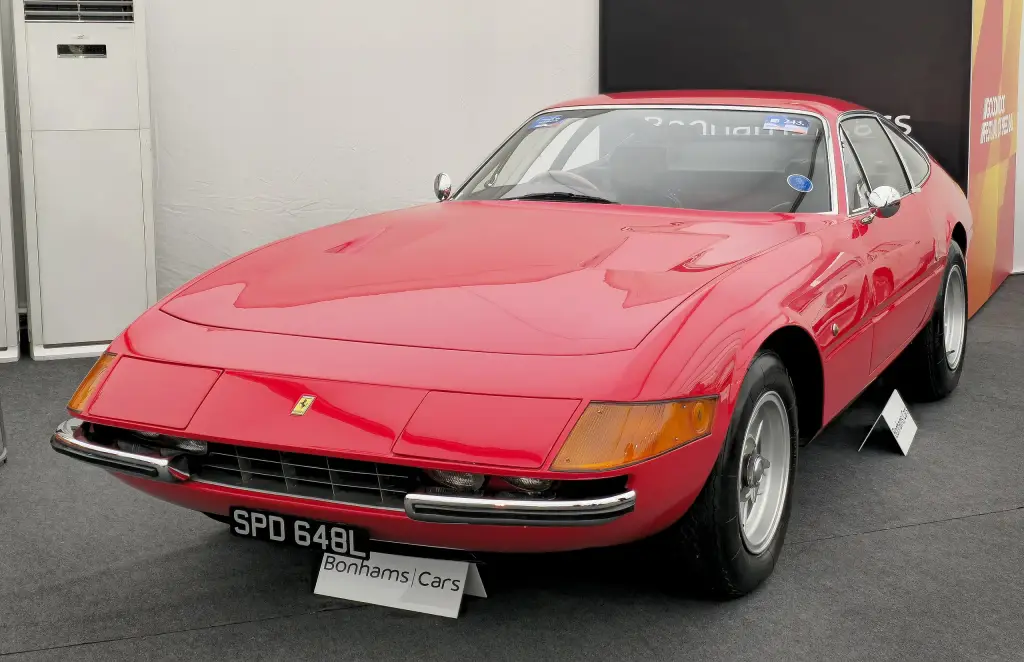
The name
The Daytona name is reported to have been applied by the media rather than by Ferrari, and it commemorates the marque’s 1-2-3 finish at the February 1967 24 Hours of Daytona with a 330 P3/4, a 330 P4 and a 412 P. Ferrari itself rarely calls the 365 a Daytona and describes the name as unofficial.
In the range
The Daytona was the last of the great front-engined V12 two-seaters before Ferrari moved its flagship to the mid-engined layout. In 1973 it was succeeded by the 365 GT4 Berlinetta Boxer, which placed a flat-twelve engine behind the driver and began the Boxer line that later became the Testarossa.
Design and features
- Tipo 251 V12: a bored-out Colombo engine with twin camshafts and six Weber carburettors.
- 352 PS and 280 km/h: genuine supercar performance in a traditional grand tourer package.
- Two body styles: the fixed-roof 365 GTB/4 and the open 365 GTS/4.
- Press-given name: “Daytona” commemorates Ferrari’s 1967 1-2-3 at the American circuit.
- End of an era: the last front-engined Ferrari flagship before the Boxer.
Ferrari Daytona versions
- 365 GTB/4 (1968–1973): the coupé.
- 365 GTS/4 (1971–1973): the spyder convertible.
- American-market cars: modified to meet local emissions and safety rules.
The Daytona replaced the Ferrari 275 and was succeeded by the Ferrari Berlinetta Boxer; the 365 grand tourers have their own page at Ferrari 365.
Video: Ferrari Daytona 365/4 GTB – Drive Experience and Discussion
Video by Shmee150 on YouTube.
Sources
- Ferrari Daytona, English Wikipedia: engine, performance, name, model history