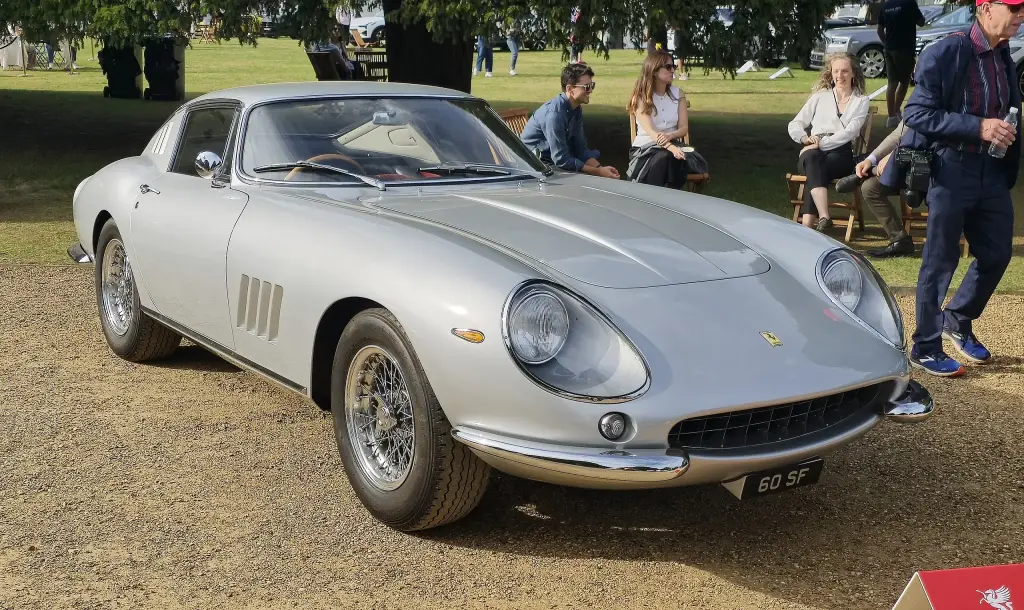
The Ferrari 275 is a series of front-engined V12 grand tourers with two-seater coupé and spider bodies, built between 1964 and 1968. They were the first road-going Ferraris to use a transaxle and independent rear suspension.
Ferrari 275 at a glance
| Production | 1964–1968 |
|---|---|
| Models | 275 GTB coupé, 275 GTS spider, 275 GTB/4, NART Spyder |
| Engine, two-cam | 3.3 L (3,286 cc) Colombo 60° V12 |
| Power, two-cam | 260–320 hp (190–240 kW) |
| Engine, 275 GTB/4 | four overhead camshafts, 300 hp (220 kW) |
| Bore × stroke, GTB | 77 × 58.8 mm |
| Carburettors | three Weber 40 DCZ 6 (six optional) |
| Gearbox | five-speed transaxle with limited-slip differential |
| Chassis | ladder frame of oval-section steel tube |
| Suspension | double wishbones and coil springs, all four wheels |
| Brakes | Dunlop discs all round |
| Bodies | Pininfarina design, built by Scaglietti |
based on one source (English Wikipedia).
History of the Ferrari 275
The 275 series ran from 1964 to 1968, with the name taken from the engine’s per-cylinder displacement of 275 cc and the Italian designation Gran Turismo Berlinetta. Early cars used a 3.3-litre overhead-cam Colombo V12, one camshaft per bank, and are often called “two-cam” cars to distinguish them from the later 275 GTB/4. Pininfarina designed the coupé and spider bodies, while Scaglietti designed the 275 GTS/4 NART Spyder, of which only ten were made.
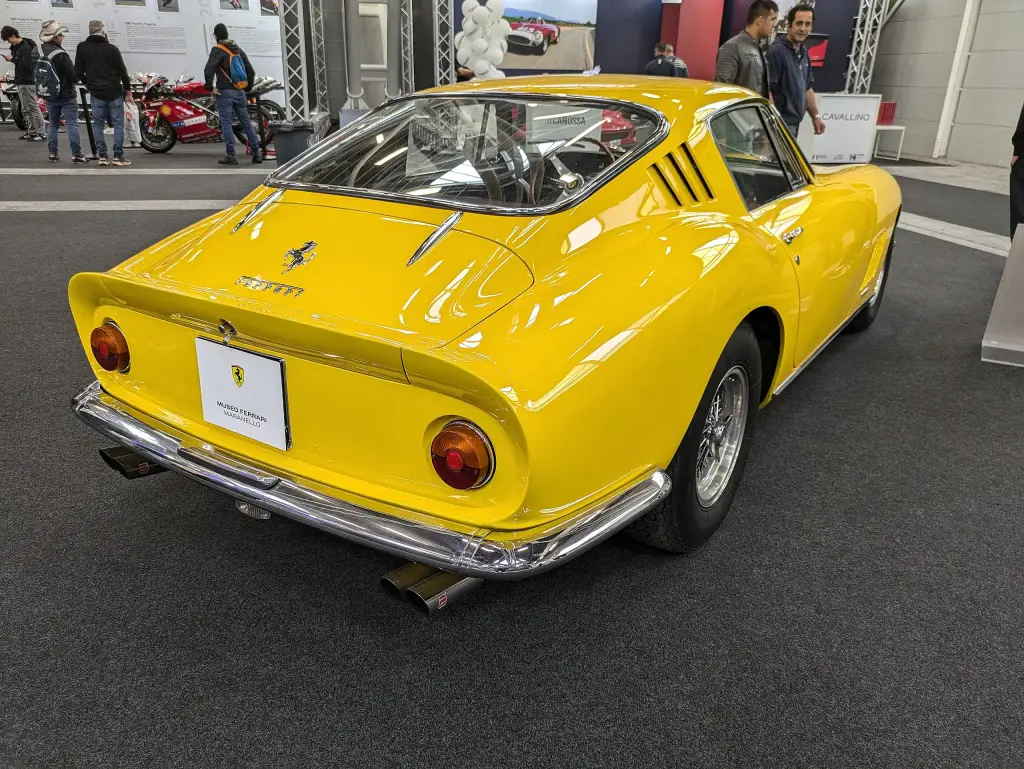
275 GTB
The 275 GTB coupé was produced from 1964 to 1966 and used a Tipo 213 3.3-litre V12 with a 77 mm bore and 58.8 mm stroke, its internals derived from the 250 GTE 2+2, 250 Lusso and 250 GTO. Three twin-choke Weber 40 DCZ 6 or 40 DFI 1 carburettors were standard, giving a claimed 280 hp at 7,600 rpm, though in practice the engine delivered closer to 240–250 hp. A factory option of six Weber 40 DCN carburettors was claimed at 320 hp, although the real gain was probably 20–25 hp. Drive went through a five-speed transaxle with Porsche-style synchromesh and a limited-slip differential — the first transaxle in a Ferrari production road car, though competition models such as the 250 Testa Rossa had used the layout before.
Chassis and suspension
The chassis was a conventional ladder frame of oval-section steel tube. Mike Parkes played a major part in developing the suspension, which used technology tested on racing cars such as the 250 TR and 250 LM: double wishbones at all four corners with Koni shock absorbers and coil springs, the first fully independent suspension on a Ferrari road car. Dunlop disc brakes were fitted all round, although even in the mid-1960s they were considered small and under-served by their servo. Cast magnesium 14-inch wheels were standard, with Borrani wire wheels optional, both on Pirelli 205VR14 Cinturato CN72 tyres. The engine and transaxle were initially bolted to the chassis at four and three points respectively and connected by a rigid driveshaft, acting as stressed members of the frame; at the end of 1965 CV joints were added at each end of the shaft to allow some flexibility.
The long nose and the four-cam
A Series II, or “long nose”, 275 GTB arrived in 1966 with a torque tube between engine and transaxle, revised mounting points and a lower, longer front end with a smaller air intake that improved stability at speed; the rear window grew and the luggage area was rearranged. That year also brought the 275 GTB/4, with a revised four-camshaft engine producing 300 hp. The standard coupé body was steel with aluminium doors, bonnet and boot lid, and at least 72 cars were built with an all-aluminium lightweight body as a factory option. Motor Trend Classic placed the 275 GTB coupé and GTS spider third among the greatest Ferraris of all time, and Road & Track called the NART Spyder “the most satisfying sports car in the world” in 1967.
Design and features
- First road-car transaxle: gearbox and differential in one unit at the rear, with Porsche-type synchromesh.
- Independent rear suspension: double wishbones on all four wheels, developed with racing experience.
- Three or six carburettors: 280 hp claimed on three Webers, 320 hp on the optional six.
- Long-nose Series II: torque tube, revised mountings and a lower nose for high-speed stability.
- Lightweight option: at least 72 cars built with all-aluminium bodies.
Ferrari 275 versions
- 275 GTB (1964–1966): the two-cam coupé, steel body with aluminium panels.
- 275 GTB long nose (1966–1968): Series II with torque tube and revised aerodynamics.
- 275 GTB/4 (1966–1968): four-cam engine, 300 hp.
- 275 GTS: Pininfarina spider on the same mechanicals.
- 275 GTS/4 NART Spyder: Scaglietti-bodied spider, only ten built.
The 275 followed the 250 series and shared its chassis with the 330 GTC and GTS. More cars are in the Ferrari collection.
Video: This Ferrari 275 GTB/4*S N.A.R.T. Spider Is One of Ten
Video by Petrolicious on YouTube.
Sources
- Ferrari 275, English Wikipedia: engines, transaxle, chassis, GTB/4, NART Spyder