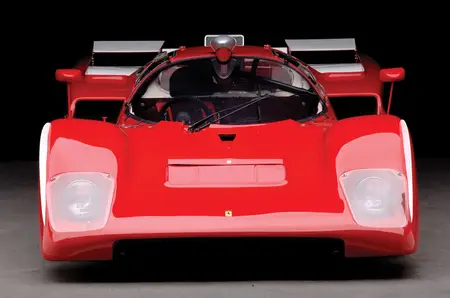
The Ferrari 512 S was a sports prototype produced from late 1969 to 1970 with a five-litre V12, homologated as a Group 5 sports car of which 25 units had to be built. Modified versions resembling the Porsche 917 became the Ferrari 512 M.
Ferrari 512 at a glance
| Production | late 1969 – 1970 |
|---|---|
| Class | Group 5 Sportscar, 25 units required |
| Engine | 5.0-litre 60° V12, all new |
| Power | 560 PS (412 kW) |
| Chassis | steel, reinforced with aluminium sheet |
| Weight | about 100 kg more than the Porsche 917 |
| Raced | 1970 and 1971 International Championship for Makes |
| Updated version | 512 M (modificata), late 1970 |
| Rivals | Porsche 917, Ford GT40 Mk.I, Lola T70 |
| Later career | Can-Am and Interserie with privateers |
based on one source (English Wikipedia); no free photographs of this racing model were found, so the previous cover is kept.
History of the Ferrari 512
In the mid-1960s Ferrari competed in sports prototype racing with the four-litre V12 cars of the P series, winning at Le Mans consecutively until 1965. Only a few works cars, the 1967 330 P4, were handed to customer teams, often with a simplified engine and the name 412P. In 1966 and 1967 the Ford GT40 Mk.II and Mk.IV won Le Mans with 7.0-litre engines and reached speeds the rule makers considered too high, so for 1968 Group 6 prototypes were limited to three litres, as in Formula One. Ferrari, despite having a suitable engine, sat out the 1968 season and returned in 1969 with the 312 P. Porsche meanwhile exploited the Group 4 rules, and at the end of 1968 took the risky decision to build 25 examples of the 4.5-litre 917 for homologation in 1969.
Building the 512 S
The sports car world was surprised by the 917, which would be a force for three seasons. Enzo Ferrari, already selling half of his business to Fiat, diverted part of those funds to match the Porsche investment. Additional 512 S cars were intended for racing customers, which meant several dozen high-powered sports cars were available at once — and with each needing two drivers in an endurance race, there was a shortage of experienced pilots. The engine was a completely new 60° V12 producing 560 PS. Compared with Porsche’s air-cooled flat-12 it needed a maze of cooling pipes and a heavy radiator, and because the chassis was steel reinforced with aluminium sheet, the car weighed about 100 kg more than the alloy-framed 917. Despite the weight and a higher centre of gravity, the two seemed fairly evenly matched.
Racing
Several 512 S cars were entered in the 1970 International Championship for Makes by Scuderia Ferrari and by private teams. At the start of 1970 the Ferraris suffered predictable early problems, including weak suspension and transmission troubles, but Porsche already had six months of experience with the 917 from 1969, which proved decisive. Ferrari also did not organise the kind of intramural competition Porsche ran: at Porsche, JWA Gulf, KG Porsche Salzburg and later Martini Racing all received direct factory support in the form of loaned cars, so at least four cars were effectively works entries, and even privateers such as AAW Shell Racing and David Piper Racing were better supported than Ferrari’s customers.
512 M and the end
Later in 1970, modified versions resembling their main competitor, the Porsche 917, were called Ferrari 512 M (for modificata). In the 1971 International Championship for Makes the factory concentrated on the new 312 PB and abandoned the 512, which was entered only by privateers. From 1972 the 512, like the 917, was withdrawn from the world championship after a change in the regulations, though some cars in private hands went on to race in Can-Am and Interserie.
Design and features
- Five-litre V12: a completely new 60° engine producing 560 PS.
- Group 5 homologation: 25 cars had to be built, just as Porsche did with the 917.
- Steel and aluminium chassis: strong but about 100 kg heavier than the 917’s alloy frame.
- 512 M update: a modified body that echoed the Porsche 917.
- Privateer career: raced in Can-Am and Interserie after the works team moved on.
Ferrari 512 versions
- 512 S (1969–1970): the original Group 5 prototype.
- 512 M (1970–1971): modified version with revised bodywork.
- Customer cars: 512s sold to private teams and raced after the works withdrawal.
The 512 S followed the Ferrari 312 P; the separate road-going Berlinetta Boxer has its own page at Ferrari 512 BB.
Video: Ferrari 512 S
Video by The Drive on YouTube.
Sources
- Ferrari 512, English Wikipedia: development, engine, 1970–1971 racing, 512 M