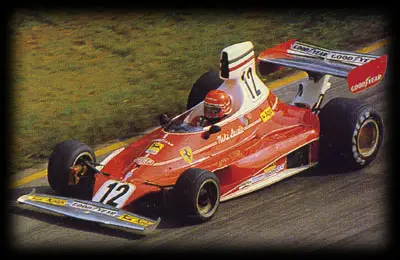
The Ferrari 312B is a Formula One car designed and built by Scuderia Ferrari, used from 1970 until early 1975. It succeeded the Ferrari 312 and was developed into the 312B2 and 312B3 as the 1970s went on.
Ferrari 312B at a glance
| Raced | 1970 – early 1975 |
|---|---|
| Designer | Mauro Forghieri |
| Engine | Tipo 001 flat-12 (“boxer”) |
| Engine position | low centre of gravity, clear airflow under the rear wing |
| Predecessor | Ferrari 312 |
| Developments | 312B, 312B2, 312B3 |
| Drivers | Jacky Ickx, Clay Regazzoni, Mario Andretti |
| 1970 wins | three for Ickx, one for Regazzoni |
| 1972 win | German Grand Prix, Ickx, his last |
| Constructors 1970 | Lotus ahead of Ferrari |
based on one source (English Wikipedia); no free photographs of this model were found, so the previous cover is kept.
History of the Ferrari 312B
The early 1970s brought success back to the Scuderia. Chris Amon, by then regarded as unlucky, left; Jacky Ickx returned and was joined by Clay Regazzoni. Under Mauro Forghieri, Ferrari developed a new Tipo 001 flat-12 engine, colloquially called a “boxer” although it was not a true boxer design. Its flat layout gave a lower centre of gravity and left a clear airflow beneath the rear wing.
1970 and 1971
In the car’s first season, 1970, Ickx battled Lotus’s Jochen Rindt and won three Grands Prix, while the Italian Grand Prix went to Clay Regazzoni after Rindt’s death in practice before the race. Ickx could not close the points gap for the drivers’ title, and Lotus took the constructors’ championship ahead of Ferrari. The 1971 season opened with a win for new signing Mario Andretti. The 312 B2, presented in January, debuted at the third round in Monaco and won the Dutch Grand Prix with Ickx, but suffered handling problems: the combination of its innovative rear suspension and the new Firestone tyres produced severe vibrations when driven near the limit. Forghieri added winglets to the front wings for the British Grand Prix, though they were not seen again, and Ferrari finished third in the constructors’ championship as Jackie Stewart and Tyrrell dominated.
1972 and 1973
Ferrari fielded a revised B2 with more conventional rear suspension in 1972 but could not keep pace, dropping to fourth by the end of the year; Ickx won the German Grand Prix at the Nürburgring, his last Grand Prix victory. During that season Forghieri experimented with front bodywork very similar to the Tyrrell 003’s, tested and fitted for the second race in South Africa but dropped because it made the cars uncompetitive. He also designed a radical car with square bodywork and a full-width nose on a very short wheelbase: the 312 B3, tested by Arturo Merzario and Ickx but never raced in a Grand Prix. For 1973 Fiat executives imposed a new technical staff and Forghieri moved to the experimental department, replaced by Sandro Colombo. The 312 B3 was redesigned with a full monocoque built by the British specialist TC Prototypes under John Thompson, and the engine became a fully stressed member. The old B2 was no longer competitive, and the new B3, which debuted at the Spanish Grand Prix, was slow and unreliable; Ferrari was outclassed through the season and even skipped races such as the Nürburgring, while Ickx left the team mid-season to race a McLaren.
Design and features
- Flat-12 engine: Forghieri’s Tipo 001 gave a low centre of gravity and clean airflow under the rear wing.
- Return to form: four wins in 1970 made Ferrari a front-runner again after several lean seasons.
- Constant development: the B2 brought new rear suspension and front winglets, not all of them successful.
- Stressed engine: the 1973 312 B3 moved to a full monocoque from TC Prototypes with the engine as a stressed member.
Ferrari 312B versions
- 312B (1970–1971): the original flat-12 car, four wins in 1970.
- 312B2 (1971–1972): new rear suspension, winglets, one win in each season.
- 312B3 (1973–1975): redesigned with an English-built monocoque and stressed engine.
The 312B came after the V12-powered 312 and before the Ferrari 126C turbo of the 1980s. Its sports-prototype cousin was the 312 P.
Video: Legendary Jacky Ickx, red Ferrari 312B and old Nürburgring
Video by scuderiabrazil on YouTube.
Sources
- Ferrari 312B, English Wikipedia: engine, 1970–1973 seasons, B2 and B3 development